Time to Eat the Dogs
A Podcast About Science, History, and ExplorationPlanning Our Trip to Mars

I’ve been grousing here and at HNN about NASA’s goal to return to the Moon and Mars, a plan that does not offer, in my opinion, a mission compelling enough to warrant its multi-billion dollar price tag.
Trolling around the blogosphere, I am beginning to realize that grumpiness about NASA’s Mars mission runs deep, extending to the ranks of policy makers, aerospace engineers, and space scientists.
For example, John Marburger, Director of the Office of Science and Technology Policy, gave a speech at the Goddard Memorial Symposium recently in which he considered the big picture of U.S. space policy. Marburger is generally supportive of space exploration, but warned about the ad hoc nature of space exploration to date:
The one big question any vision of space exploration must answer is “Are we going to do it at all?” As I put it in my speech two years ago, “Questions about the vision boil down to whether we want to incorporate the Solar System in our economic sphere, or not.” If we are serious about this, then our objective must be more than a disconnected series of missions, each conducted at huge expense and risk, and none building a lasting infrastructure to reduce the expense and risk of future operations. If we are serious, we will build capability, not just on the ground but in space. And our objective must be to make the use of space for human purposes a routine function. [full speech].
Engineers have also been speaking out about the ad hoc quality of planning the mission. From Gravity Loss:
So how is it that an agency getting 15 billion dollars a year is failing to pin down the mass numbers any better? … What will the payload landed on the moon be? What propellants are used? What is the Altair’s or Orion’s mass?…It has seemed that a certain cycle has formed. First a solution on Ares I is based on some logic linking it to Shuttle hardware, infrastructure or Ares V with common elements, which should save a lot of money and time and keep the workforce etc etc. Somewhat later, rumors about a severe performance shortfall on either launcher start circulating. Then after a while NASA announces a new configuration where the commonality is disrupted. And again forward we go. [full post]
And a similar economic criticism (with a free-market tilt), from Jon Goff at Selenian Boondocks:
Having NASA develop its Constellation architecture means that 20 years from now, it will be just as hard for a commercial entity to get to the moon as it would be if Constellation was cancelled tomorrow. Nothing that is being done “reduces the risk or expense of future operations” or “makes the use of space for human purposes a routine function.” I’m glad that at least someone is trying to tie this all back to actual benefit to the nation. I’m also glad that John pointed out that the whole “NASA only spends less than 1% of the federal budget” line does not give NASA carte blanche to spend that money however it darned well pleases. That money is supposed to be spent in a way that furthers the national interest, preferably in a way that makes space more accessible for everyone. [full post]
If I find happier opinions, I will report them here, scout’s honor. The cheeriest news, as you might expect, can be found at the NASA website.
Centre de Recherche sur la Littérature des Voyages (CRLV)
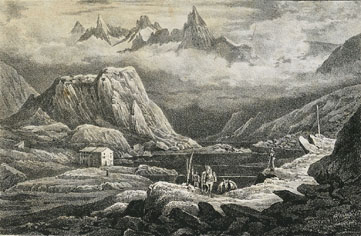 Voyage en Suisse, en Lombardie et en Piémont, 1834 (CRLV)
I have worked on Arctic exploration for over a decade and have been feeling lately that it’s time for a change. I like exploration too much to leave it as a field of study (as is probably obvious from this blog), so I have been digging into the literature on another love of mine, mountains, specifically the role of mountains in the work of nineteenth-century scientists.
 I don’t have any method for starting new research projects. I have a “if time, pursue this” file, but most of these ideas feel stale by the time I get back to them. So I usually set off into the literature much the way less-than-smart dogs take to being off the leash: running around sniffing randomly until they find something good, chasing it till it runs out, then running some more until they something else. I pursue this approach until I find food. Methodological rigor comes later, usually about the time I need to apply for a grant.
In any event, I was in my dog phase a few months ago, when I started to realize something about the secondary literature on mountains. There are some divisions I expected to find according to discipline (lots of material in art history, for example, not that much in the history of science). But there were also some divisions I didn’t expect, namely differences according to nationality. In particular, it seemed to me that French scholarship on the intellectual history of mountains was very well developed whereas Anglo-American literature was still getting off the ground.

How much do we miss by not wading into the literature of other languages, other countries? It depends upon the research question obviously. But in my case, it’s something I need to do. I can read French, with effort, fingers gripped to the side of my desk. This too must change. I have been on the lookout in the last few weeks for serious exploration blogs or sites outside of the U.S and the U.K.
One of the best that I’ve found is the Centre de Recherche sur la Littérature des Voyages (CRLV). This site has been around for a while, offers an impressive, searchable bibliography of primary literature on exploration (by author and location), a list of CRLV publications, schedule of conferences, and series of conference podcasts, some of which have abstracts and transcripts. Impressive.
I’ve been happy to note more traffic here from other countries, particularly Scandinavia. If you think I should be aware of exploration-related sites, please drop me a line.
The Explorer Type
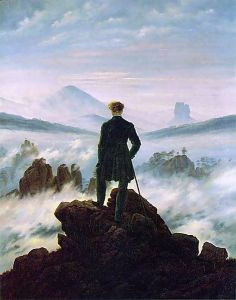 The Wanderer Above a Sea of Fog, Caspar David Friedrich
What are historians doing when “doing history”? If asked, few of us would say that we “chronicle” the past. Not that there is anything wrong with chronicling. This is certainly part of the historical craft, but if I had to wager, I’d bet most of us would use different verbs: analyze, interpret, and revise would top the list. Put differently, if we were forced to become football announcers, we would shun the position of play-by-play. We would all want to be color commentators. As much as we respect the Al Michaelses and Bob Costases of the world, we would want to be John Madden.
 John Madden
Madden lets others chronicle the game. He is there to give the viewer his cogent analysis, to link the events on the field to other games, the locker room, the ocean of football statistics. The paradox of analysis is that it leads to infinitely greater shades of difference. The deeper the comparison, the more events seem unique and incomparable. Tears in his eyes, the Patriots fan wants to place Tom Brady on Mt Olympus for breaking every passing record since Odysseus threw a stick in the eye of Cyclops, but the clear-eyed color commentator says “Not so fast. The game has changed. Quarterbacks throw more now than they used to. Plus, hitting a giant in the eye with a stick is not technically a pass.”
 Odysseus with stick
 Brady with football
So, too, the historian, who is on his game when showing how complicated the past is, suddenly gets gun-shy when making broad comparisons or generalizations. There are good reasons for the post-modern reluctance to do this, but let’s admit it, it’s also unsatisfying. As Peter Galison pointed out in the most recent issue of Isis (see Will Thomas’s post on this at Ether Wave Propaganda), there is a tension between the rigorous need for being true to the small event, the “micro-history,” and the drama of the big picture, the sweeping generalization, and the magisterial narrative.
Is there still a place for generalizations in history? Can one be sweeping and rigorous at the same time? Can we take off our post-modern shoes for a few hours and sink our toes into the soft muck of the “big picture” without messing up the house? I don’t know. Let’s try. I spend most of my time writing about complexity, specifically, how complicated explorers are and how they reflect the unique conditions of their cultural moment. This is a relatively easy point to argue. Explorers were (and are) a diverse bunch. There were the erudite explorers such as Alexander von Humboldt and Charles Darwin, military explorers such as James Cook and John Fremont, journalist-explorers such as Henry Morton Stanley and Walter Wellman, and the explorers who “go native” such as Charles Hall.
Still, I was wondering if there was something to this idea of an “explorer type.” This is certainly not a new idea. The literature of exploration and adventure is filled with talk of explorers exhibiting common personality traits (usually including some mixture of restlessness, curiosity, tolerance for danger and discomfort, etc). This doesn’t hold a lot of water for me, since I feel that these traits are often tacked on to the people who go out exploring ex post facto. “Well if he lost his toes to frost-bite, he must have been brave.” But what if we looked at the “explorer-type” as a cultural category rather than as a personality profile? Are there people who represent a kind of explorer figure across different professions or disciplines?
I few days ago I was reading Bones of Contention by Roger Lewin. In it Lewin describes the role of Louis Leakey within the field of paleoanthropology:
Although Leakey had highly respectable credentials — a degree in anthropology from Cambridge University, England and a fellowship in one of its most reverend colleges — he was more explorer than scientist. He loved to be out in the field, discovering new sites and returning to established ones…and he was irked by the conservative ways of the scientific establishment. He never held an academic post, and indeed became scornful of bookish armchair scholars… Perhaps this distance from academia freed him of the normal establishment constraints, for his claims were often a source of consternation among his colleagues in universities. When he said to Richard [his son] that day in September, “They won’t believe you,” he was pointedly echoing his own experience, and vicariously relishing the prospect of a fight.
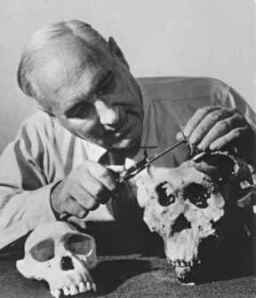 Louis Leakey, bad boy of British paleoanthropology
As I read this, I thought how similar it sounded to explorers such as Robert Peary, who put together his expeditions with private funds, and enjoyed a self-defined distance from the academic community. He would collaborate with the academy, but he never hitched his wagon to their horse. He found independent routes to money and power, just like Leakey did. What about Carl Sagan? Beloved by the public for his popularization of Cosmos, Sagan was sniffed at within his own field. Or Roy Chapman Andrews who led expeditions into Mongolia on behalf of the American Museum of Natural History, became a celebrated public figure, but was always something of an outsider to the Academy. Or William Beebe who scraped together funds from different sources to organize deep-sea expeditions in his bathysphere?
I don’t know how much meat is on this particular bone, but I thought I’d give it a gnaw. It certainly makes a better meal than saying “it’s complicated.”
What We Fear
 Historians partying like it’s 1959
Take twenty historians, put them in a backyard with grill, add beer, mix gently. Let sit. After an hour, you should have a simmering party, spiced by political commentary, outrageous jokes, and loud (if obscure) arguments. Maybe someone will throw a football. Why is it, then, that these zany, fun-loving, opinionated people take off their party hats when they sit down to write articles? What power does the written word have that it can drain the blood out of the most interesting of authors? It was as if we all took a minor in Bland at grad school. (No, not you dear reader, I’m talking about the others). Place some of the blame on inclusive language, the specialized vocabulary we use to speak to our peers (though I should say, it usually sounds boring to them as well). Place the rest of the blame on fear. Graduate students, the young sea turtles of the Academy, hatch by the thousands and run for the water, desperate to remain unnoticed until they mature enough to go on the market. Get off the beach! You may be eaten by your thesis committee. Once hired, the danger is over, but alas, the damage is done, the behavior learned. The newly minted academic passes on the instinct of Bland to the new generation.
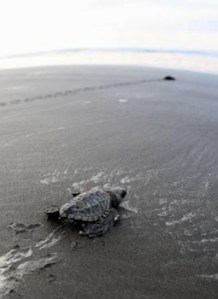 Done with prelims, thesis ahead
Not that fear goes away once hired. There are other dangers. Try this experiment at your next encounter with a historian. (It will be most effective at a conference talk). “How does your work shape your views of (insert current issue) ? A sheen of sweat will appear on his brow. His buttocks will tighten. His mouth will open and close like a trout on the dock. What is the subject of his fear? Historians are schooled to judge past and present as separate entities, related entities of course, but separate. They are first cousins, if you will, who talk nicely to each other but should never marry. To read the past through the lens of the present is to violate a sacred rule of the historiography, brought down to us by British historian Herbert Butterfield, who said Thou Shall Not Commit Whig History.
 Prophet Butterfield
What about those who would read the present though the lens of the past? This has more credibility, especially among politicians and subscribers to Readers Digest. They liberally quote author George Santayana who said “Those who cannot remember the past are condemned to repeat it.” While historians don’t exactly shudder at this pronouncement, it still makes them twitchy because it implies that there is some kind of formulaic or structuralist feature to history that allows it to keep repeating itself. In history departments today, this kind of thinking is bad. Historians are happy to admit that big forces are at work in history, but they get queasy saying things are predictable or pre-ordained. For them this sounds too much like the prophetic history of the Left Behind series (or, secular visions such as Isaac Asimov’s Foundation Series). Historians like to think that the world contains its own capricious qualities that cannot be fully known, a Heisenberg uncertainty principle of human culture. In our literature, this is called “contingency.” In history departments, this is a good word like “organic,” “fresh-baked” and “locally produced.”
I can speak so flippantly about this because it happened to me. After giving a talk about the “Theory of the Open Polar Sea” to a public audience at the Explorers’ Club in New York City last year, some one had the nerve to ask me what I thought we should be doing about about global warming in the Arctic. I made trout-like motions for a minute or so, then forced out some mumbling explanation about why, as a historian of the nineteenth century, I had no business wading into the present. The audience was silent. So I tried again, this time with some tepid position about environmental policy.
 Robinson considers the present
It made me realize that if I am really a historian interested in engaging the public (and I am), it is not enough to engage people on my terms. It meant taking their questions and approaches seriously, being willing to step outside the comfort zone of “disciplinary thinking.” So I have started writing more about current events using, when I can, the context of the past as a starting point. The History News Network just published my first editorial on exploration and U.S. space policy.
Please read it and let me know what you think.
http://hnn.us/articles/51386.html
Digital Archive: Strange Maps
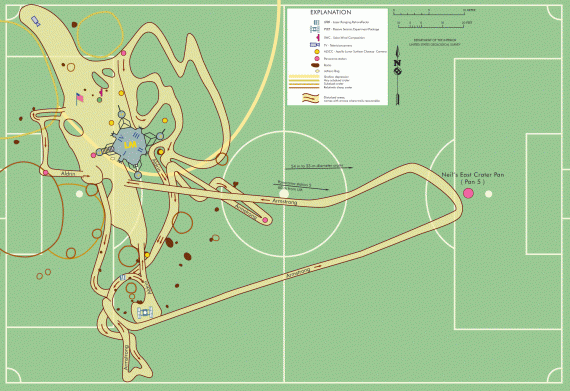 NASA map of astronaut routes over the Moon, superimposed over soccer field
Blogs are living things. They have their own cycles of growth, promiscuity, maturity, and senescence. Some rise above the tangled bank to reach the sunlight of popularity. Most crowd against each other in fits of collective navel-gazing. They soon decline in daily hits (the holy measurement of blog vigor) and die quietly in the shadows of the over-committed author. Given this instability, do blogs have the staying power to be archives?
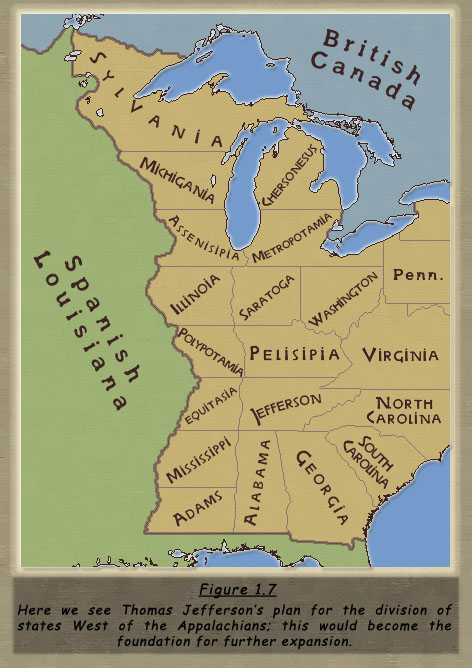 Thomas Jefferson’s proposal for dividing territories into ten states
Certainly not. While the political blog DailyKos may outrank the Library of Congress in daily web traffic, I am confident that L of C will still be hosting their Lewis and Clark materials in 2020. I don’t know what DailyKos will be doing (running a small country near Seattle perhaps). In short, blogs are not archives. Now that this is established, let me announce an amazing blog archive: Strange Maps. It is weird, historical, and snappy. If its mondo collection of bizarre maps is not exactly comprehensive, it is far-reaching in scope.
Not all of these maps have to do with exploration of course. So why feature Strange Maps here? A few weeks ago I wrote a post in which scholars weighed in on the various meanings of exploration. William Goetzmann and others view it as a process of continual re-discovery rather than a single moment of impressive flag-planting. In this spirit, Strange Maps is a place which discovers and rediscovers information about the world and projects these ideas in space. Perhaps this is an abstract and delirious way to describe the site – so to get a better idea, visit it yourself.
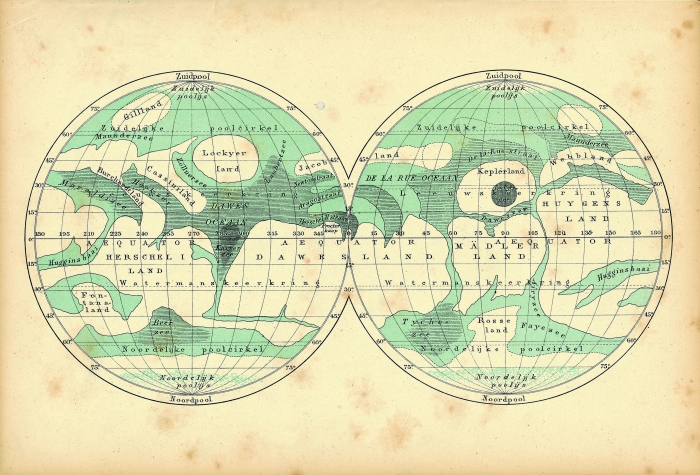 Dutch map showing the oceans of Mars


 Time to Eat the Dogs