Time to Eat the Dogs
A Podcast About Science, History, and ExplorationIsis Review: Science in the Everyday World

For those who don’t read it regularly, Isis is an academic journal “devoted to the history of science and its cultural influences.” Isis has published some path-breaking work as well as some, well, path-clogging ones. My one, long-standing complaint is that Isis tends to be rather dull, best read with coffee, never before bed, always with a pencil. I don’t know if the dullness is the result of the writing, the editing, or some combination of both. I know and respect many of the Isis crew. (Full disclosure: I’ve served as an advisory editor to Isis since 2006). I like the decision to introduce a “Focus Section” for 3-4 short articles dealing with a particular topic. But there are times when reading Isis feels more like a chore than a pleasure.
Reading the June Issue
So with this in mind, I am grateful to Will Thomas, historian of science, for profiling Isis articles on his blog Ether Wave Propaganda. In this pursuit, he has become my intellectual trainer, forcing me to get up and run through the articles before I have to lie down and smoke a cigarette. As always, I feel better for the effort.
I just finished reading Katherine Pandora and Karen Rader’s article “Science in the Everyday World” which considers the relationship between scientists and the general public. To summarize Pandora and Rader’s points: professional scientists have become closed off from the general public and its conceptions of science. As a result, these two communities do not engage each other very well, to the detriment of both. Historians of science used to side with professionals on this, seeing “real science” as stuff that happened in labs and research institutes, carried out by card-carrying scientists. As for the public, they received scientific information after the fact, in diluted form. In effect, this presented a “trickle-down theory” of science that posited doers (scientists) and receivers (everyone else). This is often called the “diffusionist theory” of scientific ideas.
In recent years, however, historians of science have begun to broaden their view of what constitutes science, now including ideas and activities that occur in the public sphere. As such, Pandora and Rader believe that historians of science are in an excellent position to help bridge the divide that has grown up between the scientific community and the public at large. Estranged by years of miscommunication, science and public can be brought back together, with historians of science acting as marriage counselors.
Together Again
I had trouble with this article.
First, I think Pandora and Rader paint scientists with a pretty broad brush here. Overall, scientists come across as out of touch, oblivious and/or unconcerned about public reactions, viewing them at times as “childish, shallow, superficial, emotional, irrational, and subjective.” The solution? “Laboratory specialists could better communicate the key ideas of their research with their publics if they attended…carefully to the relationship between form and content in their public interventions.” Maybe this is the sense one gets reading Transactions in Physical Science, but I get a very different feeling about the views of scientists when reading science blogs. Consider, for example, the blog The World’s Fair, which is a collaboration of scientists and historians of science. Or science blogs such as The Beagle Project or Laelaps who are run by scientists committed to public engagement. When one looks at the network of scientists and humanities people who are citing each other and cross listing each other on blog rolls, it becomes harder to think of these groups as two balkanized communities.
Second, Pandora and Rader talk the talk of “two-way” science, but don’t walk the walk. They certainly challenge the diffusionist model of science, stating that scientists need to take the public seriously. But why? Not because it would influence the content of their scientific findings, but because scientists run the risk of alienating the public on which their work ultimately depends. Also, its their civic duty. “If scientists ignore the arguments to be found there [in popular culture], they exacerbate a sense of disenfranchisement on the part of the public in regards to science.” At no point do Pandora and Rader give examples of how the content of scientists’ work might affected by taking the public seriously. While the authors promote the idea of diologue and collaboration, it seems to stop short at shaping the content of science.
Finally, I think that the article is a little late out of the gate. Pandora and Rader give due credit to historians of Victorian science for figuring out that science in the public is significant. But the “big-tent” view of science is now widely shared and has spread far beyond Victorian studies. Thinking of the work being done by my science historian pals (in German biology, twentieth century space science, British geography, or my own field of exploration) I am hard pressed to think of projects that don’t consider the public as an active agent in the story of science.
Jogging finished. Time to lie down.
Oh the Places You’ll Go
I have been burning the candle at both ends this summer. I just finished an article about Lewis and Clark & Alexander von Humboldt two weeks ago, wrote a review of Graham Burnett’s book, Trying Leviathan, started a review of Robert McGhee’s book, The Last Imaginary Place, and have started a new article on the work of Frederick Cook. That this seemed an excellent time to pick up blogging says something about me, I’m not sure what exactly, but it would involve words such as hubristic and harebrained. I’ve loved writing the blog to be honest…but on days like today there’s no gas left in the tank. So no grand thoughts tonight, just pictures.
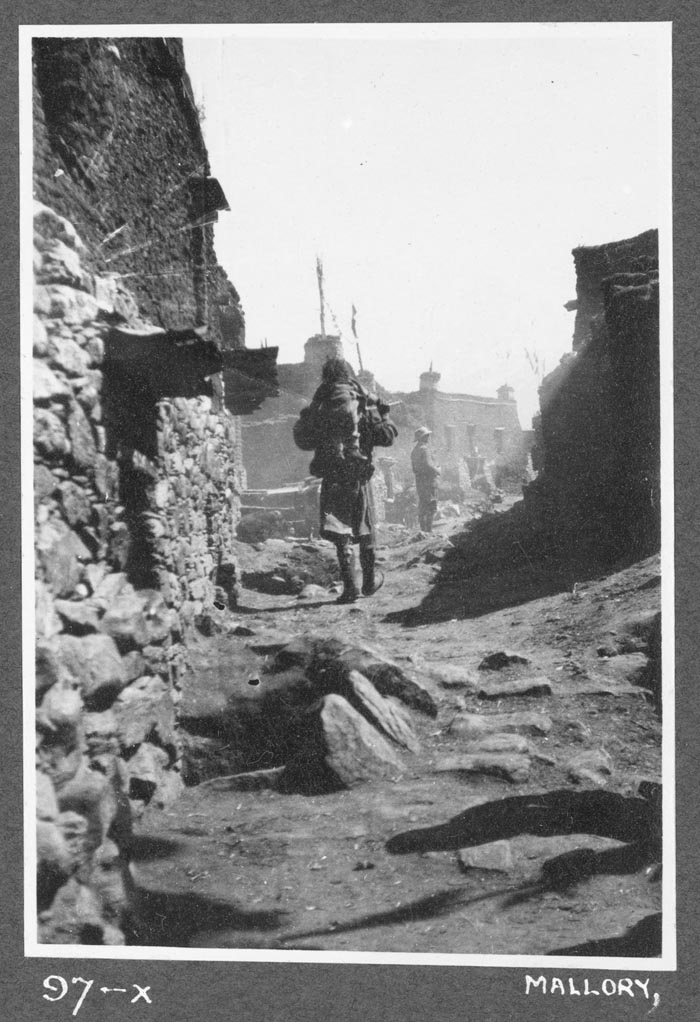
George Mallory in Tibet
I have been making up a list of visual archives. Here are three of my favorites. Bentley Beetham was a British traveler and photographer who got hooked on mountain climbing in the 1910s. His path converged with the Mount Everest Committee in the 1920s and led to his inclusion on the 1924 Everest Expedition. Mallory never returned from the mountain, but Beetham did, bringing with him hundreds of photographs of the mountains, climbers, and Tibetan life. The Bentley Beetham Collection offers 2000 of his works, a combination of brilliant lantern slides and photo prints.
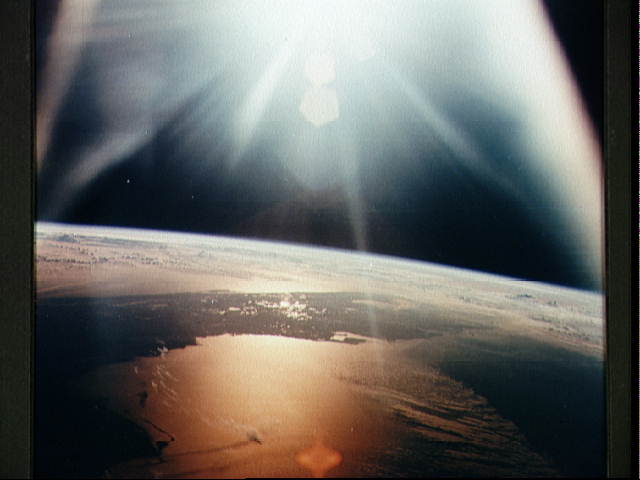
Morning in Orbit, Apollo 7, JSC Digital Image Collection
NASA gets beat up a lot here at Time to Eat the Dogs. As much as I complain about its policies, though, I admit to some weak-knee moments when I see images of the Saturn V hurling itself into space. The NASA Johnson Space Center has archived nine thousand images of the manned space program online on the JSC Digital Image Collection. It represents half a century of human missions, from Mercury to the Space Shuttle.
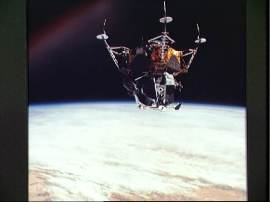
Test driving the lunar Lander in Earth orbit, Apollo 9, JSC Digital Image Collection
BibliOdyessey is a digital cabinet of curiousities authored by the Australian “PK”. PK must be in good with the Sydney archivists. Not only has he gotten some serious archive time, he’s also managed to bring his hi-def scanner along with him. BibliOdyessey offers stunning scans of the amazing, the obscure, and the bizarre. These are usually good tags for voyages of exploration – which are also well represented here.
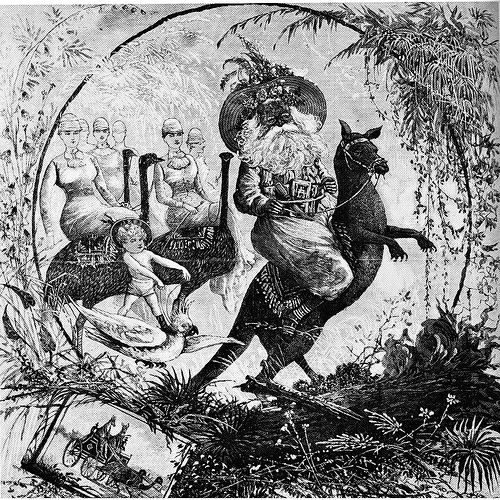
"Christmas in the Colonies," Illustrated Sydney News, 1882, BibliOdyssey
I’ll be on the road for the next few weeks updating when I can. Happy Voyages.
Digital Archive: The Joseph Dalton Hooker Website

Joseph Dalton Hooker: not your average armchair naturalist
Of Victorian England’s perambulating naturalists, Charles Darwin is the most celebrated. But he was only one of many, a throng of young men and women who left British shores for places unknown including Joseph Banks, Alfred Russell Wallace, Thomas Huxley, Mary Kingsley, and Henry Walter Bates. These were not foppish lads and doe-eyed ingénues on vacation. They followed new, dangerous itineraries: into the Pacific and Polar Regions, the interiors of South America and Africa, and the islands and archipelagos of the Indian Ocean. This was not some logical extension of the European Grand Tour; these men and women sought to bring home information that would shape science, and, no doubt, further their careers.

Sketch of a Himalayan Rhododendron by Joseph Dalton Hooker
One of the most important of these ranks was Joseph Dalton Hooker, doctor, naval surgeon, mountain climber, and botanist. Hooker traveled to the Antarctic with James Ross, dug for fossils in Wales, and tromped up the Himalayas in search of botanical specimens (interested in, among other things, testing Darwin’s theories of biogeography and isolation).
If this whets your appetite, check out Jim Endersby’s Joseph Dalton Hooker Website, a nicely designed site with biographical pages, extensive extracts of Hooker’s writings, and a list of collectors who helped him in the field. If this is not enough for the obsessive-compulsive Hookerologist in you, Endersby has also provided a list of archives and secondary literature on Hooker to keep you occupied until the bicentennial of Hooker’s birth in 2017.
Enjoy!
http://www.jdhooker.org.uk/index.htm
For more on Hooker, see Michael Barton’s post as well as Brian Switek’s.
The Problem with Scientific Exploration
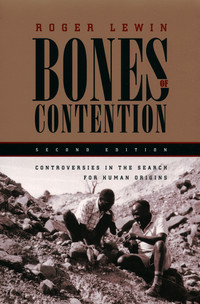
As I make my way through Roger Lewin’s book Bones of Contention: Controversies in the Search for Human Origins, I’ve become convinced of two things.
First, I am embarrassed not to have read it already. Bones of Contention is well written, filled with balanced portrayals of all the major players (with personal interviews of many), crammed with arguments and counter arguments, all the while retaining a sociological slant on the business of science. That is, the creation of new knowledge in paleoanthropology seems to have less to do with new fossils or dating techniques than personalities, group dynamics, and intellectual preconceptions. Fossils matter, but often yield center stage to the human actors whirling around them. Yet through all of this, the characters of this story, many of whom are still alive, are not reduced to caricatures. They remain interesting, passionate, even sympathetic figures. I wonder why it isn’t featured in more history of modern science courses? It’s now on my list.
Second, I keep finding parallels between the history of exploration and the history of paleoanthropology. As I mentioned in a previous post, Louis Leakey seems to fit a more generalizable “cultural type” for the modern explorer. As I read about Louis’s son Richard I have been finding similar parallels. For example, there is a point in the late 19th century when explorers, particularly Arctic explorers begin to distance themselves from science. There are many reasons for this, but part of it stems from a question of self-image. Some explorers are able to generate a certain anti-scientific cachet with patrons and the press. Something like this happened with Richard Leakey as well:
Leakey is frank about his lack of technical training.”I am not a proper scientist, never will be.” Although Leakey sometimes wears this like a badge, his friends and colleagues believe that in the KBS affair, at least, it was a liability. (251)
The other point that I found interesting was in the way that Richard Leakey organized his expeditions. They tended to be very close-knit affairs, with individuals expected to work together as well as protecting one another professionally. His expeditions tended to be very well run at the expense, it turns out, of academic independence:
Anyone who has had experience of field camps will acknowledge that none is run like Leakey’s. In addition to the practical side of life in the Leakey camp, which is excellent, there is demanded a very special form of commitment. Ian Findlater, who was part of the Leakey team for more than five years, describes it this way: “Richard ran an expedition and as joint leader and main operator of the practical side he felt that he had a right to loyalty from the expedition members. Inevitably that meant agreement with him on all important factors associated with the expedition. In fact, I suspect that it was the only way such an expedition can be run. Glynn’s democractically run side of the expedition was always chaotic and badly organized. Richard’s way has its weaknesses — if you did not agree on important issues you could either back down or leave. Most of us backed down for a few times and then eventually left. Despite this, my own preference would be to work for an expedition run by Richard.” (250)
This sounds somewhat similar to Robert Peary’s expeditions to the Arctic, highly organized, tightly run affairs that offered a lot of experience to other members. At the same time, most of the members of the expedition who had aspirations to lead their own expeditions (or to capitalize on the expedition with the press) ended up running afoul of Peary who rigidly controlled what members said and wrote about his treks into the Arctic.
So in the end, it makes me wonder about models of exploration. Which of them are best suited for doing science, at least science as we currently conceive of it? In the cases of Peary and Leakey, their private field expeditions depended heavily on private funding and their personal appeal as celebrities. Richard Leakey had a deeper commitment to scientific knowledge than Robert Peary, but in both cases, their approach to exploring, so well suited for travel, survival, and promotion made them less well suited for the professional give-and-take needed for scientific work.
The Explorer’s Universe
 Map by Ron Barrett, New York Times
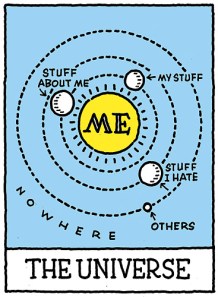
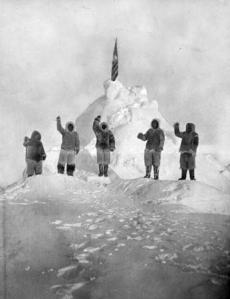
Explorers find praise as ambassadors of the unknown, knowledge seekers, the eyes and ears of the people they’ve left behind. But ultimately, how many iconic explorers are in this business because of knowledge? When Robert Peary wasn’t mushing his dogs over hummocks of pack ice, he was scribbling down his plans for his post-polar life. Dozens of pages in his Arctic journal are devoted to his plans for gaining publishing contracts, designs for geographic medals of honor, and a plan for the mausoleum that would one day hold his mortal remains (if he turned out to be mortal). One might argue that these explorers are the exceptions to the rule, that most were out risking life and limb for higher purposes. Perhaps, perhaps.
 Robert Peary with party at the North Pole (or not)
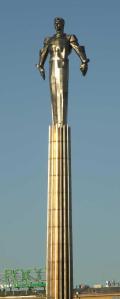
Certainly large scale, state-sponsored expeditions are immune from this sort of vanity, right? Or do these expeditions merely institutionalize the cult of the explorer? Cold War space missions were, let’s face it, more about impressing the neighbors than understanding the universe.
 Monument to cosmonaut Yuri Gagarin
I don’t want to paint with too broad a brush here. There are many explorers, past and present, who do not fit this description. But they do not receive much attention, competing as they are with the explorers who are on the media’s A-list.


 Time to Eat the Dogs