Time to Eat the Dogs
A Podcast About Science, History, and ExplorationWhere No ENFP Has Gone Before, Part I

Myers-Briggs personality assessments are sprouting up everywhere on Facebook this week. For those who don’t know what this is, the Myers-Briggs Type Indicator (MBTI) is the most widely used personality profile in the United States, a favorite tool of career planners, team-builders, and guidance counselors.
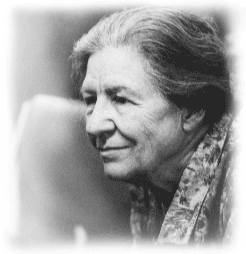
Isabel Briggs Myers
Brain child of Katherine Briggs and her daughter Isabel Myers, the MBTI divides the human psyche in four separate areas, each one of which has two different tendencies or dichotomies:
Extraverion (E)/Introversion (I)
Intuition (N)/Sensation (S)
Thinking (T) /Feeling (F)
Judging (J) /Perceiving (P)
There is nothing obvious about these psychic divisions. In truth, the categories of the MBTI were long in the making. In the early 1920s, Briggs was experimenting with a number of different categories for explaining the diversity of human behavior. More specifically, she was interested in explaining the strange, unBriggs-like behavior of her new son-in-law.
Then Myers read Carl Jung’s Psychological Types in 1923 and psychometric light bulbs started to go off in her head. Jung’s system seemed perfectly suited for creating a system of personality profiles. This is probably because Jung had his own strange in-law to explain, former mentor and father-figure Sigmund Freud.
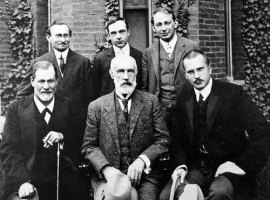
Carl Jung (lower right) and Sigmund Freud (lower left), 1908
Freud, Jung observed, gained energy by focusing on the outside world, a process that Jung called extraversion. Jung, however, was different. He found succor looking inward. (As a boy Jung spent his days writing secret messages to a mannequin carved on the end of his ruler). These were not neuroses, he thought, as much as they were different expressions of personality (though Jung does make one wonder).
Indeed, Jung felt that the spectrum of introversion and extraversion expressed a key dichotomy in western thought, one that dated back to the different approaches of Plato, who usually sought truth inwardly through the world of ideas, and Aristotle, who looked for reality in the phenomena of the world around him.
All of this is to say that the roots of the MBTI go deep. By the 1940s, Myers had expanded on Jung’s types and established a test that could be used for commercial application. Since then the MBTI has rocketed into mainstream culture, used to profile everyone from religious seminarians to astronauts.
Next Post: MBTI and the Explorer Type
Visions of Exploration
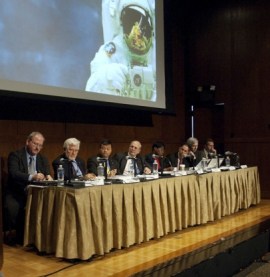
The Augustine Committee on Human Space Flight, July 2009
In these dog days of August, NASA is feeling the heat. The Review of U.S. Human Space Flight Plans Committee (aka Augustine Committee) is now spell-checking its final report for the Obama Administration about the direction of U.S. space policy. With talk of exploration in the air, Dan Lester (astronomy research scientist, University of Texas-Austin) and I thought it was a good time to take a closer look at the different meanings of exploration and their use by policy makers. The full article on the subject, “Visions of Exploration” is now out in the journal Space Policy and available here.
Here’s an excerpt:
The historical record offers a rich set of examples of what we call exploration: Christopher Columbus sailing to the New World, Roald Amundsen driving his dogs towards the South Pole, and Neil Armstrong stepping into the soft dust of the moon. Yet these examples illustrate the difficulty in pinning down exploration as an activity.
If we define exploration as “travel through an unfamiliar area in order to learn about it” we exclude Columbus, whose discovery was serendipitous rather than purposeful. We would also have to exclude Amundsen and Armstrong, and indeed many of the pantheon of explorers, who tended to dash across new terrain rather than investigate it systematically.
Even more expansive terms such as “discovery” sometimes offer a poor fit for the object of modern expeditions: did Robert Peary discover the North Pole in 1909, an axis point that Greek astronomers knew about 2500 years ago? Not in any meaningful sense of the word. Students of exploration, then, must make peace with this uncomfortable fact: “exploration” is a multivalent term, one which has been (and undoubtedly will continue to be) used in different ways by different people. Geographical discovery, scientific investigation, resource extraction, and high-risk travel are activities tucked inside this definitional basket.
Because of exploration’s multiple historical meanings, policy makers and administrators have often used this history selectively and out of context. Specifically, policy statements cite the history of exploration in order to make two points: first, that humans are compelled to explore, that curiosity about the world is an innate attribute of our species; and second, that this compulsion has expressed itself most fully in the United States, where exploration has moved beyond matters of trade and settlement to become a part of national identity, a symbol of American idealism, enterprise, and self-sufficiency
Let’s take these ideas in order, starting with the human impulse to explore. We cannot deny that the history of our species is a history of motion. We are all the children of travelers: of long migrations out of Africa, oceanic crossings and continental traverses. Archaeological evidence suggests that humans spent most of their prehistory, from 120,000 BCE to 10,000 BCE, on the move.
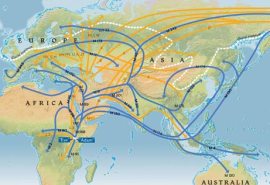
Possible human migration routes out of Africa ~100,000 BCE based on DNA evidence, courtesy National Geographic Maps
We bear the marks of these migrations: in the foods we eat, the languages we speak, and the places we live. Indeed, we carry traces of our itinerant past inside of us: in our dietary preferences for foods salty and sweet, our peculiar anatomy and physiology, and our unique mitochondrial DNA, which, read carefully, offers us a road map of our ancestors’ paleolithic travels.
Yet these facts, so well established, tell us little about motives. Human curiosity has a long and storied history. Aristotle begins his Metaphysics by stating “All men possess by nature a craving for knowledge”, an observation borne out in the earliest works of human literature.
Yet there is little evidence to suggest that humans traveled primarily, or even incidentally, because of curiosity. During the long millennia of our prehistory, the most obvious reason for travel was survival, following seasonal animal migrations, escaping harsh weather, avoiding predators and, perhaps, other humans.
Evidence points to exploration – in all of its incarnations of meaning – as a cultural or political activity rather than a manifestation of instinct. History’s most celebrated voyagers — Pytheas, Zhang He, and Columbus — sailed from nations with imperial ambitions. As Stephen Pyne points in his survey of the ages of exploration, “There is nothing predestined about geographic discovery, any more than there is about a Renaissance, a tradition of Gothic cathedrals, or the invention of the electric light bulb.” (Pyne, “Seeking Newer Worlds,” in Critical Issues in the History of Space Flight, 2006)
The notion that exploration expressed deeper impulses, such as wanderlust or curiosity, came much later, during the Enlightenment, when voyages took up the systematic practice of science: gathering specimens and ethnographic data, observing celestial events, and testing geographical hypotheses. These expeditions expressed a genuine curiosity about the globe, yet they elicited state sponsorship only because rulers saw political value in discovery expeditions, a form of “soft power” statecraft that could enhance national prestige rather then add to colonies or imperial coffers.
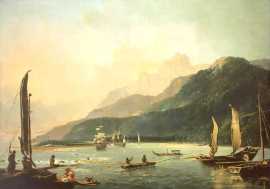
James Cook's 1773 Expedition to Tahiti (in background: HMS Resolution)
If eighteenth-century audiences came to accept the lofty trait of curiosity as a driving force behind voyages of discovery, nineteenth-century audiences found deeper impulses behind humanity’s urge to explore. In particular, the Romantic Movement gave rise to ideas central to the ethos of modern exploration; first, that discovery is a process that includes, but is not contained by, practical pursuits. While geographical discovery, science, and resource extraction all have their parts to play, exploration has an intangible, ineffable quality that cannot simply be reduced to logical goals. The second idea (which follows closely from the first) is that the value of exploration is tied to the subjective experience of the explorer, a symbol of the nation at home.
Blue Hole
In 1989, I accepted a two-year job teaching English in Egypt. The school offered $50/month and a place to live. The city of Cairo offered everything else, a theater of sound and spectacle, and a small part for me to play alongside seventeen million other residents, all acting out their lives on a stage twice as crowded as Tokyo. None of this felt comfortable.
Growing up in Maine, I was nurtured in a world of careful distances, social and spatial. This was exactly the point, I guess, in going to Cairo: to push beyond the boundaries of comfort, to come up against the hard-to-digest, to learn truths not accessible in the coffee shops of Portland or the classrooms of Boston.
Still, everyone has limits. When I reached mine, we, my roommates Joe and Alex (also American teachers), would head for Dahab, a dusty Bedouin village on the East coast of the Sinai Peninsula – about as remote and sparsely populated a place as you could reach from Cairo on our salary.
Dahab was the anti-Cairo, a place of self-indulgence and open spaces. It was our refuge from work in the city, a world of scattered huts and ex-pat dive shops, a place that always smelled of grilled fish, motor oil, and hashish, where daily calls to prayer had to compete with Sinead O’Conner’s Nothing Compares 2 U.
We spent most of our time there underwater. When we weren’t snorkeling, we were reading, or writing, or drinking warm beer in the bars that lined the beach. One time we arranged a ride to the Blue Hole, a coral lagoon just outside of town.
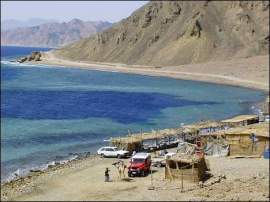
The Blue Hole, Eastern Coast of the Sinai Peninsula
From the front seat of a Fiat, the Blue Hole did not look like much. It was much like the rest of the Sinai coast, arid, brown, and rocky, devoid of life. Two things stuck out though: a giant gouge of blue water in the long shallow shelf of coral that hugged the shore, and a set of improvised memorials for dead divers on the rocky beach.
I put on my snorkel and flippers and swam towards the gouge, the tip of which was only a few feet from the shore. What I saw there made me flinch: a vertical wall of coral that dropped straight down, hundreds of feet, out of sight into blackness. The wall extended in a rough circle the size of a stadium.
Beneath me were schools of fish, angel and butterfly fish, clown fish, and beneath them, anemone fish and coral groupers, and beneath them, other fish that I couldn’t see clearly because they were so far away.
To swim in the Blue Hole was to hover at the top of a giant underwater atrium, the walls of which were alive and moving with color, a column with no bottom, no reference points except void and sky. It was unnerving and disorienting, an effect that became more pronounced the further I swam away from shore and towards the outer edge of the reef. There, I felt as if I was swimming through an electric current. My limbs felt twitchy and my heart raced. I felt exhilarated and ebullient and, strangely enough, like I was about to die.
Joe and Alex were also deeply moved. We spoke about it back in Dahab, wrote about it, continued talking about it back in Cairo. It entered our discussion of books — The Razor’s Edge, On Human Bondage, Steppenwolf, Siddhartha, and The Fountainhead — , which we swapped back and forth, the young man’s library of self-discovery.
Swimming into the Blue Hole, “the abyss” as we now called it, became a metaphor for this quest of meaning, a measure of authentic experience. Real change, it seemed to us, had to evoke fear and present dangers. It could not be controlled and would always exact something as payment. After I started graduate school in the 1990s, I laughed when I discovered that a long tradition of Romantic self-discoverers had already thought through this sort of experience and named it “the sublime.” We were only 250 years behind Edmund Burke. At twenty-three, I had the hubris to think it was something new.
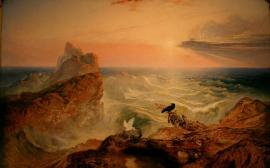
Assuaging the Waters, John Martin, 1840
But I didn’t care and don’t care much now. If the questions were not historically unique, the experience was, a moment seared into our collective memory. It still is. And the questions raised by Dahab still linger: does authentic, change-provoking, experience always come through such electrifying moments? Does it have to produce terror and exaltation? Or is this a young person’s enlightenment, only one of many paths to discovery? Perhaps are there different, more incremental experiences that etch change more indelibly on the psyche: a decade of grading papers, reading bedtime stories, tying shoes, changing diapers.
Twenty years after Dahab, I have different questions. What are the elements that most affect us when we travel? People buy guide books and travelogues and maps on the presumption that places have qualities that are important, durable, and thought-provoking, that a meaningful tour of New York City requires stops to the Statue of Liberty, Nathans, and Broadway. Historians tend to see the larger forces at work: our trip to Dahab came only seven years after Israel returned the Sinai to Egypt – and was only a few months removed from the beginning of the First Gulf War.
Yet maybe these features of landscape, culture, and politics are not always so important – the catalysts at best to a process of change that is latent, subliminal, primed for expression. Perhaps my moments of discovery — Boston 1988, Dahab 1990, Copenhagen 2009 — are about people rather than places. Perhaps Joe and Alex were the key features of this Sinai landscape, not deserts or coral reefs. Or maybe the peoples, places, and things of any trip always take on changing levels of importance, values of meaning that, like schools of fish, are always in flux.
Know Your Ingredients

The Joy of Cooking has many merits: simplicity, comprehensiveness, ease of use. It doesn’t put on airs. My 1967 copy includes a diagram for skinning squirrel along with preparations for raccoon, woodchuck, and wild boar.
The best thing about the cookbook is the “Know Your Ingredients” section which offers data about cooking equivalencies. In the Anglo-American world, many know that three teaspoons make a tablespoon and that sixteen tablespoons make a cup. But how many know that the British Imperial Gill (ie the standard measuring cup) holds ten ounces rather than eight? Or that one ounce is sixteen drams? Or that 60 drops equals a teaspoon? Or best of all, that a cup of yogurt serves as adequate substitution for a cup of buttermilk in a pinch. No yogurt? Don’t despair: you can also use a cup of milk with a tablespoon of vinegar.
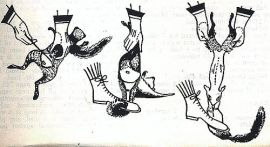
Skinning a squirrel, Joy of Cooking, 1962
My point here is less about buttermilk than equivalences. They are powerful. Within mathematics, their power is expressed in transitivity relations, the most famous one of which is:
If A=B and B=C, then A=C
But mathematics and cooking are not the only disciplines which rely upon equivalencies.
Western explorers have used equivalencies for centuries. Encountering things unknown, we try to understand them in terms, ideas, and objects of the familiar. Explorers were no different. Darwin’s first glimpse of the Cordilleras in South America made him think of the Andes – mountains that he knew less from experience than from another act of translation: viewing the vertiginous landscapes of J. M. W. Turner.
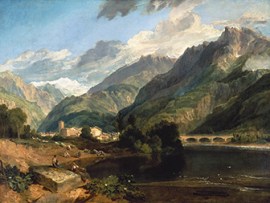
"Bonneville, Savoy, with Mount Blanc," J M W Turner, 1803
Yet the most powerful equivalencies in exploration were reserved for people. Early Spanish and Portuguese explorers frequently compared American Indians to children: innocent, emotional, lacking in judgment. By contrast, Europeans tended to identify themselves with parental figures: rational, worldly, prudent. This child metaphor proved enormously powerful, creating an equivalency between children and non-western peoples that was used to develop and justify colonial policies through the mid twentieth century.
Such was the power of the savage = child equivalency that it spawned new ones. In the early 20th century, Ernest Thompson Seton helped found the Boy Scouts, an organization that put boys in the wild on the premise that if savages are like children, then perhaps children are like savages. The child (or more precisely for Seton, the white child) must pass through a primitive phase before developing into a rational, prudent, moral adulthood. Getting out into nature was not just good exercise, but a way of coaxing young savages into the next phase of their physical and moral development.
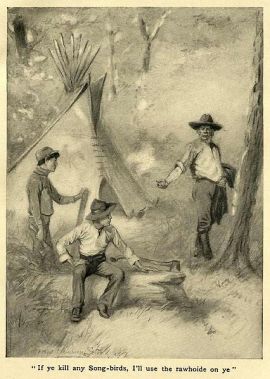
Illustration from Two Little Savages by E T Seton, 1903
The child=savage equivalency expanded to include historical (not merely personal) development. If savages were like children, nineteenth century scholars thought, perhaps they represented a child-stage in the evolution of our species. As such, the savage was not merely the equivalent of a child, but a missing link, a living artifact of our earlier history as a species. When Roy Chapman Andrews wrote a book about the “primitive” peoples of the world in 1945, he titled it Meet Your Ancestors: A Biography of Primitive Man.
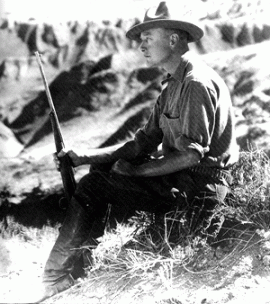
Roy Chapman Andrews
Others took the equivalency into the human psyche. Freud’s study Totem and Taboo makes comparisons between the behavior of so-called primitive peoples and the neurosis of white adults. Freud’s comparison is based upon the assumption that the human mind carries the imprint of its evolutionary history. That is, humans have an animal mind which has become augmented with the higher structures of the civilized mind. By this line of thinking, the Id is not merely an abstract facet of human psyche, but a historical remnant of our animal mind, an evolutionary calling card from the deep past.
If one accepts (as one shouldn’t) that the child= savage = id = prehistoric ancestor equivalency is true, a number of claims can be made:
- children are useful in understanding primitive societies
- voyages to non-European worlds are voyages back in time
- primitive societies help us understand prehistoric life
- our prehistoric ancestors lived without the constraints of moral inhibition
Yet this set of equivalencies – so powerful in the 19th and early 20th century – has fallen out of favor. Humans do not yield so easily to the transitive processes of mathematics and basic cooking.They are categorically messy, hard to organize, difficult to understand. Perhaps this is best.
News of the Expedition: Absolutely Free
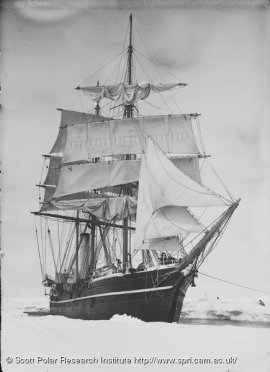
Terra Nova, British Antarctic Expedition, 1910. Courtesy of Freeze Frame.
Sitting at the long desk of an archive, wearing cotton gloves, reading old letters on the verge of turning to powder; this is about as good as it gets for a historian. Yet more and more of my research takes place elsewhere, now on my laptop mostly, looking at materials that have been scanned and displayed online.
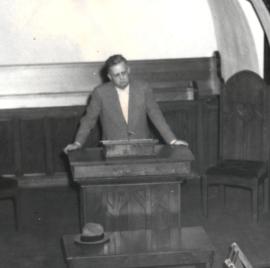
Frank Luther Mott, 1951
Things have changed. When Frank Luther Mott began researching his comprehensive History of American Magazines in the 1920s, he had to track down a paper copy of each periodical in libraries scattered across the country. Many of these publications, printed on acidic paper, were already falling apart.
By 1941, University Microfilms (now ProQuest) began photographing American periodicals, making them available as reels of microfilm. By the time the project was complete, UM had a collection of 1100 American periodicals spanning the years from 1741-1900.
This was the state of things when I began my dissertation research in the late 1990s. When I wanted to find out what was being written about Arctic exploration in the press, I consulted a set of books, the 19th century Poole’s Guide to Periodical Literature, which gave titles and citations of popular literature by subject. Then I would drive to Chicago (from Madison WI) with my list of citations to track down the articles on the spools of microfilm housed at University of Chicago and Loyola University.
Now Poole’s has been turned into a digital database that can be searched online. The American Periodical Series has also been scanned, and, because of character recognition software, can be searched down to the level of single words. Where I spent hours tracking down a handful of articles indexed by Pooles by title and subject, a “full text” search of the American Periodical Series online yields thousands of results, all of which are instantly readable, printable, and download-able from the comfort of my front porch.
Less romantic than heading to the archive, I understand, but infinitely more powerful and convenient.
Still, the conversion to digital has its downside. Poole’s and the American Periodical Series have been digitized by private companies which sell subscriptions to their databases at a hefty price. The result is that that Research I universities like Yale have extraordinary access, whereas smaller universities like the University of Hartford make due with less. Many of my European friends — working at institutions with little money for databases — go without.
The good news is that freely available digital resources are growing in breadth and depth. While the American Periodical Series remains a subscription-service, students of American history can access the 3.8 million pages of 19th century books and periodicals in the Making of America database developed by the University of Michigan. You can also find close to a million pages of material at the Making of America sister site at the Cornell University. Serious free research also extends to the Library of Congress’s 1 million pages of newspaper text at Chronicling America.
These are general databases for American history. Students of more specialized topics, such as the history of exploration, can also find free riches online. In addition to the links at the right, you might also want to check out:
Harvard University Library’s Expedition and Discoveries
A site of highlights and citations from dozens of 19th century expeditions fielded by Harvard and other organizations.
The Scott Polar Research Institute’s collection of polar images from 1845-1982, searchable by date, expedition, photographer, or subject matter.
Mountaineering and Polar Collection
The National Library of Scotland’s site for important historical expeditions, from the ascent of Mt. Blanc to investigations of Antarctica.


 Time to Eat the Dogs