Time to Eat the Dogs
A Podcast About Science, History, and ExplorationSearching for Hobbits
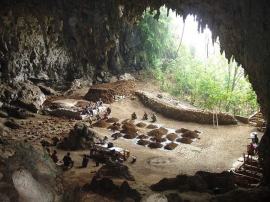
Liang Bua
In 2003, a team of archaeologists discovered a new hominin species in a cave on the island of Flores in Indonesia. The fossils were a big story not only because they were new, but also because they were so small. Homo Floresienses stood about three feet tall.
Paige Madison talks about her work at the Liang Bua cave in Indonesia where she studies Homo Floresiensis as well as the team of researchers who have worked at the cave for years, sometimes for generations. Madison is a PhD candidate in the history of science at Arizona State University where she also works with The Center for Biology and Society and the Institute of Human Origins. She writes about paleoanthropology at the blog Fossil History. She returns to Liang Bua as a Fulbright scholar this fall.
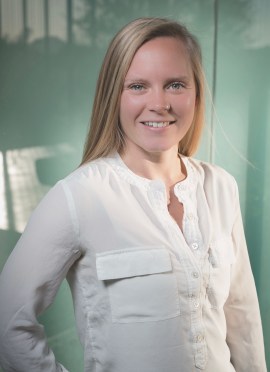
Paige Madison
Episode 46: Australians’ First Encounter with Captain Cook
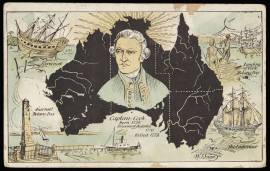
Postcard featuring James Cook superimposed over a map of Australia. Cook’s encounter with Aboriginal Australians at Botany Bay is illustrated in the top right corner (1907). Credit: National Museum of Australia
Maria Nugent talks about Aboriginal Australians first encounter with Captain Cook at Botany Bay, a violent meeting has come to represent the origin story of Australia’s colonization by Europeans. The encounter itself has been symbolized by a bark shield – said to have been used by indigenous Australians defending themselves against gunfire from Cook’s crew.
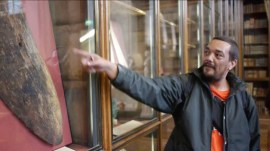
Gweagal activist Rodney Kelly pointing to the bark shield in the British Museum in 2016. Kelly seeks to return the shield to Australia. Credit: Rodney Kelly
Now on permanent display at the British Museum, the shield has come to mean different things for settler Australians and Indigenous Australians, even as historians and archaeologists debate whether it was it was really there at Botany Bay for this historic encounter. Maria Nugent is a Fellow in the Australian Centre for Indigenous History in the School of History at the Australian National University. She is the author of Captain Cook Was Here.
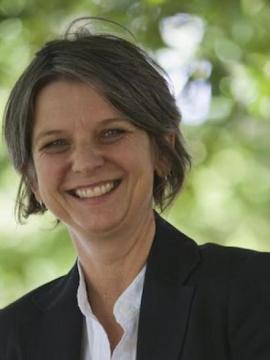
Maria Nugent
Episode 45: An American in Soviet Antarctica, Part II
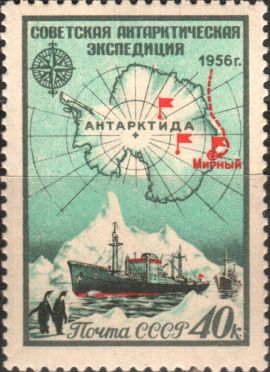
Stamp commemorating the Soviet Union’s Antarctic bases
Stewart Gillmor — the sole American at Mirny Station in 1961 and 1962– continues his discussion of life at the Soviet base: how communism plays out 10,000 miles from Moscow, the problems with planes in Antarctica, and what to do when the diesel generator dies at the coldest place in the world.
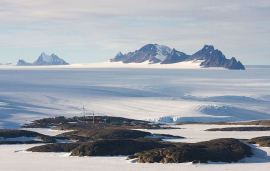
Mirny Station
Episode 44: An American in Soviet Antarctica, Part I
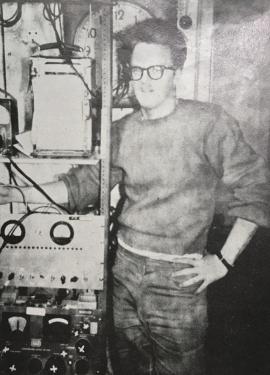
Stewart Gillmore in Mirny Station, 1961.
Stewart Gillmor talks about his fourteen-month stay at Mirny Station, the Soviet Union’s Antarctica base. Gillmor was the sole American at Mirny in 1960-1962 during the height of the Cold War.
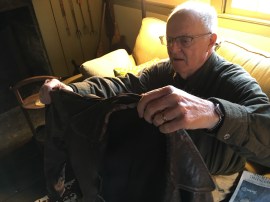
Gillmor holding the Russian coat he used at Mirny Station.
Episode 43: The 1948 Arnhem Land Expedition
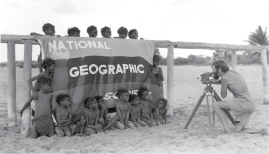
Howell Walker photographing at Umbakumba, 1948. Photograph by Charles P Mountford. Courtesy of the State Library of South Australia, PRG487/1/2/209/1.
Historian Martin Thomas discusses the 1948 Arnhem Land expedition and the controversy that surrounds it. His new documentary, Etched in Bone (Ronin Films), which he co-directed with Beatrice Bijon, traces the events of the expedition and its effects upon the aboriginal communities of Northern Australia.
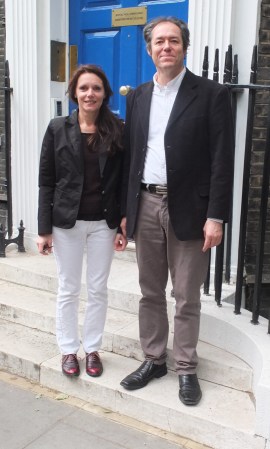
Beatrice Bijon (left) and Martin Thomas (right)


 Time to Eat the Dogs