Time to Eat the Dogs
A Podcast About Science, History, and ExplorationReplay: Monsters on the Map
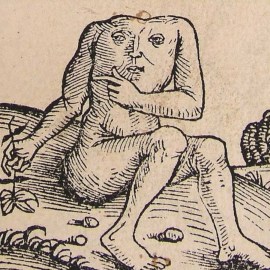
“Blemmyae,” from Liber chronicarum (Die Schedelsche Weltchronik, Das Buch der Croniken und Geschichten von Hartmann Schedel), woodcut, 1493
Cannibals, headless men, and giants were common figures on Medieval and Renaissance maps. Historian Surekha Davies tells us why we need to take these figures seriously. Davies is the author of Renaissance Ethnography and the Invention of the Human: New Worlds, Maps and Monsters (Cambridge University Press, 2016) winner of the 2016 Morris D. Forkosch Prize (Journal of the History of Ideas) and the 2017 Roland H. Bainton Book Prize (Sixteenth Century Society and Conference).
Surekha Davies
Read about Surekha Davies’ work on her website
Death in the Ice
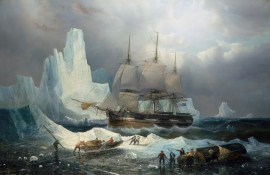
H.M.S Erebus in the Ice, François Etienne Musin (1846) Credit: National Maritime Museum
This week, Death in the Ice, a new exhibition about the Franklin Expedition opens at the Mystic Seaport Museum. Among other things, it features artifacts raised from the underwater wreck of HMS Terror. Russell Potter discusses this and new developments in the search for answers about the Franklin Expedition — a British mission to find the Northwest Passage — that disappeared in 1845 without a trace. Potter is professor of English and Media studies at Rhode Island College. He is a lead consultant of “Death in the Ice” and the author of Finding Franklin: The Untold Story of a 165-Year Search.
Russell Potter
Replay: The History of UFOs
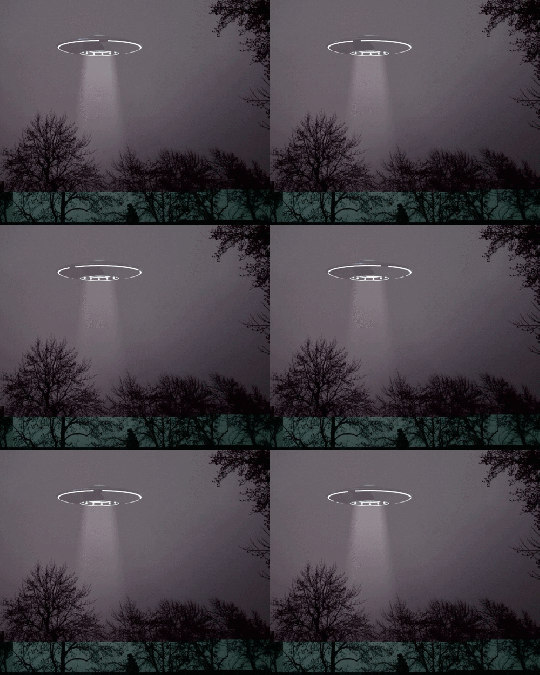
Whatever one thinks about UFOs — are they natural phenomena, military aircraft, mass hysteria, or alien visitors? — we can agree that they are freighted with a lot of meaning. Everyone has an opinion.

Greg Eghigian
How did this come to be? In 1946, Swedish and Finnish observers reported “ghost rockets” flying over Scandinavia. In the United States, they became known as “flying saucers.” This is the starting point for historian Greg Eghigian who discusses the science and culture of UFOs in the twentieth century. Eghigian is professor of history at Penn State University. He also holds the Charles A. Lindbergh Chair in Aerospace History at the Smithsonian Air and Space Museum (rebroadcast).
Read Eghigian’s essay, When Did Alien Sightings Turn into Alien Abductions?
How Isolated Tribes Fight Back
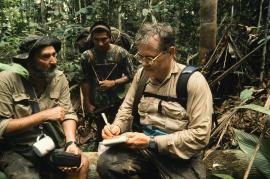
Scott Wallace (center) talking with Sydney Possuelo (left)
Scott Wallace talks about his recent trip to Brazil reporting on the Guajajara people’s efforts to protect uncontacted tribes from loggers, miners, and poachers. Wallace is a journalist and professor of journalism at the University of Connecticut. His article ‘The Last Tribes of the Amazon’ was the cover story of National Geographic in October 2018.

Replay: Backpack Ambassadors

Backpackers in the Netherlands, 1969. Life Photo: Carlo Bavagnoli
Richard Ivan Jobs talks about the rise of backpacking in Europe after the Second World War. Jobs argues that youth travel helped create a new European culture after the war, contributing to the integration of Europe during the 1960s and 70s. Jobs is a professor of history at Pacific University. He is also the author of Backpack Ambassadors: How Youth Travel Integrated Europe recently released by University of Chicago Press (rebroadcast).

Richard Ivan Jobs


 Time to Eat the Dogs