Time to Eat the Dogs
A Podcast About Science, History, and ExplorationReplay: The Medieval Pilgrimage
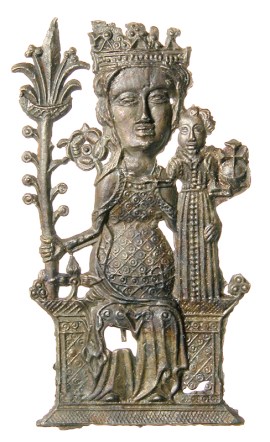
A pilgrim badge portraying Our Lady of Tombelaine, early 1400s
Fran Altvater talks about the Medieval Pilgrimage, a practice that became central to Christian Europe in the early Middle Ages and evolved into the military pilgrimages of the Crusades in the 11th, 12th and 13th centuries. Altvater is a professor of art history at the University of Hartford. Her book, Sacramental Theology and the Decoration of Baptismal Fonts, was published recently by Cambridge Scholars Publishing.

Fran Altvater
Here are some of Altvater’s other writings as well as a good overview of pilgrimage in the Middle Ages by Jean Sorabella:
Calendar Images and Romanesque Baptismal Fonts
Saintly Bodies, Mortal Bodies: Hagiographic Decoration on English Twelfth Century Baptismal Fonts
Pilgrimage in Medieval Europe (Sorabella)
Replay: Inventing the American Astronaut
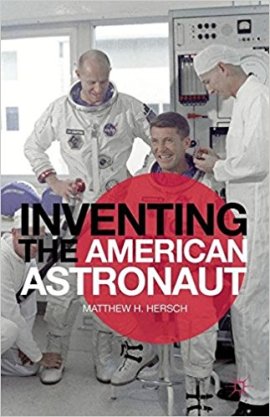
It seems logical that would NASA select military test pilots to be the first astronauts, right? They were used to risk. They were good with machines. They already explored extreme environments. But these skills were not unique to test pilots. There were also mountaineers, scuba divers, and explorers. They too were considered. So why did NASA choose test pilots?
Matthew Hersch, assistant professor of history at Harvard University and author of Inventing the American Astronaut, talks about this and other aspects of the astronaut program.
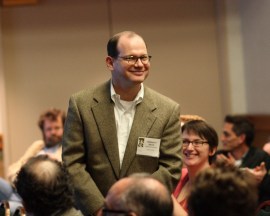
Matthew Hersch
The Navigator in the Early Modern World
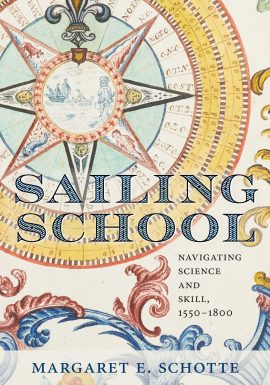
Margaret Schotte talks about how sailors were trained to do the difficult and dangerous work of navigation in the early modern world. Schotte is an Assistant Professor of History at York University. She is the author of Sailing School: Navigating Science and Skill.

Margaret Schotte
Replay: How We Got the Scientific Revolution Wrong
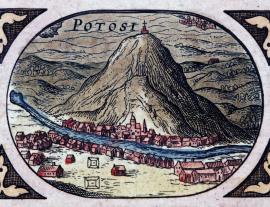
Potosí from a 17th century atlas engraving
In the late 1500s, the mines of Potosí –a mountain in southern Bolivia — produced 60% of the world’s silver. It was a place of great wealth and terrible suffering. It is also a place, Jorge Canizares-Esguerra argues, that challenges the very idea of the Scientific Revolution.
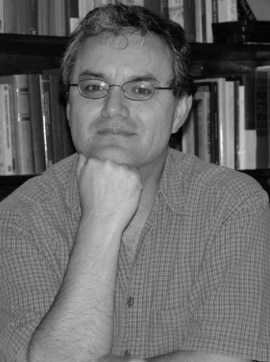
Jorge Canizares-Esguerra
Canizares-Esguerra discusses Potosí and how its peoples and technologies shaped 16th century science. He is the Alice Drysdale Sheffield Professor of History at the University of Texas at Austin. His work has been honored by awards from the American Historical Association and the History of Science Society. His book How to Write the History of the New World was cited as one of the best books of the year by the Economist, Independent, and the Times Literary Supplement.
Mountaineering and Glaciology after World War II
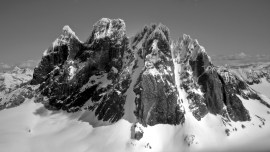
Devil’s Paw, Juneau Icefield
The Juneau Icefield is home to some of the most spectacular glaciers in North America. In the 1940s, it was the place where science and mountaineering joined hands and, occasionally, came into conflict.
Dani Inkpen talks about the links between mountaineering and glaciology after World War Two. Inkpen is a faculty fellow at NYU Gallatin. She is the author of “The Scientific Life in the Alpine: Recreation and Moral Life in the Field” published this year in the history of science journal Isis.

Dani Inkpen


 Time to Eat the Dogs