Time to Eat the Dogs
A Podcast About Science, History, and ExplorationReplay: The Amazing Phytotron
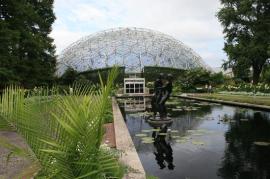
Climatron, Missouri Botanical Garden
“Phytotron” is such a great name for something that is, when you look at it, a high-tech greenhouse. But don’t sell it short! The phytotron was not only at the center of post-war plant science, but also connected to the Cold War, commercial agriculture, and long-duration space flight.

Today I speak with David Munns, professor of history at John Jay College, about his new book, Engineering the Environment: Phytotrons and the Quest for Climate Control in the Cold War, but we also talk about Matt Damon, shitting in space, and growing pot in your dorm room.
Check out David Munns’ website on The World of Trons.
Should We Colonize Mars?
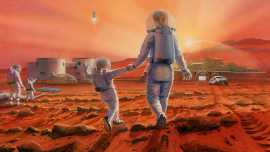
Credit: Robert Murray
Lucianne Walkowicz talks about the ethics of Mars exploration and new developments in the search for extraterrestrial life. Walkowicz is an astronomer and TED Senior Fellow at the Adler Planetarium in Chicago. This year she served as the Baruch S. Blumberg NASA/Library of Congress Chair in Astrobiology.

Lucianne Walkowicz
Replay: Chasing Exoplanets
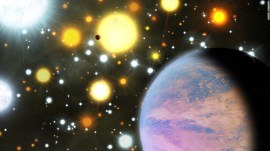
One of the things you hear about space exploration is that if humans aren’t involved — that is, being hurled into orbit– no one’s going to pay much attention. Robots are one thing, astronauts are another. There may be some truth to this. But I think exoplanets — planets that orbit stars outside our own solar system– are soon going to prove this maxim wrong. No one is traveling to extra-solar planets any time soon, (especially Kepler-10b, a planet so close to its sun that its surface is a glurping ocean of molten lava) but they are the coolest thing coming out space science these days – an ever expanding menagerie of the spherically weird and wonderful. Scientists have identified almost 4000 exoplanets so far and — with powerful new telescopes about to come on line — they’re just getting started.
Today I speak with exoplanet scientist Hannah Wakeford, Giaconni Fellow at the Space Telescope Science Institute. Wakeford has also served as a NASA Postdoctoral Research Fellow at NASA’s Goddard Space Flight Center and as a Research Fellow at the University of Exeter. She is also a host of the podcast, Exocast, along with co-hosts (and exoplanet scientists) Hugh Osborn and Andrew Rushby.
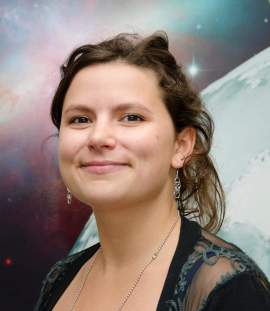
Hannah Wakeford
Searching for the Origins of Humankind
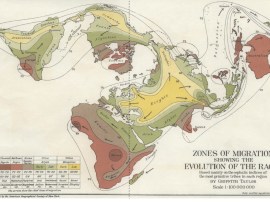
“Zones of Migration Showing the Evolution of the Races” Griffith Taylor, 1919
Historian Emily Kern talks about the search for human origins in the 19th and 20th centuries, specifically why anthropologists came to see Africa – rather than Asia – as the cradle of the human species. Kern is a Postdoctoral Research Associate in New Earth Histories at the University of New South Wales in Sydney, Australia where she specializes in the history of modern science. She is currently completing her book Out of Asia: a History of the Global Search for the Origins of Humankind.

Emily Kern
Replay: The History of Madagascar in Trade and Exploration
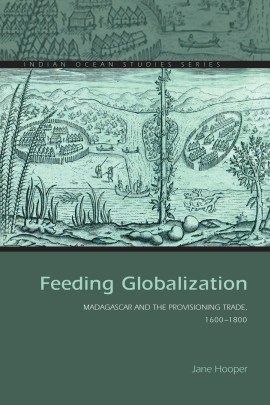
Madagascar lies so close to the African coast –and so near the predictable wind system of the Indian Ocean– that it’s easy to overlook the island, the fourth largest in the world, when talking about oceanic trade and exploration. But there is a lot to tell.
Jane Hooper talks about Madagascar and its importance to the history of Indian Ocean trade and exploration. Hooper is the author of Feeding Globalization: Madagascar and the Provisioning Trade, 1600-1800, recently published by Ohio University Press.


 Time to Eat the Dogs