Time to Eat the Dogs
A Podcast About Science, History, and ExplorationReplay: Watching Vesuvius
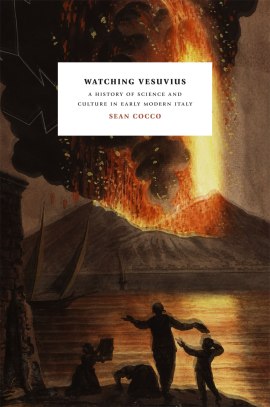
Sean Cocco talks about the 1631 eruption of Vesuvius and its impact on Renaissance science and culture. Cocco is an associate professor of history at Trinity College. He is the author of Watching Vesuvius: A History of Science and Culture in Early Modern Italy.
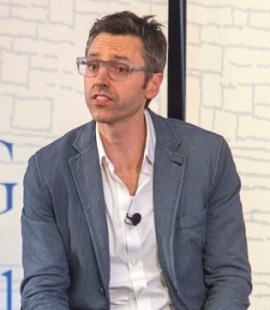
Sean Cocco
The Medieval Invention of Travel
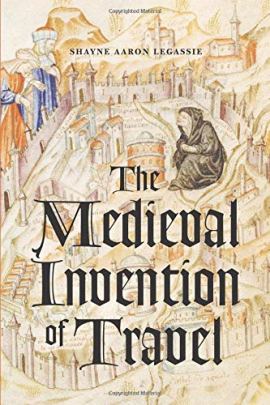
Shayne Legassie talks about medieval travel, especially long distance travel, and the way it was feared, praised, and sometimes treated with suspicion. He also talks about the role the Middle Ages played in creating modern conceptions of travel and travel writing. Legassie is an associate professor of English and Comparative literature at the University of North Carolina, Chapel Hill. He is the author of The Medieval Invention of Travel.
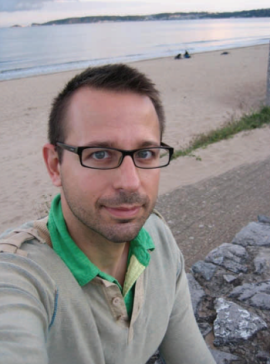
Shayne Legassie
Replay: Mapping the Polar Regions
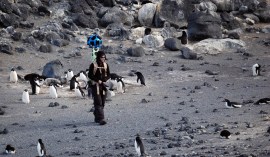
Cole Kelleher walks through the Adélie penguin colony at Cape Royds
Cole Kelleher talks about his work for the Polar Geospatial Center at the University of Minnesota, an agency that uses satellite data to support polar scientists in the field. In addition to making maps, Kelleher works with polar scientists, and coolest of all, has teamed up with Google to provide street views of McMurdo Station in Antarctica (see links below).
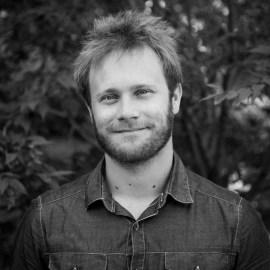
Cole Kelleher
Links:
Antarctica Street Views on Google:
Apollo in the Age of Aquarius
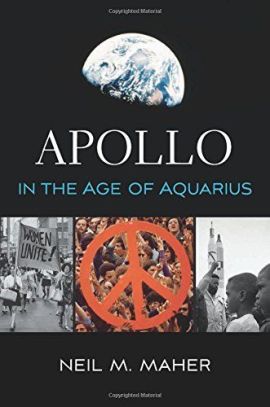
Neil Maher talks about the social forces that shaped NASA in the 1960s and 70s, connecting the space race with the radical upheavals of the counterculture. Maher is a professor of history at the New Jersey Institute of Technology and Rutgers University, Newark. He is the author of Apollo in the Age of Aquarius.
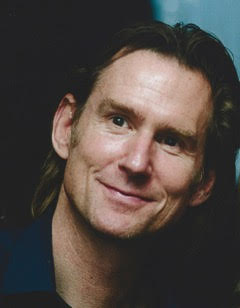
Neil Maher
Replay: The Last Uncontacted Tribes
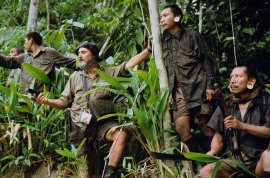
Sydney Possuelo, Tepi Matis, and Txema Matis in the Vale Do Javari Indigenous Land, 2002
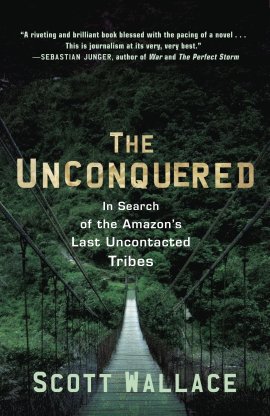
Journalist Scott Wallace talks about a 2002 FUNAI expedition to find the Arrow People, one of the last uncontacted tribes in the world. Wallace is a writer and photojournalist who covered the wars in El Salvador and Nicaragua in the 1980s for CBS and the Guardian. Since then he has written extensively for National Geographic. His book, The Unconquered: In Search of the Amazon’s Last Uncontacted Tribes, tells the story of this expedition. Wallace’s work about the Amazon has also recently appeared in the New York Times.
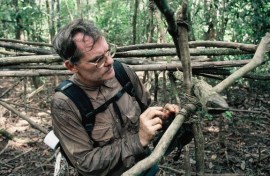
Scott Wallace


 Time to Eat the Dogs