Time to Eat the Dogs
A Podcast About Science, History, and ExplorationSpace Science and the Arab World
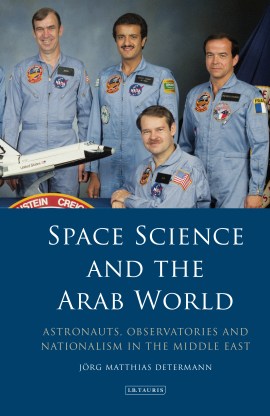
Matthias Determann talks about the importance of the space sciences in the Arab World. Determann is an associate professor of history at Virginia Commonwealth University in Qatar. He is the author of Space Science and the Arab World: Astronauts, Observatories and Nationalism in the Middle East.
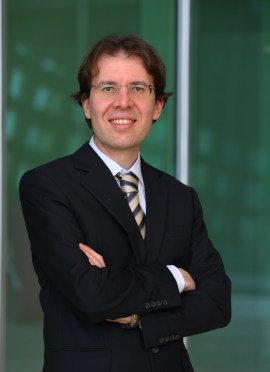
Matthias Determann
Replay: Living on the International Space Station
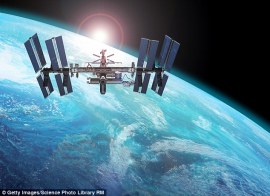
International Space Station
Astronaut Garrett Reisman talks about life aboard the International Space Station (ISS). Reisman flew on two shuttle missions to ISS where he conducted three 7-hour spacewalks. In 2011, he joined SpaceX as Director of Space Operations. This year he joined the engineering faculty of University of Southern California where he teaches courses on human spaceflight.

Garrett Reisman
Faces, Beauty, and the Brain
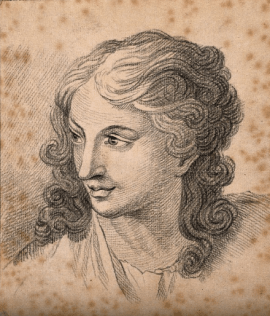
“An ideal head, destitute of character” Johann Lavater, 1792.
Rachel Walker talks about physiognomy — the study of the human face — and why it was so popular among scientists and the general public in the 18th and 19th centuries. Walker is an assistant professor of history at the University of Hartford. She is completing a book based on her dissertation, “A Beautiful Mind: Faces, Beauty, and the Brain in the Anglo-Atlantic World, 1780-1860.”

Rachel Walker
Replay: Aboriginal Australians’ First Encounter with Captain Cook
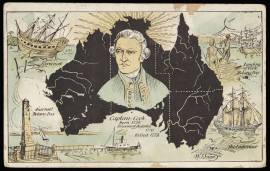
Postcard featuring James Cook superimposed over a map of Australia. Cook’s encounter with Aboriginal Australians at Botany Bay is illustrated in the top right corner (1907). Credit: National Museum of Australia
Maria Nugent talks about Aboriginal Australians first encounter with Captain Cook at Botany Bay, a violent meeting has come to represent the origin story of Australia’s colonization by Europeans. The encounter itself has been symbolized by a bark shield – said to have been used by indigenous Australians defending themselves against gunfire from Cook’s crew.
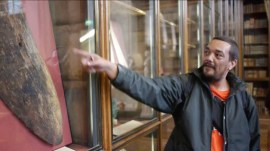
Gweagal activist Rodney Kelly pointing to the bark shield in the British Museum in 2016. Kelly seeks to return the shield to Australia. Credit: Rodney Kelly
Now on permanent display at the British Museum, the shield has come to mean different things for settler Australians and Indigenous Australians, even as historians and archaeologists debate whether it was it was really there at Botany Bay for this historic encounter. Maria Nugent is a Fellow in the Australian Centre for Indigenous History in the School of History at the Australian National University. She is the author of Captain Cook Was Here.
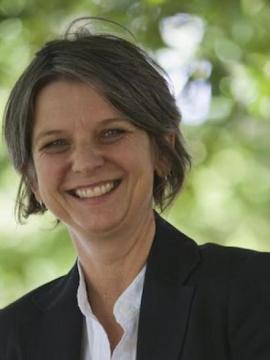
Maria Nugent
The History of Arctic Fever
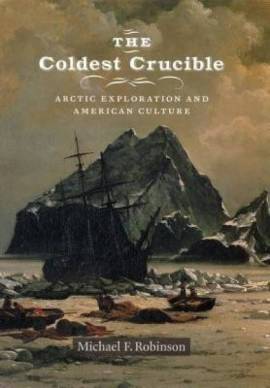
Radio host Kevin Fox interviews me about the history of American Arctic exploration, the subject of my first book, The Coldest Crucible: Arctic Exploration and American Culture. The disappearance of the Franklin Expedition in 1845 turned the Arctic into an object of fascination.
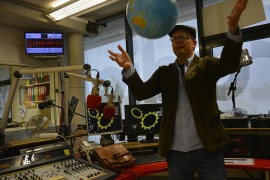
Kevin Fox
By the end of the century, it had become an ‘Arctic Fever.’ Fox is the host of the radio program Geographical Imaginations for RadioFabrik in Salzburg, which is also available on iTunes as a podcast.
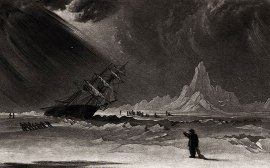
U.S. Grinnell Expedition, 1854


 Time to Eat the Dogs