Time to Eat the Dogs
A Podcast About Science, History, and ExplorationThe Expedition that Tested Einstein’s Theory
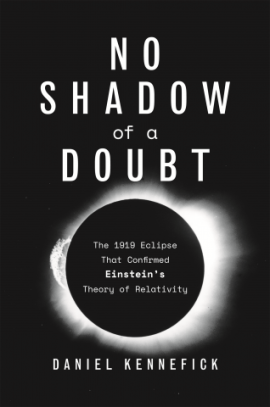
Daniel Kennefick talks about resistance to relativity theory in the early twentieth century and the huge challenges that faced British astronomers who wanted to test the theory during the solar eclipse of 1919. Kennefick is an associate professor of physics at the University of Arkansas, Fayetteville. He’s the author of No Shadow of Doubt: the 1919 Eclipse that Confirmed Einstein’s Theory of Relativity.
Daniel Kennefick
Replay: Searching for the Origins of Humankind
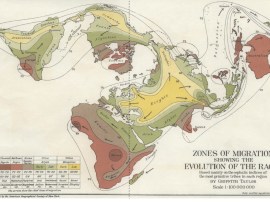
“Zones of Migration Showing the Evolution of the Races” Griffith Taylor, 1919
Emily Kern talks about the search for human origins in the 19th and 20th centuries, specifically why anthropologists came to see Africa – rather than Asia – as the cradle of the human species. Kern is a Postdoctoral Research Associate in New Earth Histories at the University of New South Wales in Sydney, Australia where she specializes in the history of modern science. She is currently completing her book Out of Asia: a History of the Global Search for the Origins of Humankind.

Emily Kern
Chasing the Moon
Director Robert Stone talks about his film Chasing the Moon, a three part documentary which aired on PBS’s American Experience for the fiftieth anniversary of the Apollo 11 mission. Stone talked to me in front of live audience at Bard College after he showed some clips from the film. Thanks to Paul LaBarbera and Cariahbel Azemar of Bard AV Services who recorded the audio for this episode. And thanks too to Paul Cadden-Zimansky, director of the Physics Program, who organized the event and introduced both of us to the audience.

Robert Stone
Replay: The Navigator in the Early Modern World
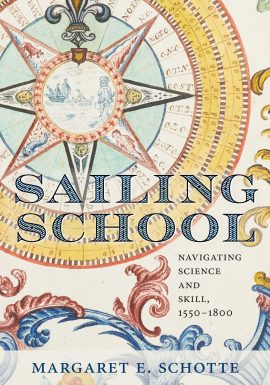
Margaret Schotte talks about how sailors were trained to do the difficult and dangerous work of navigation in the early modern world. Schotte is an Assistant Professor of History at York University. She is the author of Sailing School: Navigating Science and Skill.

Margaret Schotte
Scurvy!
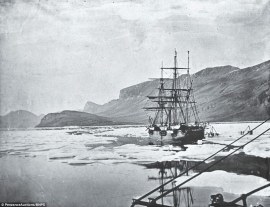
Nares Expedition (1875)
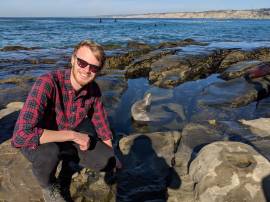
Ed Armston-Sheret talks about the mysterious disease of scurvy: how it affected expeditioners and why it was so difficult to understand. Armston-Sheret is a PhD candidate at Royal Holloway University of London. He’s the author of “Tainted bodies : scurvy, bad food and the reputation of the British National Antarctic Expedition, 1901–1904,” published this year in the Journal of Historical Geography.
Ed Armston-Sheret


 Time to Eat the Dogs