Time to Eat the Dogs
A Podcast About Science, History, and ExplorationArchive for Popular Culture
Katherine Pandora on “Science in the Everyday World”
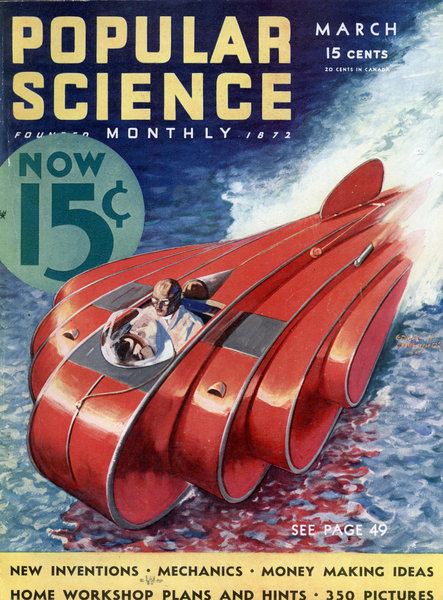
A little while ago, the journal Isis came out with a series of articles exploring the intersection between science and the history of science. Katherine Pandora and Karen Rader’s article “Science in the Everyday World” generated quite a bit of discussion in the science/history of science blogosphere. Pandora has written an account of the goals of this paper and responds to some of the comments made here and elsewhere.
Check it out: Petri Dish
Women Explorers
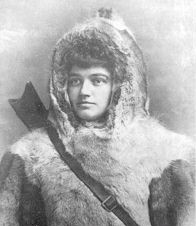
Josephine Peary
At one time returning explorers could expect a hearty welcome back home: good press, medals of honor, product endorsements, and lecture halls filled to capacity. Times have changed. Since the late nineteenth century, the press and public have been tougher on explorers, challenging their missions, their claims of discovery, and their behavior in the field.
Certainly there are still moments when the public’s knees get wobbly: the orbital flights of Yuri Gagarin and John Glenn and Armstrong’s touchdown on the moon. But even national pride cannot quite extinguish the feeling that we are watching some kind of carnival attraction, that things are not what they seem, that the dog-faced boy will reveal himself to be a carny in make-up.
The proof? It’s not just lemon-faced academics who are writing skeptically about travelers and explorers. Critics now come at the subject from all sides. Adventure writers such as Jon Krackauer psychoanalyze the ethos of the “go it alone” explorer in books like Into the Wild while explorers themselves hurl slings and arrows at each other on ExplorersWeb. Reading one of the glibby heroic biographies of Robert Peary or Elisha Kane is a bit like drinking coffee with lots of syrup: too sweet, no bite.

The Nineteenth-Century Explorer Narrative
Still there are areas where criticism remains muted or under-reported, where one can read heroic narratives of old and ignore for a while the nattering nabobs of negativism. Mostly I see this in books on women and indigenous explorers.
It’s understandable. For hundreds of years, women and native peoples were routinely written out of explorer narratives. When they managed to make it in, they were usually playing set characters that readers would understand: the women who travel in the footsteps of intrepid husbands, the noble savages and their thievish brethren, all of them children of one sort or another. No surprise that as social mores have changed, we see attempts to bring these two-dimensional characters to life. In the past twenty years, there have been scores of books on women explorers alone. The Boston Public Library’s list of “Adventurous Women: Explorers and Travelers” gives a taste of this literature. Indeed, the fact that the BPL felt compelled to create this list for its patrons says something about popular demand.
Many books on women explorers hew closely to the heroic model of biography that was popular in the nineteenth century. Of her choice of subjects for the book Women of Discovery, author Milbry Polk said:
So in the end, we chose about 84 women that covered 2,000 years of history, more than a dozen different nationalities. And their endeavors crossed a wide swath of interests from every kind of science to our geography and painting. And, honestly, we chose most of them because we really liked them.
I don’t think that there’s anything wrong with an author liking his or her subjects, as long as it doesn’t interfere with reporting the less noble aspects of the subject’s actions. Many women explorers, often white, well-educated, and upper-class, were just as racist and vain-glorious as their male counterparts (Josephine Peary comes to mind here). A number of them did not rail against “sexism,” in our parlance, but accepted the conventional attitude that men and women were inherently different. Indeed, one of the most fascinating aspects of women travelers is the degree to which they were able to turn these conventional attitudes to their own advantage. For example, Americans were transfixed by Nelly Bly’s bid to travel around the world in eighty days . . . not because she aspired to be look or act as tough as the boys but because she seemed so, well, girly.

Nellie Bly, 1890
This does not take away from the impressiveness of her accomplishments or others. Indeed, it makes the story of these women all the more interesting. More often than not, they did not buck a system of rigid gender roles…rather they used the system to make a space for themselves. Certainly this was not the exclusive strategy of women explorers. Frances Willard, Jane Addams, and other women of consequence did the same.
So I think it’s a shame that many biographies play up the idea of heroic women overcoming adversity through sheer strength of will. It’s a simplistic story that doesn’t do them justice. As a result, these books read very much like nineteenth-century biographies of their male counterparts.
Not that all work on women explorers fits into this category. In her account of Mary Kingsley, British explorer of West Africa, Alison Blunt warns of the dangers of placing women travelers on pedestals. Says Blunt:
Recent interest in white women in colonial settings has often taken the form of romantic, nostalgic imagery in literature, television, and film, notably since the 1980s…These approaches isolate and often celebrate individual “heroic” women rather than question constructions of gender… [Travel, Gender, and Imperialism: Mary Kingsley in West Africa, 5-6]
So where do we turn for good work on women and non-white explorers? Here’s a short list of favorites. Patricia Erikson’s current work on Josephine Peary promises a new, nuanced take on this controversial and complicated explorer. Dierdre Stam’s work on Matthew Henson also will provide some balance and context to the U.S.’s most famous African-American explorer. These are works in progress, so in the interim, you might want to read these:
Patricia M.E. Lorcin’s essay on women’s travel writing which offers a good overview of the field as well as some great secondary sources.
Patricia Gilmartin’s excellent essay on women and exploration in the Oxford Companion to World Exploration (which I reviewed here). Also see Gilmartin’s website for a more complete bibliography of her work.
Lisa Bloom’s controversial, pathbreaking book Gender On Ice which discusses the gender construction of Arctic narratives in the 19th and 20th centuries.
Carla Ulloa Inostroza’s excellent blog on the history of women’s travel Mujeres Viajeras
Laura Kay’s course reading list at Barnard.
If all of this gets a bit wonky for you, head over to the Victorian Women Writers Project where you can read the chronicles of Isabella Bird as she travels through the Rocky Mountains and the islands of Hawaii in the 1870s.
Also see my posts AfricaBib on women travelers and the Gertrude Bell Archive
Blue Moon

To see how often speakers at the Democratic National Convention brought up the idea of reaching the Moon, you would have thought they were talking about Florida. Who can forget Ted Kennedy, grand old man of the Democratic Party, telling adoring delegates:
We are Americans. This is what we do. We reach the moon. We scale the heights. I know it. I’ve seen it. I’ve lived it. And we can do it again.
Later, most of these delegates were napping, chatting, and or freshening up their martinis when Brian Schweitzer told the floor:
President Kennedy’s idealism and spirit of possibility inspired [my parents] to send all six of us children to college. And when he said, “we’re going to the moon,” he showed us that no challenge was insurmountable.
No problem taking a martini break at the DNC or RNC, however, because one can always hear the same speech again. So it was with Ted Sorensen’s speech a few hours later:
Confronting a Soviet military advantage in space, [Kennedy] made all Americans proud by literally reaching for the moon.
Or if they stayed in the bar all afternoon, they could still reemerge on the DNC floor to hear Frederico Pena say:
John Kennedy, a Democratic president, committed us to putting a man on the moon. American energy, American technology, American jobs, ready to be created, right now. That’s the change we need.
Even if they passed out in their hotel rooms, they could still pick up a copy of the DNC’s Platform Report “Renewing America’s Promise” which would have told them:
We know that at every turning point in our nation’s history, we have demonstrated our love of country by uniting to overcome our challenges-whether ending slavery, fighting two world wars for the cause of freedom or sending a man to the moon.
In all of this, the moon has no value in and of itself. It does not represents an economic or scientific imperative. Rather, it functions solely as a benchmark of American accomplishment, a symbol of technological progress, and a reminder that young, good-looking Democratic presidents have the chutzpah to do cool things in office.
No surprise then that Barack Obama’s statement on Science Policy also mentions the moon, albeit with a slightly different spin:
In the past, government funding for scientific research has yielded innovations that have improved the landscape of American life-technologies like the Internet, digital photography, bar codes, Global Positioning System technology, laser surgery, and chemotherapy. At one time, educational competition with the Soviets fostered the creativity that put a man on the moon. Today, we face a new set of challenges, including energy security, HIV/AIDS, and climate change.
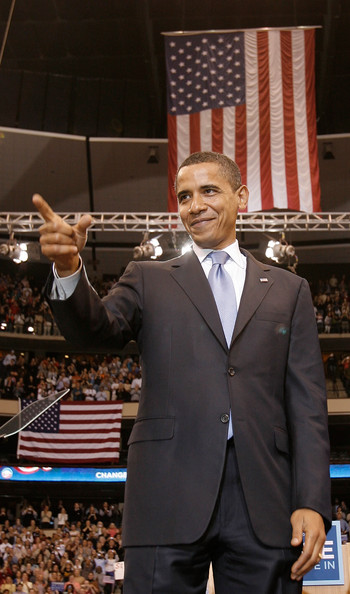
In this incarnation, reaching the moon represents a benchmark of American educational accomplishment, a golden age that Obama implies is beyond us now. Indeed, Obama’s Space Policy in late 2007 seemed to pit money for space exploration up against federal money for education. Said Obama:
We’re not going to have the engineers and the scientists to continue space exploration if we don’t have kids who are able to read, write and compute.
As for Republicans, the moon received nary a mention at their national convention. Testament to the fact, I imagine that they see it primarily as free advertising for Kennedy and therefore Obama by proxy.
On the surface John McCain’s policy on space exploration seems much more vigorous than Obama’s. He is committed to continuing President Bush’s 2004 Vision for Space Exploration (VSE) which anticipates a return to the moon in the coming decade as a prelude to the eventual manned mission to Mars in 2020. Yet what is the ultimate objective of human space flight? McCain begins by discussing (much as Kennedy did) the accomplishments of international rivals:
China, Russia, India, Japan and Europe are all active players in space exploration. Both Japan and China launched robotic lunar orbiters in 2007. India is planning to launch a lunar orbiter later this year. The European Space Agency (ESA) is looking into a moon-lander, but is more focused on Mars. China also is actively pursuing a manned space program and, in 2003, became only the third country after the USSR and the US to demonstrate the capability to send man to space. China is developing plans for a manned lunar mission in the next decade and the establishment of a lunar base after 2020.

Ultimately, McCain concedes that the principle objective of human space flight is not science or commerce but national prestige. Boldly going where no one has gone before is, in effect, a matter of keeping up with the Jones:
Although the general view in the research community is that human exploration is not an efficient way to increase scientific discoveries given the expense and logistical limitations, the role of manned space flight goes well beyond the issue of scientific discovery and is reflection of national power and pride.
This is a very expensive way to show “prestige.” So despite the Democrats paper-thin, hokey moon-talk at the DNC, and the lack of Obama’s specifics about alternatives to human space exploration as proposed by the VSE, I tilt towards Obama on space policy if only because McCain seems to be willing to maintain the rather shallow vision of exploration put forth by Bush.
Web Review: ExplorersWeb
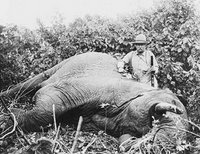
Theodore Roosevelt on Safari
There is a freedom that comes with studying dead people. We, the historians of the not-so-recent, learn about our subjects in archives and newspaper columns, from photos, maps, and bank statements. We reveal what we’ve learned, personal and perhaps unflattering, knowing that the people we’ve researched cannot talk back to us, sue us, or toss rocks through our windows. (This is work best left to other historians). Still there are times when I meet my subjects sort of. I often talk shop with modern-day explorers at meeting and lectures, some of whom share the goals and sensibilities of the people I study. This is always a welcome experience for me, but one that often feels a bit strange, since I look at the work of past explorers with such a critical eye. What has been refreshing to find, however, is how self-aware and historically-minded many modern day travelers and explorers are.
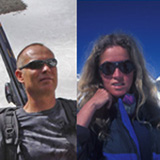
Tom and Tina Sjogren, founders of Explorersweb.com
For example, take the site ExplorersWeb.com, a clearinghouse of information about extreme travel in the polar regions, the oceans, mountains, and space. It is the brainchild of Tom and Tina Sjogren, two Swedish uber-travelers, who provide daily updates about expeditions in the field as well as their own exposes of expeditionary bad-behavior, from selfish guides, and faulty equipment manufacturers, to climbers who fib about their summit climbs. The reports of Explorersweb have not been without controversy, particularly from veteran mountaineers who’ve been the object of scrutiny. Nevertheless, it’s worth taking a look at.
Columbus on the Green
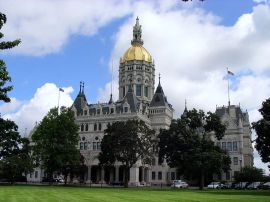
Connecticut State Capitol, Hartford CT
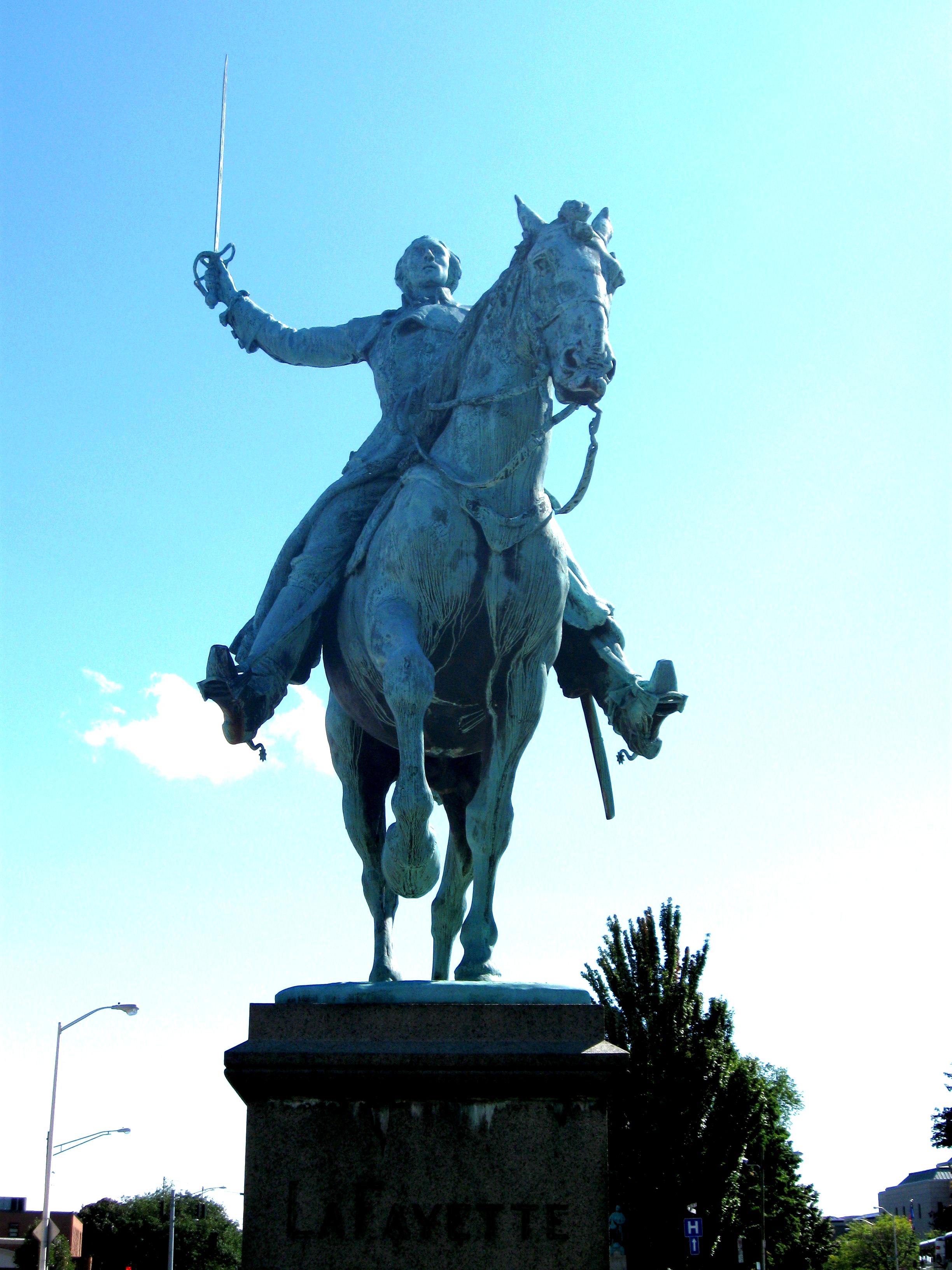
To drive into downtown Hartford is to drive back in time. Shopping malls and 7-11s give way to quiet brownstones, corniced Victorians, and brick factory buildings. Near the city’s center, the gold-domed State Capitol rises above the billboards of I-84. The Capitol is a fairy-tale structure, built in high Gothic Victorian, more at home in a novel by Bram Stoker than in “the Insurance Capital of the World.” Surrounding the Capitol are statues and commemorations of every kind, including Greek goddesses, Civil War cannons, busts of American writers, triumphal arches, and a squat, sword-wielding Confucius. A towering Marquis de Lafayette, mounted upon a stallion, always catches my eye as I drive past the Capitol towards the Hartford Public Library. He is trotting off to help Washington at Valley Forge. I am off to return overdue books.
A bit further down the green, less than a block from the Marquis, stands another figure, an eleven-foot high Christopher Columbus, coppery-green, perched on a nine-foot marble pedestal.
Looking at the statue, one imagines Columbus aboard the Santa Maria (a ship he disliked), clutching a nautical chart, gazing to his right, beyond Hispanola perhaps? But the Admiral needs to watch where he’s sailing. Just beyond the bowsprit, look out, Leviathan-Ho!
: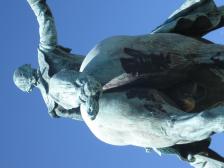
What were the city fathers thinking? They have set Columbus, discoverer of the New World, on a collision course with the soaring backside of Lafayette’s mount. Perhaps, I thought, Columbus’s remove from Lafayette made this visual insult hard to see. Clearly this had to have been an unintentional joke, the unwitting error of a middle-manager in the Parks Department, invisible to the good people of Hartford, obvious only to prurient-minded people like me. Still a joke is a joke and, seeing as this one involved Columbus, I wanted to know more.
The story of Lafayette and Columbus turns out to be a lot more complicated than I thought. Connecticut has at least seventeen monuments honoring Columbus. While the Chicago Columbian Exposition of 1893 was the biggest Columbus event ever organized (about 27 million people attended the fair, a number that equaled half the U.S. population), most of Connecticut’s monuments were built, with considerably less fanfare, in the twentieth century. The Chicago Fair, while nominally celebrating Columbus, was really a showcase of White Anglo Saxon Protestant achievement in the New World, a paean to American Exceptionalism.
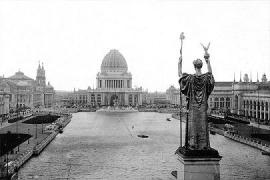
The Chicago Columbian Exposition of 1893. Not an Italian in sight.
By contrast, most of the Columbus monuments of the twentieth-century were built by Italian-American groups. One expects that the new ranks of Italian immigrants pouring into American cities, most of whom were working-class Catholics, did not endear themselves to members of the WASP ruling class. Nor did the Sacco-Vanzetti trial, which led to the execution of two Italian anarchists in 1927, do much to help relations between classes. Or, for that matter, the Italian Mafia, which catered to the thirstier citizens of the Prohibition Era.
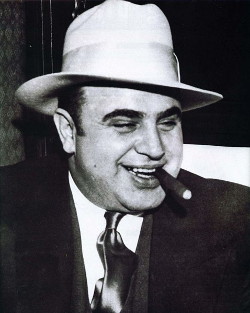
Al Capone, Mafia boss, has no statues in Connecticut.
In this climate, one imagines that monuments to Columbus offered the American public a subtle reminder of the greatness of Italian heritage. Tea-totaling Protestants may have held the reins of power in the U.S., but Italian-Americans wanted it made clear: the tower of Anglo-Saxon prosperity rested on the foundations laid by a Catholic, wine drinking sailor from Genoa.
In Hartford, the plan to commemorate Columbus started auspiciously enough. Italian-Americans raised $15,000 to put up their local Columbus on Lafayette Green, then unoccupied by any other statue. Columbus was unveiled on 12 October 1926 before a crowd of three thousand, accompanied by a two-mile parade, floats, and speeches by the mayor of Hartford, the Governor of Connecticut, congressmen, and the Italian vice-council. Prize for “best-looking girl float” (for the float, the girl?) went to the Yolando Club of Waterbury. All in all, it appeared to be a happy event, a win for the Italian community and the civic-minded citizens of Hartford.
This lasted about ten months. Problems began the following year when organizers of the Columbus monument sought to change the name of Lafayette Green to “Columbus Green” in time for the Columbus Day celebration of 1928. The Board of Aldermen, unsure of what to do, referred the issue to the Park Commissioners, who, in turn, referred the issue back to the Board.
Meanwhile, the forces of Lafayette had gathered to launch a counter-attack. The French-American Republican Club drafted a resolution condemning the name change. They were soon joined by a phalanx of societies including the Connecticut Society of the Colonial Dames of America, the Connecticut Historical Society, the Committee on Historic Sites, the Connecticut Society of the Sons of the American Revolution, the French Social Club, the Franco-American Foresters, and L’Association Canado-Americaine, all of whom protested The Great Admiral’s annexation of this small tuft of grass.
Katherine Day, Chairwoman of the Committee on Historic Sites, explained her opposition:
Why intrude Columbus on this area? Or, if so, why not the statues of Leif Ericson, Cabot and all the other brave explorers? … Should not our own soldiers and sailors and civil heroes have first place near the seat of our State life?
Day must have forgotten that Lafayette was a French aristocrat. As Hartford’s ethnic groups squared off against each other, the Board of Alderman quickly tabled the motion to change the name of the green. There matters stood until an Italian-American alderman raised the motion again in 1930.
A plan had been in the works for some time, at least five years, to erect a statue of Lafayette on the Green named after him but it had not moved forward for want of funds. Suddenly, after this second petition to change the name, an anonymous donor offered funds to complete the project. By 1932, Lafayette and his horse had found their new homes on the Green, showing their faces forever to the Capitol, and their backsides eternally to the Mariner of the Seas.
I had assumed that the monumental mooning of Columbus was unintentional. Now I’m not so sure.
Next Post: Columbus on the Green, Part II


 Time to Eat the Dogs