Time to Eat the Dogs
A Podcast About Science, History, and ExplorationArchive for Explorers
Web Review: ExplorersWeb
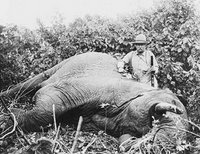
Theodore Roosevelt on Safari
There is a freedom that comes with studying dead people. We, the historians of the not-so-recent, learn about our subjects in archives and newspaper columns, from photos, maps, and bank statements. We reveal what we’ve learned, personal and perhaps unflattering, knowing that the people we’ve researched cannot talk back to us, sue us, or toss rocks through our windows. (This is work best left to other historians). Still there are times when I meet my subjects sort of. I often talk shop with modern-day explorers at meeting and lectures, some of whom share the goals and sensibilities of the people I study. This is always a welcome experience for me, but one that often feels a bit strange, since I look at the work of past explorers with such a critical eye. What has been refreshing to find, however, is how self-aware and historically-minded many modern day travelers and explorers are.
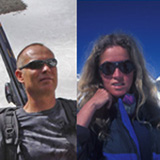
Tom and Tina Sjogren, founders of Explorersweb.com
For example, take the site ExplorersWeb.com, a clearinghouse of information about extreme travel in the polar regions, the oceans, mountains, and space. It is the brainchild of Tom and Tina Sjogren, two Swedish uber-travelers, who provide daily updates about expeditions in the field as well as their own exposes of expeditionary bad-behavior, from selfish guides, and faulty equipment manufacturers, to climbers who fib about their summit climbs. The reports of Explorersweb have not been without controversy, particularly from veteran mountaineers who’ve been the object of scrutiny. Nevertheless, it’s worth taking a look at.
The Last Imaginary Place
Two thousand years ago, a new innovative culture emerged in the world, one which established large, wide-ranging settlements and networks of long distance trade. Between 500 and 1500 CE, this culture began to expand, developing new technologies which allowed it to move into other regions thousands of miles from its place of origin. Ultimately, these technological advancements allowed it to dominate and displace the native peoples who lived there. By 1000, it had establishing a place for itself in a new system of trans-Atlantic trade.
I speak not of Romans or Vikings but of the Inuit, who developed from the Old Bering Sea people two thousand years ago on the coast of Alaska. The Old Bering Sea people lived in large, year round settlements and established long-distance trading networks. They developed or acquired the bow and arrow as well as the means to hunt bowhead whales. Shortly thereafter, they began moving northeast, towards the Arctic shores of North America, displacing the Tuniit, an Arctic culture that predated them by hundreds of years. It is not clear what drew the Old Bering Sea people east, but evidence suggests that they were eager to acquire metal impliments brought by Norse peoples who began to occupy Greenland.
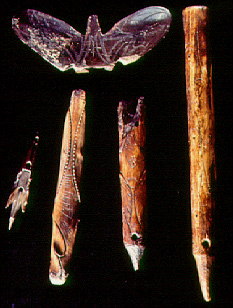
Old Bering Sea Culture Equipment
All of this information comes from Robert McGhee’s new book “The Last Imaginary Place: A Human History of the Arctic World.” McGhee’s Arctic is no wintery wasteland, but a dynamic place, the crossroads of many different cultures: Asian, American, and European. At 270 pages, McGhee can hardly be comprehensive. But he manages to tell his stories of Arctic history with an impressive cast of characters: Inuit, Tuniit, European, and Siberian.
One of the goals of McGhee’s analysis is to destroy the myths that still haunt our image of the Arctic and its peoples. For centuries, Europeans described the Inuit as the primitive children of nature, a timeless people who scratched out a living in the same manner as their stone-age ancestors did thousands of years before. In truth they had much in common with their European counterparts. They were expansionist, adaptive, and quick to exploit the resources of their environment.
McGhee also manages to link his broader points to personal experience. On the Inuit for example he states:
The realization that the Inuit are not a peripheral people was forced on my mind one night on the coast of Chukotka, as I climbed by myself over the remains of the ancient community at Ekven. A few kilometers up the coast, the low night-time sun was throwing an orange glow on the rocks of Cape Dezhneva, the most easterly point of Asia, and on Great Diomede Island halfway across the Bering Strait to Alaska. In the bright calm night I suddenly had the overwhelming sense that I was not standing at the distant margin of a world, the end of the earth, as far as one could travel from Europe. Instead I was standing at the very heart of another world, a nexus that for millenia had linked the peoples and cultures of Asia and America. It was a world in which many nations and cultures had flourished, among them the Inuit and their way of life.
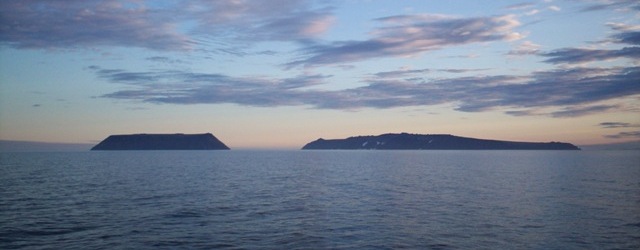
The Diomede Islands of the Bering Sea
This is a terrific book. I’ll be writing a more formal review of it soon for The Historian.
Guest Blogger: Russell Potter
Dr. Russell Potter
I’m very happy to have Russell Potter, author of Arctic Spectacles, give us his views of the current search for missing British explorer Sir John Franklin. Russell’s impressive book Arctic Spectacles: The Frozen North in Visual Culture, 1818-1885 came out last year with the University of Washington Press. He has also recently been profiled by the PBS series NOVA which aired the program Arctic Passage on the Franklin search. If this blog post whets your appetite for more, check out Russell’s website and Google “knol” on Arctic Exploration.
Oh the Places You’ll Go
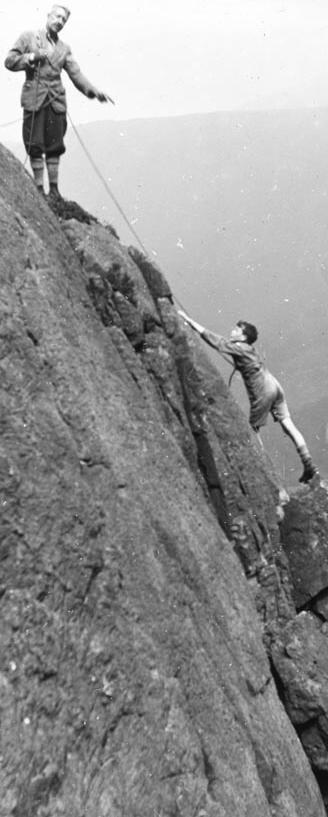
I have been burning the candle at both ends this summer. I just finished an article about Lewis and Clark & Alexander von Humboldt two weeks ago, wrote a review of Graham Burnett’s book, Trying Leviathan, started a review of Robert McGhee’s book, The Last Imaginary Place, and have started a new article on the work of Frederick Cook. That this seemed an excellent time to pick up blogging says something about me, I’m not sure what exactly, but it would involve words such as hubristic and harebrained. I’ve loved writing the blog to be honest…but on days like today there’s no gas left in the tank. So no grand thoughts tonight, just pictures.
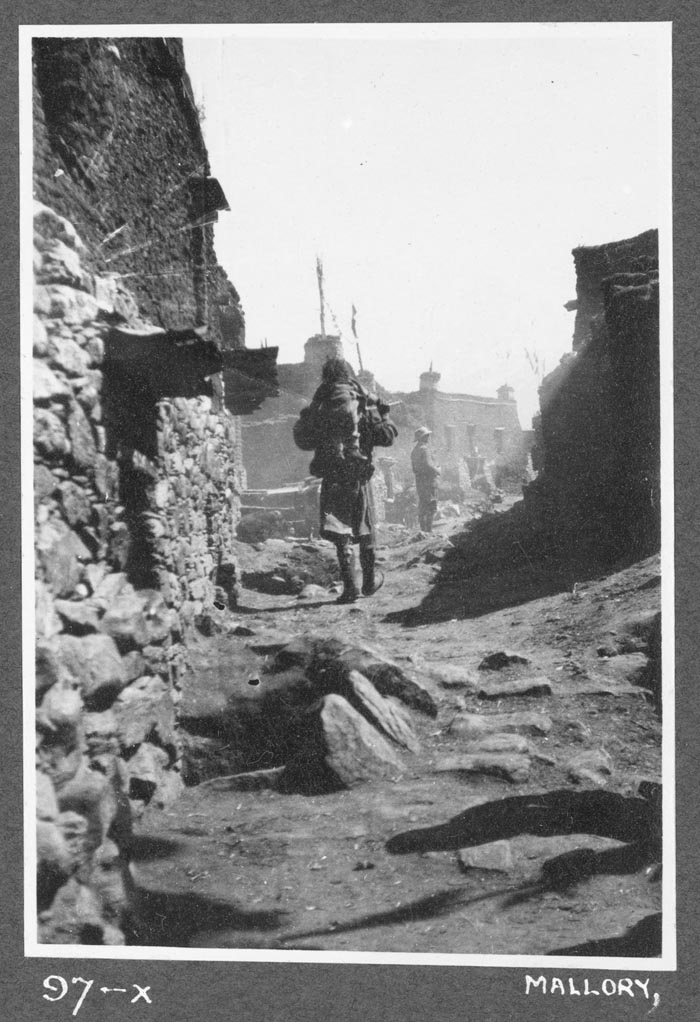
George Mallory in Tibet
I have been making up a list of visual archives. Here are three of my favorites. Bentley Beetham was a British traveler and photographer who got hooked on mountain climbing in the 1910s. His path converged with the Mount Everest Committee in the 1920s and led to his inclusion on the 1924 Everest Expedition. Mallory never returned from the mountain, but Beetham did, bringing with him hundreds of photographs of the mountains, climbers, and Tibetan life. The Bentley Beetham Collection offers 2000 of his works, a combination of brilliant lantern slides and photo prints.
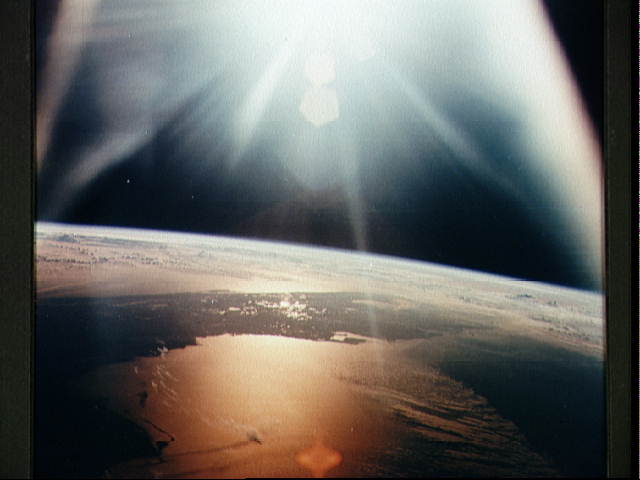
Morning in Orbit, Apollo 7, JSC Digital Image Collection
NASA gets beat up a lot here at Time to Eat the Dogs. As much as I complain about its policies, though, I admit to some weak-knee moments when I see images of the Saturn V hurling itself into space. The NASA Johnson Space Center has archived nine thousand images of the manned space program online on the JSC Digital Image Collection. It represents half a century of human missions, from Mercury to the Space Shuttle.
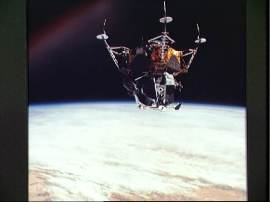
Test driving the lunar Lander in Earth orbit, Apollo 9, JSC Digital Image Collection
BibliOdyessey is a digital cabinet of curiousities authored by the Australian “PK”. PK must be in good with the Sydney archivists. Not only has he gotten some serious archive time, he’s also managed to bring his hi-def scanner along with him. BibliOdyessey offers stunning scans of the amazing, the obscure, and the bizarre. These are usually good tags for voyages of exploration – which are also well represented here.
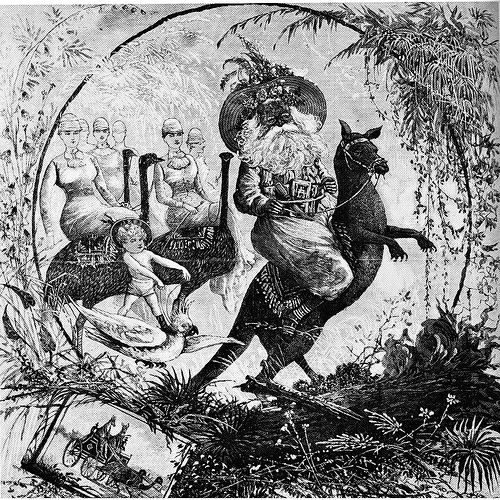
"Christmas in the Colonies," Illustrated Sydney News, 1882, BibliOdyssey
I’ll be on the road for the next few weeks updating when I can. Happy Voyages.
Digital Archive: The Joseph Dalton Hooker Website

Joseph Dalton Hooker: not your average armchair naturalist
Of Victorian England’s perambulating naturalists, Charles Darwin is the most celebrated. But he was only one of many, a throng of young men and women who left British shores for places unknown including Joseph Banks, Alfred Russell Wallace, Thomas Huxley, Mary Kingsley, and Henry Walter Bates. These were not foppish lads and doe-eyed ingénues on vacation. They followed new, dangerous itineraries: into the Pacific and Polar Regions, the interiors of South America and Africa, and the islands and archipelagos of the Indian Ocean. This was not some logical extension of the European Grand Tour; these men and women sought to bring home information that would shape science, and, no doubt, further their careers.

Sketch of a Himalayan Rhododendron by Joseph Dalton Hooker
One of the most important of these ranks was Joseph Dalton Hooker, doctor, naval surgeon, mountain climber, and botanist. Hooker traveled to the Antarctic with James Ross, dug for fossils in Wales, and tromped up the Himalayas in search of botanical specimens (interested in, among other things, testing Darwin’s theories of biogeography and isolation).
If this whets your appetite, check out Jim Endersby’s Joseph Dalton Hooker Website, a nicely designed site with biographical pages, extensive extracts of Hooker’s writings, and a list of collectors who helped him in the field. If this is not enough for the obsessive-compulsive Hookerologist in you, Endersby has also provided a list of archives and secondary literature on Hooker to keep you occupied until the bicentennial of Hooker’s birth in 2017.
Enjoy!
http://www.jdhooker.org.uk/index.htm
For more on Hooker, see Michael Barton’s post as well as Brian Switek’s.


 Time to Eat the Dogs