Time to Eat the Dogs
A Podcast About Science, History, and ExplorationArchive for Explorers
The Gertrude Bell Archive
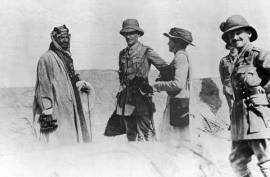 Gertrude Bell and Sir Percy Cox, Mesopotamia, 1917
My students are usually pretty good at the why questions of history. Why did the French revolt against their King? Answers include “Peasant frustration.” “Anger at the monarchy.” “Expensive bread.” It’s the when questions that cause students trouble. Why did the French revolt in 1789? What particularities of this historical moment led to the great unraveling of the French Monarchy?
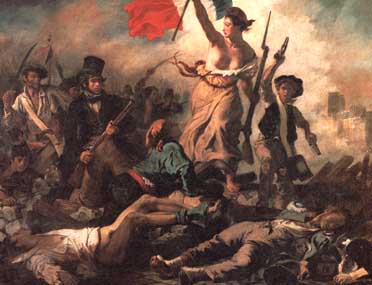
La Liberté guidant le peuple, Eugène Delacroix, 1830
This pattern holds true for discussing women in history, or more specifically, the actions of women travelers and explorers. Why did Annie Peck climb the Matterhorn (1895)? Or Fanny Bullock Workman the Himalayas (1899-1912)? Why did Mary Kingsley canoe her way up the Ogawe River in Africa (1895)? Or Nelly Bly circle the globe in 72 days (1889)? Student answers usually come in some variety of “They had to prove something to the world.” Ok, fair enough. But here is the more interesting question: Why did they all feel the need to prove it at the same time?
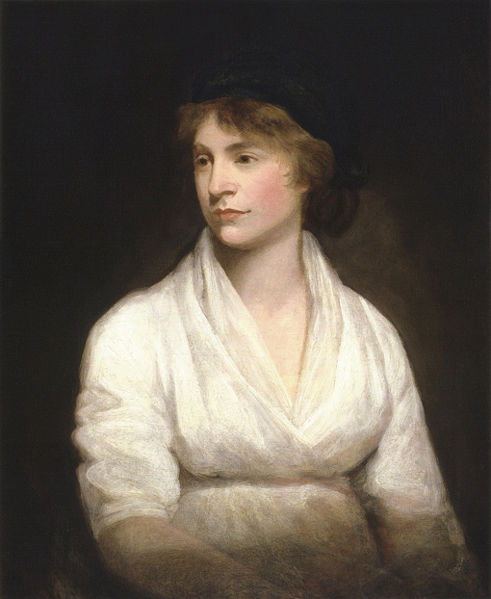
Mary Wollstonecraft, by John Opie, 1797
Mary Wollstonecraft certainly felt she had something to prove. Enlightenment novelist and historian, philosopher and feminist, Wollstonecraft authored A Vindication of the Rights of Woman a full 136 years before Britain fully granted women the right to vote in 1928. But living at the end of the 18th century, Wollstonecraft is something of an outlier in women’s history, a person whose beliefs and actions were at considerable remove from the rest of society. Peck, Workman, and Bly, by contrast, were part of a large social movement that extended across the Atlantic, a movement that gleefully assaulted the idea of a “separate spheres” for men and women.
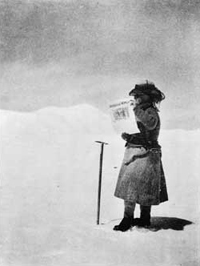
Fanny Bullock Workman holding up "Votes for Women" sign at 21,000 ft
In this sense, Gertrude Bell was a women of her time: born in Britain, Oxford educated, Bell was an omnivorous learner and traveler, fluent in Persian, Arabic, Turkish, and German. She voyaged around the world twice and took up a passion for mountain climbing in the Alps all before “settling down” in the Middle East as archeologist, author, and British political agent during the First World War. She collaborated with T.E. Lawrence to draw up the modern political map of the Middle East including Jordan and Iraq. Yet Bell remains hard to categorize. Sitting at the center of British political activity in the Middle East, Bell also served as honorary secretary of the British Women’s Anti-Suffrage League.
Bell left 1600 letters, 16 diaries, and 7000 photographs, all of which are in the possession of the University of Newcastle upon Tyne. Now the University Library has begun a four-year project to put these materials online. Here for example is Bell’s description of her ascent of the Aiguille du Géant in the Alps:
Demarquille was frozen. I gave him my big woollen gloves. My hands were warmed by the rock work, but I continued to shiver, though not unpleasantly, almost until we returned to the foot of the Aiguille. We crossed a bit of snow and turned to the left under the Aiguille where we found a hanging rope – it was just about here that a guide was killed a fortnight ago by lightening, after having accomplished the ascent by a new road up the N face said to be easier than the old. The first hour or so was quite easy. Straight up long slabs of rock with a fixed rope to hold by. Then a flank march which was rather difficult; the rocks from here to the top of the NE summit are extremely steep. At one point my hands and arms were so tired that I lost all grip in them. A steep bit down, a pointed breche and a very steep up rock leads to the highest summit where there is a cairn.
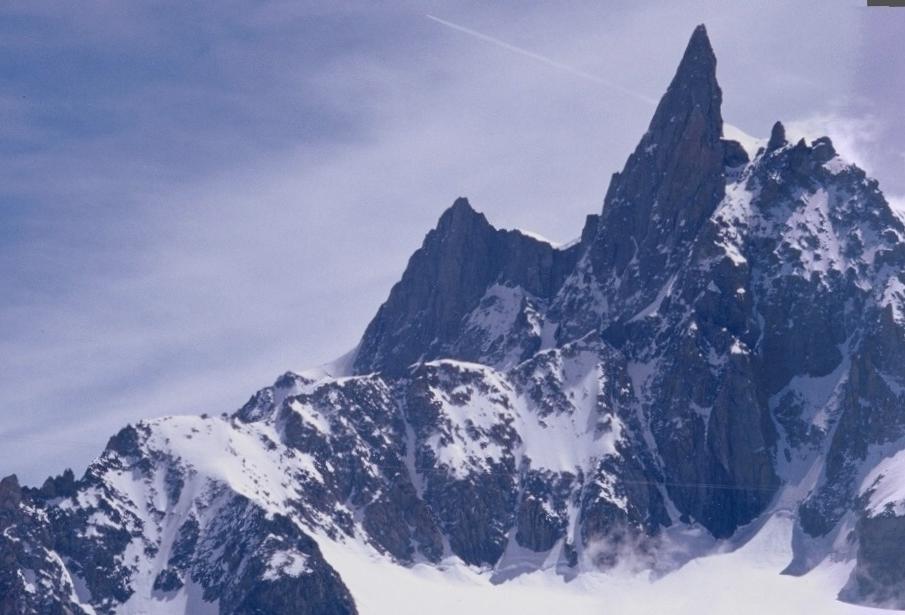
Aiguille du Géant
The Gertrude Bell Archive is a work in progress. Not all of the materials have been scanned. It does not have keyword or full-text search capabilities. Still it deserves to be filed as a bookmark in your growing list of exploration archives.
For more on women explorers, see posts on
Digital Archive: Conrad Martens
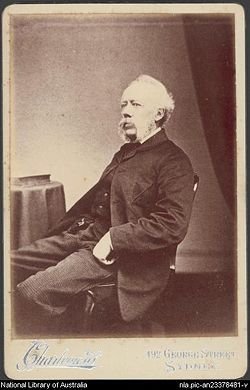
Conrad Martens
Before I starting working on the frost-bitten, scurvy-riddled, dog-eating world of Arctic explorers, I researched more inviting places, such as Valparaiso Chile, “the Vale of Paradise.” In the 19th century, Valparaiso was a popular port for European and North American voyagers, a place for crew to load up on provisions, repair hullwork, mend sails, and dive into debauchery before the long sail across the Pacific.
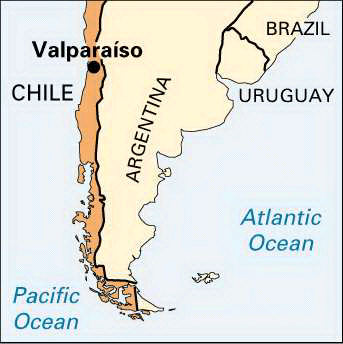
The U.S Exploring Expedition stopped here, as did the U.S. Astronomical Expedition, and even HMS Beagle, disembarcking a sprightly young, recently-graduated Charles Darwin into town for some quick surveys of the Cordilleras before heading out into the Pacific (with a minor port-of-call in the Galapagos on the way). My masters thesis “Describing the Vale of Paradise: Valparaiso Chile in the Years after Humboldt” looked at the way these various scientific expeditions talked about Valparaiso, and more importantly, how they rendered it in images.
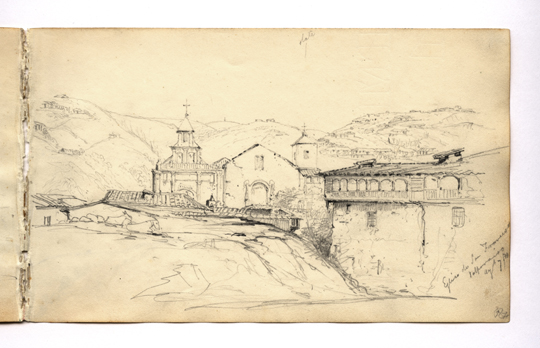
Eglise de San Francisco, Valparaiso Chile, Conrad Martens, 1834
Darwin did not leave much in the way of illustrations of the town, but the Beagle’s draughtsman, Conrad Martens did. Martens’ landscapes are quiet, almost languid, places, a world apart from the pulse-pounding wind-swept, volcano-erupting landscapes of his fellow Romantics. As I sat in the stacks of the Wisconsin Historical Society looking at these far away places, they gave me a feeling of Darwin’s world…an imperfect impression to be sure, but a feeling nevertheless. Thanks again to the Beagle Project Blog, great conduit of all things Darwin, I have learned that Martens work is now available for all to see at the Cambridge University Library’s website. They have scanned two of the four extant Martens sketchbooks made from the voyage. They include, be still my heart, lovely Valparaiso.
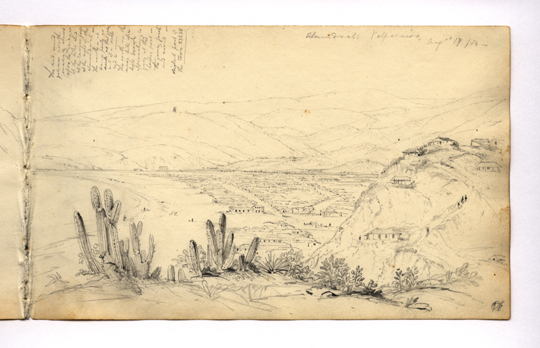
View of Valparaiso from the Bluffs, Conrad Martens, 1834
Digital Archive: James Cook
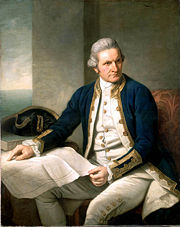
Captain James Cook
In his book New Lands, New Men, William Goetzmann describes the 18th and 19th centuries as the “Second Age of Discovery.” The First Age of Discovery, kicked off by the Mediterranean powers of the 15th century, developed maritime routes to Africa, Asia and the Americas. Best known of these early discoverers is Christopher Columbus who sought to extend Spanish dominion, proselytize natives, and bring home piles of loot, objectives followed by his 16th and 17th century successors.
By the 18th century, however, the goals of exploration had changed. Empire and commerce still had their place in voyages of discovery, but they increasingly made room for other, secular objectives such as natural history, ethnography, and natural philosophy, changes that reflected new attitudes about knowledge and learning back home in Europe.
Captain James Cook, who led three expeditions to the Pacific in the 1760s and 1770s, became the poster-child of Enlightenment voyaging. Of modest birth and education, Cook was not himself a philosopher of nature. But his command of three discovery expeditions – to study the transit of Venus, discover the extent of the Antarctic continent, and investigate the possibility of a Northwest Passage – set the benchmark for scientific expeditions to come over the next century. Cook’s chronicles and those of his men of science (Joseph Banks and Johann Forster) provided models for the expeditions of Jean-Francois de la Perouse (France), Alessandro Malaspina (Spain), and Charles Wilkes (United States) among others.
Cook’s serendipitous discovery of the Hawaiian Islands in 1778 (which he named the Sandwich Islands) was also, ultimately, the cause of his demise. After a series of quarrels with Hawaiians of the Big Island, Cook was killed in a skirmish with islanders on the beach of Kealakekua Bay.
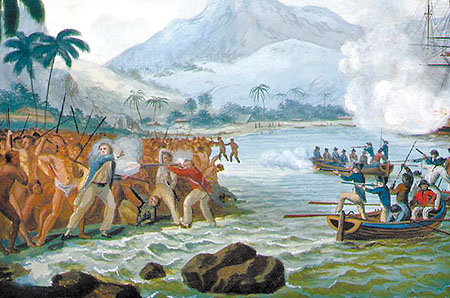
The Death of Cook
The National Library of Australia and the Center for Cross-Cultural Research have developed an impressive website on Cook’s legacy, South Seas: Voyaging and Cross-Cultural Encounters in the Pacific. Focusing on Cook’s first voyage, South Seas offers accounts from Cook, Joseph Banks, Sydney Parkinson, and John Hawkesworth. A world map of Cook’s route allows the viewer to zoom in features of interest, identifying the dates of Cook’s passage, landfalls, as well as diary entries for dates mentioned. A set of four “Cultural Atlases” offer maps and descriptions of the native peoples which Cook visited in Tierra Del Fuego, the Society Islands, Botany Bay, and Endeavour River. South Seas also offers some indigenous histories and European reactions to Cook’s voyage.
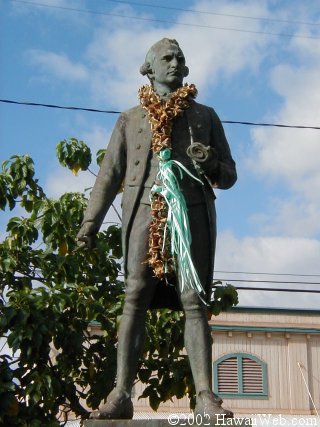
Cook welcomes visitors to Waimea, West Kauai
There are a few “links to nowhere” on South Seas. Perhaps the project ran out of funding before it was fully completed. But even in its unfinished form, there are gems here for the student of Enlightenment voyaging.
Also on Cook see:
The Mariner Museum’s Age of Exploration
The Historical Record of New South Wales on Google Books
Many of the full text books on South Seas are also available on Google Books for viewing or download
The Coldest Crucible: Web Simulcast
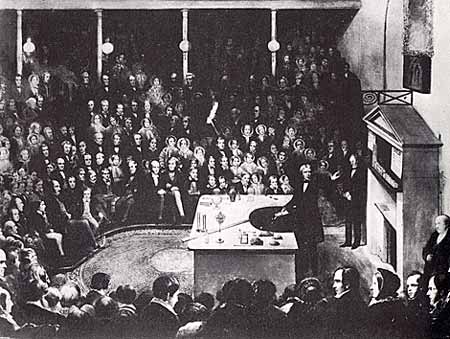
I’m at the University of Delaware this week to give some lectures related to my book, The Coldest Crucible. My Wednesday night talk will be simulcast on the web (and on Second Life, a world I have never visited). The lecture starts at 7:30 EST and goes for about an hour. I think the webcast will be archived if you have something more pressing to attend to at 7:30 like open heart surgery. For everyone else, I expect to see you there. Wish me luck!
Women Explorers
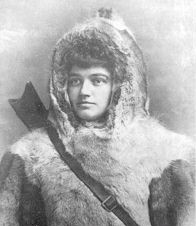
Josephine Peary
At one time returning explorers could expect a hearty welcome back home: good press, medals of honor, product endorsements, and lecture halls filled to capacity. Times have changed. Since the late nineteenth century, the press and public have been tougher on explorers, challenging their missions, their claims of discovery, and their behavior in the field.
Certainly there are still moments when the public’s knees get wobbly: the orbital flights of Yuri Gagarin and John Glenn and Armstrong’s touchdown on the moon. But even national pride cannot quite extinguish the feeling that we are watching some kind of carnival attraction, that things are not what they seem, that the dog-faced boy will reveal himself to be a carny in make-up.
The proof? It’s not just lemon-faced academics who are writing skeptically about travelers and explorers. Critics now come at the subject from all sides. Adventure writers such as Jon Krackauer psychoanalyze the ethos of the “go it alone” explorer in books like Into the Wild while explorers themselves hurl slings and arrows at each other on ExplorersWeb. Reading one of the glibby heroic biographies of Robert Peary or Elisha Kane is a bit like drinking coffee with lots of syrup: too sweet, no bite.
The Nineteenth-Century Explorer Narrative
Still there are areas where criticism remains muted or under-reported, where one can read heroic narratives of old and ignore for a while the nattering nabobs of negativism. Mostly I see this in books on women and indigenous explorers.
It’s understandable. For hundreds of years, women and native peoples were routinely written out of explorer narratives. When they managed to make it in, they were usually playing set characters that readers would understand: the women who travel in the footsteps of intrepid husbands, the noble savages and their thievish brethren, all of them children of one sort or another. No surprise that as social mores have changed, we see attempts to bring these two-dimensional characters to life. In the past twenty years, there have been scores of books on women explorers alone. The Boston Public Library’s list of “Adventurous Women: Explorers and Travelers” gives a taste of this literature. Indeed, the fact that the BPL felt compelled to create this list for its patrons says something about popular demand.
Many books on women explorers hew closely to the heroic model of biography that was popular in the nineteenth century. Of her choice of subjects for the book Women of Discovery, author Milbry Polk said:
So in the end, we chose about 84 women that covered 2,000 years of history, more than a dozen different nationalities. And their endeavors crossed a wide swath of interests from every kind of science to our geography and painting. And, honestly, we chose most of them because we really liked them.
I don’t think that there’s anything wrong with an author liking his or her subjects, as long as it doesn’t interfere with reporting the less noble aspects of the subject’s actions. Many women explorers, often white, well-educated, and upper-class, were just as racist and vain-glorious as their male counterparts (Josephine Peary comes to mind here). A number of them did not rail against “sexism,” in our parlance, but accepted the conventional attitude that men and women were inherently different. Indeed, one of the most fascinating aspects of women travelers is the degree to which they were able to turn these conventional attitudes to their own advantage. For example, Americans were transfixed by Nelly Bly’s bid to travel around the world in eighty days . . . not because she aspired to be look or act as tough as the boys but because she seemed so, well, girly.
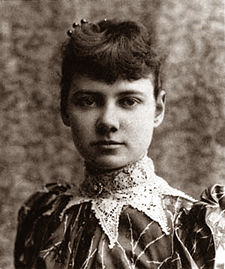
Nellie Bly, 1890
This does not take away from the impressiveness of her accomplishments or others. Indeed, it makes the story of these women all the more interesting. More often than not, they did not buck a system of rigid gender roles…rather they used the system to make a space for themselves. Certainly this was not the exclusive strategy of women explorers. Frances Willard, Jane Addams, and other women of consequence did the same.
So I think it’s a shame that many biographies play up the idea of heroic women overcoming adversity through sheer strength of will. It’s a simplistic story that doesn’t do them justice. As a result, these books read very much like nineteenth-century biographies of their male counterparts.
Not that all work on women explorers fits into this category. In her account of Mary Kingsley, British explorer of West Africa, Alison Blunt warns of the dangers of placing women travelers on pedestals. Says Blunt:
Recent interest in white women in colonial settings has often taken the form of romantic, nostalgic imagery in literature, television, and film, notably since the 1980s…These approaches isolate and often celebrate individual “heroic” women rather than question constructions of gender… [Travel, Gender, and Imperialism: Mary Kingsley in West Africa, 5-6]
So where do we turn for good work on women and non-white explorers? Here’s a short list of favorites. Patricia Erikson’s current work on Josephine Peary promises a new, nuanced take on this controversial and complicated explorer. Dierdre Stam’s work on Matthew Henson also will provide some balance and context to the U.S.’s most famous African-American explorer. These are works in progress, so in the interim, you might want to read these:
Patricia M.E. Lorcin’s essay on women’s travel writing which offers a good overview of the field as well as some great secondary sources.
Patricia Gilmartin’s excellent essay on women and exploration in the Oxford Companion to World Exploration (which I reviewed here). Also see Gilmartin’s website for a more complete bibliography of her work.
Lisa Bloom’s controversial, pathbreaking book Gender On Ice which discusses the gender construction of Arctic narratives in the 19th and 20th centuries.
Carla Ulloa Inostroza’s excellent blog on the history of women’s travel Mujeres Viajeras
Laura Kay’s course reading list at Barnard.
If all of this gets a bit wonky for you, head over to the Victorian Women Writers Project where you can read the chronicles of Isabella Bird as she travels through the Rocky Mountains and the islands of Hawaii in the 1870s.
Also see my posts AfricaBib on women travelers and the Gertrude Bell Archive


 Time to Eat the Dogs