Time to Eat the Dogs
A Podcast About Science, History, and ExplorationArchive for May, 2008
Digital Archive: The U.S. Exploring Expedition
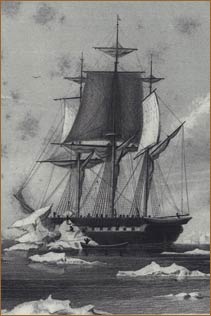
Which is the most significant expedition in U.S. history? I would put my money on the U.S. Exploring Expedition (1838-42). Today Lewis and Clark get most of the attention for their impressive trek to the Pacific in 1804. Yet they were not very well known in the 19th century and did not leave much of an impact on scientists or the general public. But the U.S. Ex Ex, as it came to be known, helped shape American exploration for the rest of the century. As America’s first international discovery expedition, it was a way to show the world that the United States had come of age as a civilized nation. Where the government had frowned upon all but the most practical goals in exploring the west, it proved more indulgent of scholarly objectives in exploring the world. It was not that the government placed greater significance on the geography outside its borders. Rather, it was that the wider world offered a more prestigious stage for explorers than the American West, a place where their actions would be more keenly noticed. Under such scrutiny, U.S. expeditions put on their best face, sailing with corps of “scientifics” to advance geographical knowledge, and in the process, to persuade other nations that the United States was more than a republic of untutored farmers. In short, pursuit of knowledge gave U.S. expeditions symbolic heft. It ushered the United States into an enlightenment tradition of imperial voyaging and – its organizers hoped – into the ranks of civilized nations. Back home, the collections of the US Ex Ex became the basis of the Smithsonian Institution when it opened under the direction of Joseph Henry. Read the rest of this entry »
Book Review: The Making of John Ledyard
Edward G. Gray, The Making of John Ledyard: Empire and Ambition in the Life of an Early American Travel (New Haven: Yale University Press, 2007)
John Ledyard, America’s first man of the world, spent most of his time in motion: outrunning debtors, impressing patrons, exploring the unknown. It was a kinetic approach passed on to him by his father, who captained vessels in the West Indies trade in the mid-1700s. Young Ledyard would also take to the sea, serving as a sailor on commercial ships bound for Europe. Read the rest of this entry »
Popular vs Academic History


Dan Todman, British cultural historian, writes in Trench Fever that an increasing number of popular, poorly researched, histories have come out recently. Shoddy works not only dupe the public – but make it more difficult for serious researchers to get their work published. Read the rest of this entry »
The Escape from Civilization?
“The true spirit of the explorer is a primordial restlessness” wrote Robert Dunn in The Shameless Diary of an Explorer in 1907. Explorers were “men with the masks of civilization torn off.” This is an image of the explorer that has continued to resonate with us today: the go-it-alone explorer who seeks to escape the artifices and contrivances of modern life. Yet Dunn’s escape from civilization never took him so far away from the modern world that he would be unable to capitalize on his success back home. Dunn quickly published an account of his journey (in this case, a failed attempt to scale Denali) on his return. In this, Dunn is not exceptional but representative: all of the major 19th and 20th century explorers were deeply connected to the modern world, even as they spoke about their great urge to escape it.


 Time to Eat the Dogs