Time to Eat the Dogs
A Podcast About Science, History, and ExplorationArchive for Expeditions
Columbus on the Green, Part Two
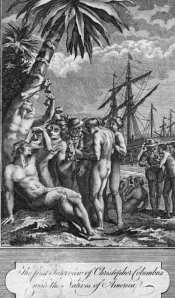 First Encounter: Columbus, Natives, and Lots of Bells
Columbus’s public image has changed many times over the past five hundred years. He was a figure well-known, if not well loved, by Americans in the Colonial Era, a name children memorized in school. The educated Brahman class of the Early Republic even threw him a party of sorts in 1792 to celebrate the three-hundredth anniversary of the discovery of the New World. But as the United States cleaved itself off from Great Britain, the nation sought out new stories that would distinguish it from mother England. In this environment, Columbus gained new popularity. Here was a figure that pre-dated British colonization of the New World, who was not British himself, yet who set the stage for the advancements by Euro-Americans in the centuries to come. This is the analysis of Claudia Bushman, author of the excellent book America Discovers Columbus: How an Italian Explorer Became an American Hero. Only in the late 19th century did Columbus become the superstar that he remains today, hurled aloft by the spectacle of the Chicago Columbian Exposition of 1892-3.
Even at the height of popularity, though, Columbus meant different things to different people. White Protestants viewed him as a man who brought Christianity to the New World, whereas Italians and Irish viewed him as the pioneer of Catholicism in America, the herald of their own immigration four hundred years later. Indeed, the years around the Columbian Exposition of 1893 saw the rise of what Bushman calls “Catholic Columbianism” a fierce pride in Catholicism and the American nation. Irish Catholics had tried to develop fraternal organizations around many famous figures and concepts. ( The Ancient Order of Foresters, formed by some Catholic parishioners, confused everyone and was quickly discarded as a title). In 1881, they struck upon the “Knights of Columbus” an organization that was fraternal, Catholic, filled with martial imagery, and avoided hot-button terms like “Irish” and “Italian” which might have put off other ethnic groups. Under this title, Catholic Columbianism flourished, gained broader credibility for its civic work, all the while pushing for increased recognition of Columbus as an “American” hero. By 1909, the K of C (among other groups) had helped establish Columbus Day as a state holiday in 10 states including Connecticut.
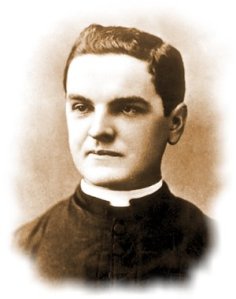 Father Michael J. McGivney, Founder of the Knights of Columbus
Bushman ends her discussion of Columbus in the early 20th century, showing how broadly popular he had become with many different groups. We fast forward to 1992 when the 500th anniversary of the discovery of the New World provokes a very mixed reaction, particularly from Native Americans. What I find interesting about the Lafayette-Columbus debate in Hartford is that it demonstrates that he remained a contested figure even after all of the pomp and circumstance of the Columbian Exposition and the efforts of the K of C, a flash-point of ethnic controversy. While I haven’t looked at the reception of other Columbus monuments outside of Hartford, I do know that one monument, the Columbus monument in New Haven, CT (headquarters of the K of C, no less), became the meeting ground for Italian Americans protesting the execution of Sacco and Vanzetti.
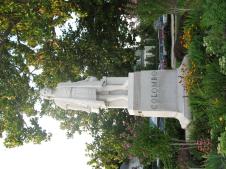 Columbus Monument, New Haven CT
These early twentieth century protests against Columbus had nothing to do with Native Americans, genocide, slavery etc. They seem to play out between different groups of ethnic Euro-Americans: those who immigrated earlier from Western Europe early vs. those Catholic immigrants who arrived from Ireland and Italy late.
I hope to have more on this story after I do some more digging.
Columbus on the Green
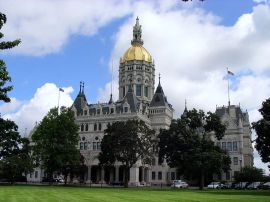
Connecticut State Capitol, Hartford CT
To drive into downtown Hartford is to drive back in time. Shopping malls and 7-11s give way to quiet brownstones, corniced Victorians, and brick factory buildings. Near the city’s center, the gold-domed State Capitol rises above the billboards of I-84. The Capitol is a fairy-tale structure, built in high Gothic Victorian, more at home in a novel by Bram Stoker than in “the Insurance Capital of the World.” Surrounding the Capitol are statues and commemorations of every kind, including Greek goddesses, Civil War cannons, busts of American writers, triumphal arches, and a squat, sword-wielding Confucius. A towering Marquis de Lafayette, mounted upon a stallion, always catches my eye as I drive past the Capitol towards the Hartford Public Library. He is trotting off to help Washington at Valley Forge. I am off to return overdue books.
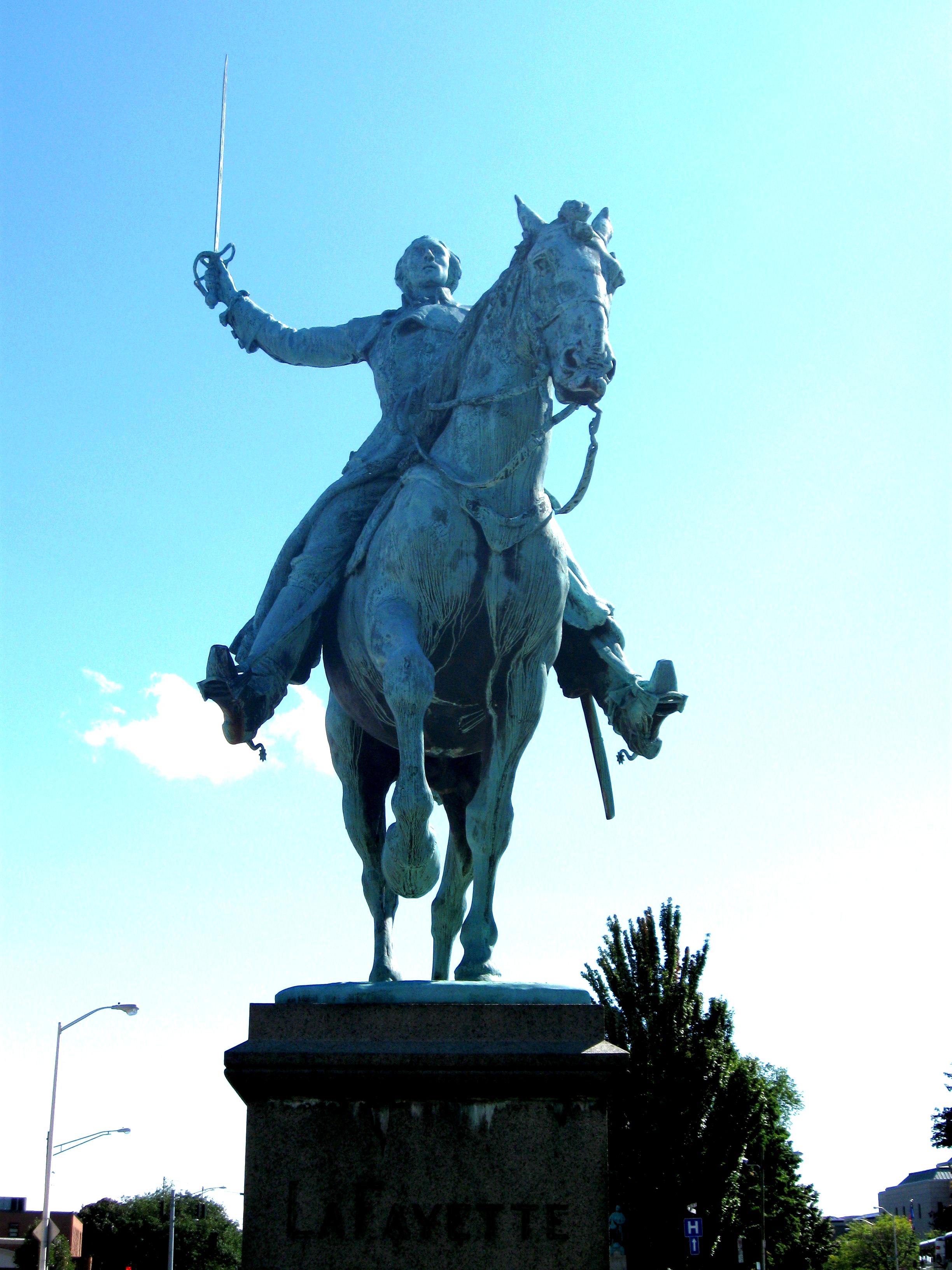
A bit further down the green, less than a block from the Marquis, stands another figure, an eleven-foot high Christopher Columbus, coppery-green, perched on a nine-foot marble pedestal.
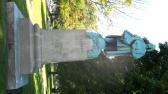
Looking at the statue, one imagines Columbus aboard the Santa Maria (a ship he disliked), clutching a nautical chart, gazing to his right, beyond Hispanola perhaps? But the Admiral needs to watch where he’s sailing. Just beyond the bowsprit, look out, Leviathan-Ho!
: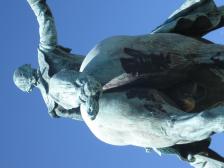
What were the city fathers thinking? They have set Columbus, discoverer of the New World, on a collision course with the soaring backside of Lafayette’s mount. Perhaps, I thought, Columbus’s remove from Lafayette made this visual insult hard to see. Clearly this had to have been an unintentional joke, the unwitting error of a middle-manager in the Parks Department, invisible to the good people of Hartford, obvious only to prurient-minded people like me. Still a joke is a joke and, seeing as this one involved Columbus, I wanted to know more.
The story of Lafayette and Columbus turns out to be a lot more complicated than I thought. Connecticut has at least seventeen monuments honoring Columbus. While the Chicago Columbian Exposition of 1893 was the biggest Columbus event ever organized (about 27 million people attended the fair, a number that equaled half the U.S. population), most of Connecticut’s monuments were built, with considerably less fanfare, in the twentieth century. The Chicago Fair, while nominally celebrating Columbus, was really a showcase of White Anglo Saxon Protestant achievement in the New World, a paean to American Exceptionalism.
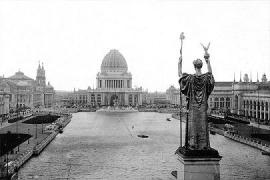
The Chicago Columbian Exposition of 1893. Not an Italian in sight.
By contrast, most of the Columbus monuments of the twentieth-century were built by Italian-American groups. One expects that the new ranks of Italian immigrants pouring into American cities, most of whom were working-class Catholics, did not endear themselves to members of the WASP ruling class. Nor did the Sacco-Vanzetti trial, which led to the execution of two Italian anarchists in 1927, do much to help relations between classes. Or, for that matter, the Italian Mafia, which catered to the thirstier citizens of the Prohibition Era.
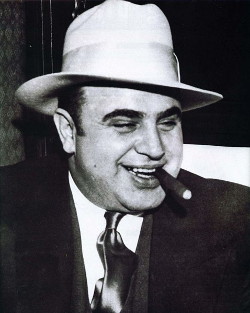
Al Capone, Mafia boss, has no statues in Connecticut.
In this climate, one imagines that monuments to Columbus offered the American public a subtle reminder of the greatness of Italian heritage. Tea-totaling Protestants may have held the reins of power in the U.S., but Italian-Americans wanted it made clear: the tower of Anglo-Saxon prosperity rested on the foundations laid by a Catholic, wine drinking sailor from Genoa.
In Hartford, the plan to commemorate Columbus started auspiciously enough. Italian-Americans raised $15,000 to put up their local Columbus on Lafayette Green, then unoccupied by any other statue. Columbus was unveiled on 12 October 1926 before a crowd of three thousand, accompanied by a two-mile parade, floats, and speeches by the mayor of Hartford, the Governor of Connecticut, congressmen, and the Italian vice-council. Prize for “best-looking girl float” (for the float, the girl?) went to the Yolando Club of Waterbury. All in all, it appeared to be a happy event, a win for the Italian community and the civic-minded citizens of Hartford.
This lasted about ten months. Problems began the following year when organizers of the Columbus monument sought to change the name of Lafayette Green to “Columbus Green” in time for the Columbus Day celebration of 1928. The Board of Aldermen, unsure of what to do, referred the issue to the Park Commissioners, who, in turn, referred the issue back to the Board.
Meanwhile, the forces of Lafayette had gathered to launch a counter-attack. The French-American Republican Club drafted a resolution condemning the name change. They were soon joined by a phalanx of societies including the Connecticut Society of the Colonial Dames of America, the Connecticut Historical Society, the Committee on Historic Sites, the Connecticut Society of the Sons of the American Revolution, the French Social Club, the Franco-American Foresters, and L’Association Canado-Americaine, all of whom protested The Great Admiral’s annexation of this small tuft of grass.
Katherine Day, Chairwoman of the Committee on Historic Sites, explained her opposition:
Why intrude Columbus on this area? Or, if so, why not the statues of Leif Ericson, Cabot and all the other brave explorers? … Should not our own soldiers and sailors and civil heroes have first place near the seat of our State life?
Day must have forgotten that Lafayette was a French aristocrat. As Hartford’s ethnic groups squared off against each other, the Board of Alderman quickly tabled the motion to change the name of the green. There matters stood until an Italian-American alderman raised the motion again in 1930.
A plan had been in the works for some time, at least five years, to erect a statue of Lafayette on the Green named after him but it had not moved forward for want of funds. Suddenly, after this second petition to change the name, an anonymous donor offered funds to complete the project. By 1932, Lafayette and his horse had found their new homes on the Green, showing their faces forever to the Capitol, and their backsides eternally to the Mariner of the Seas.
I had assumed that the monumental mooning of Columbus was unintentional. Now I’m not so sure.
Next Post: Columbus on the Green, Part II
Uncharted Waters: A Skeptic’s View of the latest search for the lost ships of Sir John Franklin
By Russell A. Potter
http://www.ric.edu/faculty/rpotter/sjfranklin.html
The news is currently making the rounds that another, bigger and better search for the lost ships of Sir John Franklin is being mounted by the Canadian government. There’s some historical irony here – since “bigger” and “better” were the very words used to underpin public confidence Franklin’s original expedition when it first sailed – and we all know how well that turned out. Nevertheless, there are some modest auguries of success with the present expedition, though nothing quite as grand as the press releases would suggest; even when looking for a needle in a haystack, there is something to be said for looking where others have not looked before, and having more people doing the looking.
The chief reason given for the launch of a new search at this time is historian Dorothy Eber’s account of fresh evidence from Inuit oral traditions, as well as the discoveries of modern-day Inuit themselves. Eber’s evidence, gathered together for her upcoming book Encounters on the Passage: Inuit Meet the Explorers (University of Toronto Press), is unusual in that most of it dates to the past forty years, a time when the oral traditions of the Inuit have been interrupted by resettlement, loss of language, and enormous changes in everyday life. True, the elders still preserve an enormous wealth of traditional knowledge, but when it comes to recollections of specific historical events, the continuity of that tradition has been severely compromised. The principal witnesses of the fate of the Franklin expedition, it should be recalled, were actually quite few in number – the party of three hunters who encountered a group of survivors at Washington Bay were the only ones to speak with the living – and many of the eyewitnesses were members of Inuit bands, such as the Utjulingmiut, whose members were already scattered and displaced when they spoke with John Rae at Repulse Bay in 1854. The echoes of that tradition, such as they are, are faint indeed, and in many instances in Eber’s book, it’s not quite clear which among these new accounts can actually be definitely identified as stories of Franklin’s party.
Almost all of the Inuit testimony agrees that one of Franklin’s ships was deliberately anchored, and her gangplank lowered, somewhere in the vicinity of Queen Maud Gulf, most likely on the western shores of the Adelaide Peninsula. This is the area where David C. Woodman, the foremost modern interpreter of the Inuit testimony, has been searching for years despite limited funds and resources. Through his labors areas near Kirkwall Island and O’Reilly Island, two sites which match the early Inuit stories, have been fairly exhaustively searched, but represent only a small percentage of the overall area associated with the Inuit tales. The present search will be led by Robert Grenier, lead archaeologist for Parks Canada, who caught the Franklin bug while working with Woodman. Initially a skeptic of Inuit testimony, Grenier was impressed by finds of sheet copper and other nineteenth-century relics at sites identified by Woodman as those in the Inuit stories.

Robert Grenier
He has now, apparently, linked these to tales recounted by one of Ebert’s informants, who believed that the remaining ship was in fact further west, in the vicinity of the Royal Geographical Society Islands. Unlike Woodman, who believes Inuit accounts of the ship having been deliberately anchored, Grenier says in his proposal that the ships may have drifted to this location, or run aground.

Prior northern surveys for the Franklin wreck - Blue (1997) and Brown (2000)
As suggestive as it is, the testimony about the RGS Islands site is one of several accounts in Eber’s book, others of which are quite different, and even mutually exclusive. Some even suggest that one of Franklin’s ships attempted to sail around the eastern shores of King William Island, the opposite of what has always been believed to be their route. These stories seem to be based not on sighting of ships, but of debris and cargo. A more likely explanation lies in a substantial amount of material tossed overboard by Roald Amundsen near this point in order to enable his ship the Gjøa to ride higher in the water, and thus navigate the shallows – but in the ice-floes of such a long tradition, keeping one story distinct from another is as treacherous as navigating a strait far narrower and more convoluted that that where these boxes of supplies were found. For a Franklin researcher such as myself, Eber’s book makes for fascinating reading, but as a guide for archaeological searches it may prove frustrating.
Another source of evidence has been provided by contemporary Inuit searchers, such as Gjoa Have resident Louie Kamookak. Kamookak, who some years ago led the crew of the St. Roch II expedition to human remains near the Todd Islets on the south coast of King William Island, is to be part of Grenier’s new search. The bones located by Kamookak, however, had actually been found many years previous; their location was known to Hall (although snow prevented him from seeing much), and the entire site was gone over by William Gibson in the 1931, who located and reburied some skeletal remains. Kamookak simply did the modern searchers the favor of reminding them of something they actually already knew. Of course it is vital to include Inuit in the search for an expedition that involved their ancestors, and in the recounting of the history of the Franklin era – but there’s not necessarily any special knowledge of this period among Inuit today. A coordinated search of all known Franklin sites and reports might be better begun in a research library than in the Arctic itself, at least if the findings of the past are not to be needlessly repeated.

Louie Kamookak
All of which illustrates the difficulty of using Inuit evidence to limit the area of one’s search – there are so many tales, so intertwined, that it’s nearly impossible to separate one sighting of “Kabloonas” from another. This is a difficulty which Grenier’s party may find slightly less daunting; with more resources to deploy, a wider area can be searched, and precise accuracy may be less important. The unusually good ice conditions these past few seasons have also opened up areas for searching by ship that were formerly rendered inaccessible by heavier coastal ice. If indeed, as the Inuit stories traced by Woodman recount, the lost vessel was at anchor, and sunk at its moorings in an area shallow enough that the tops of the masts were still above water, then there may be some hope that the hull of the vessel is largely intact, supposing it could be found.
And yet, if it is, it will be the preponderance of the Inuit testimony – and the courage of researchers such as Woodman in trusting it – rather than any new bit of information, that should be credited with the find. If you look back far enough, in fact, it’s really Charles Francis Hall who deserves the ultimate credit – for it was he, during a time when most Europeans and Americans discounted the word of the Inuit as the “vague babble of savages” (the phrase is Charles Dickens’s) who continued to collect, and to implicitly trust, the accounts of the Inuit people of the fate of Franklin’s men. In his tiny, folded “field notebooks” from the 1860’s – preserved at the Smithsonian Institution in Washington, D.C. – lie the original accounts, carefully translated by his faithful guide Tookoolito, upon which the hopes of present searchers most greatly depend.
Recommended Links:
The Fate of Franklin
http://www.ric.edu/faculty/rpotter/sjfranklin.html
David C. Woodman’s Search Pages (at my Franklin site): http://www.ric.edu/faculty/rpotter/woodman/mainpage.html
Inuit Testimony about Franklin, collected by Hall, Schwatka, and Rasmussen:
http://www.ric.edu/faculty/rpotter/inuittest.html
Robert Grenier’s original IPY Proposal for the new search
http://classic.ipy.org/development/eoi/proposal-details.php?id=330
The Birth of Exploration

When did exploration begin? A difficult question. If we consider exploration in its broadest sense as an activity that takes people to places they’ve never been before, then we have to start very early indeed. Evidence suggests that hominids left Africa in a series of migrations over millions of years. If we limit ourselves only to homo sapiens sapiens, we still have to go back 50,000 or 60,000 years, the time when many sorts of evidence suggest a small population of humans left Africa, probably without a road atlas.
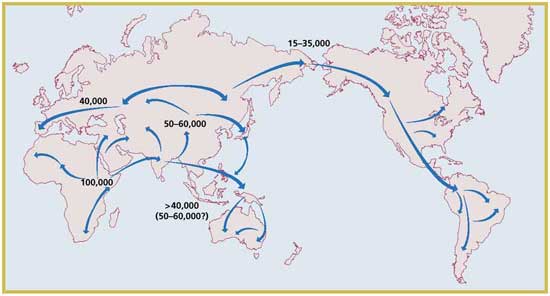
Out of Africa
But perhaps we should narrow our definition a bit. Most of us now think of exploration as something more than mere migration, something that includes a self-conscious pursuit of the unknown. If this is our definition, we need to start much later. How much later is hotly debated, perhaps as late as the 14th or 15th century CE.
Even this starting point has problems. First, many Renaissance explorers like Columbus were not primarily interested in discovery of unknown regions, but hoped to find new routes to known locations such as Cathay (China) and the Spice Islands (Indonesia). On this see my earlier post. Second, terms such as “explorer” were not yet used to describe people who set off in search of discovery. For all of their impressive nautical muscle-flexing, Columbus, Cabot, Hudson were viewed as “travelers,” and their voyages, “travels.”
By the 1800s, however, the umbrella of “travel” had become very large indeed. Not surprisingly, the idea of the traveler was also in flux, a category that had come to encompass every itinerant from Joseph Banks, science officer of the Endeavour, to British lads on vacation. As the concept of traveler lost definition in the eighteenth century, “explorer” entered the vernacular to delineate it, to distinguish the serious investigator of the unknown from more quotidian voyagers, the doe-eyed ingénues of the Grand Tour.
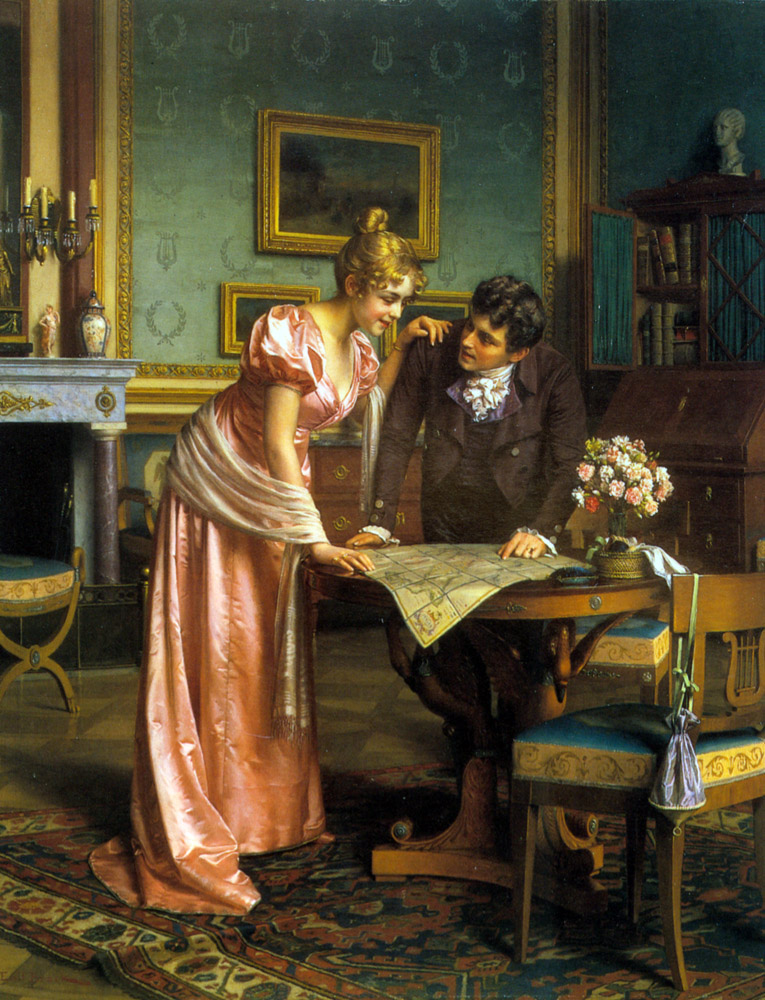
Planning the Grand Tour, Emil Brack
So we could start our study of modern exploration in 1800. A very judicious decision. Except that we would be basing this starting point on the use of words, “explorer” and “exploration,” rather than a shift in thinking or practices. This is not very satisfying either. Certainly ideas about mapping unknown regions have been around a long time, even if they were called something else.
In his excellent book The Beginnings of Western Science, David Lindberg identifies a parallel problem for the history of science. If words like “science” or “biology” constitute one’s starting point for modern science, then the historian begins her task quite late, in the nineteenth century. If she considers scientific ideas or methods to be the key, then the starting line could be pushed back into the early Renaissance. But even this date ignores the work of earlier scholars (naturalists or philosophers we might call them) who spent their lives trying to understand the functioning of nature deep into recorded history, say 600 BCE.
In short, no starting point is perfect. One thing is clear though; the relationship between exploration and travel is too strong to be ignored. It might sound easy to group them together, but for scholars of the voyage, this can be more difficult than it appears. The division that grew up between these concepts in the 19th century has also come to define a modern boundary of sorts. The subject of exploration attracts many scholars today, with historians probably represented in largest numbers. By comparison, the study of travel, particularly travel writing, has become a favorite subject of literary and cultural studies scholars. One sees this division in the academic journals and websites devoted to travel vs. scientific exploration.
So in the next few months I will be doing some exploring of my own, wading into the travel literature from the other side of the disciplinary fence. In the meantime, if you are interested, I’ve put up some links on travel writing.
Isis Review: Science in the Everyday World
For those who don’t read it regularly, Isis is an academic journal “devoted to the history of science and its cultural influences.” Isis has published some path-breaking work as well as some, well, path-clogging ones. My one, long-standing complaint is that Isis tends to be rather dull, best read with coffee, never before bed, always with a pencil. I don’t know if the dullness is the result of the writing, the editing, or some combination of both. I know and respect many of the Isis crew. (Full disclosure: I’ve served as an advisory editor to Isis since 2006). I like the decision to introduce a “Focus Section” for 3-4 short articles dealing with a particular topic. But there are times when reading Isis feels more like a chore than a pleasure.
Reading the June Issue
So with this in mind, I am grateful to Will Thomas, historian of science, for profiling Isis articles on his blog Ether Wave Propaganda. In this pursuit, he has become my intellectual trainer, forcing me to get up and run through the articles before I have to lie down and smoke a cigarette. As always, I feel better for the effort.
I just finished reading Katherine Pandora and Karen Rader’s article “Science in the Everyday World” which considers the relationship between scientists and the general public. To summarize Pandora and Rader’s points: professional scientists have become closed off from the general public and its conceptions of science. As a result, these two communities do not engage each other very well, to the detriment of both. Historians of science used to side with professionals on this, seeing “real science” as stuff that happened in labs and research institutes, carried out by card-carrying scientists. As for the public, they received scientific information after the fact, in diluted form. In effect, this presented a “trickle-down theory” of science that posited doers (scientists) and receivers (everyone else). This is often called the “diffusionist theory” of scientific ideas.
In recent years, however, historians of science have begun to broaden their view of what constitutes science, now including ideas and activities that occur in the public sphere. As such, Pandora and Rader believe that historians of science are in an excellent position to help bridge the divide that has grown up between the scientific community and the public at large. Estranged by years of miscommunication, science and public can be brought back together, with historians of science acting as marriage counselors.
Together Again
I had trouble with this article.
First, I think Pandora and Rader paint scientists with a pretty broad brush here. Overall, scientists come across as out of touch, oblivious and/or unconcerned about public reactions, viewing them at times as “childish, shallow, superficial, emotional, irrational, and subjective.” The solution? “Laboratory specialists could better communicate the key ideas of their research with their publics if they attended…carefully to the relationship between form and content in their public interventions.” Maybe this is the sense one gets reading Transactions in Physical Science, but I get a very different feeling about the views of scientists when reading science blogs. Consider, for example, the blog The World’s Fair, which is a collaboration of scientists and historians of science. Or science blogs such as The Beagle Project or Laelaps who are run by scientists committed to public engagement. When one looks at the network of scientists and humanities people who are citing each other and cross listing each other on blog rolls, it becomes harder to think of these groups as two balkanized communities.
Second, Pandora and Rader talk the talk of “two-way” science, but don’t walk the walk. They certainly challenge the diffusionist model of science, stating that scientists need to take the public seriously. But why? Not because it would influence the content of their scientific findings, but because scientists run the risk of alienating the public on which their work ultimately depends. Also, its their civic duty. “If scientists ignore the arguments to be found there [in popular culture], they exacerbate a sense of disenfranchisement on the part of the public in regards to science.” At no point do Pandora and Rader give examples of how the content of scientists’ work might affected by taking the public seriously. While the authors promote the idea of diologue and collaboration, it seems to stop short at shaping the content of science.
Finally, I think that the article is a little late out of the gate. Pandora and Rader give due credit to historians of Victorian science for figuring out that science in the public is significant. But the “big-tent” view of science is now widely shared and has spread far beyond Victorian studies. Thinking of the work being done by my science historian pals (in German biology, twentieth century space science, British geography, or my own field of exploration) I am hard pressed to think of projects that don’t consider the public as an active agent in the story of science.
Jogging finished. Time to lie down.


