Time to Eat the Dogs
A Podcast About Science, History, and ExplorationArchive for Expeditions
New With Age

The XX
I downloaded the album XX this morning from Itunes. I’d heard bits and pieces of it over the past few months as it trickled through the estuaries of popular culture into my living room: AT&T commercials, HBO shows, and finally an interview with the lead singers Romy Croft and Oliver Sim on National Public Radio.
The shy, breathy duets of Croft and Sim sounded to me like Everything But the Girl. Lead guitarist Baria Querishi’s spare treble notes brought memories of New Order, the Cure, and Roxy Music. The XX looked new, but they sounded old, twenty-somethings channeling the spirits of the Second British Invasion. I felt conflicted at the end of it all: the music compelled attention, but at the same time, seemed derivative.

The Cure
“Derivative” cuts deep, worse perhaps than “awful.” After all, there are gentler explanations for awful. It could mean that an artist is pushing through too many conventions, going farther than an audience is willing to follow. In this sense, today’s awful holds the promise of being tomorrow’s brilliant. Derivative, however, lives without hope. It can only been seen as an attempt at novelty that has fallen short, a poorly disguised act of mimicry.
Or are there other explanations for derivative? Though I heard other bands playing through XX, the label derivative didn’t really match my experience of listening to it. I like the album. I found myself listening to it again. It was in my head as I left the house. I turned it on when I got back home. Would I really be so patient with an album that was a complete knock off?
At some unconscious level, then, the XX provided something new.
Seen with the dispassion of distance, of course, there is no such thing as new. Music, like any other human expression, is forged in the crucible of culture. It cannot escape the conditions of its creation – whether you want to call it borrowing, inspiring, or mimicking. Originality in this sense is a myth. Everything grows from a source. “Nothing comes from nothing” says Parmenides (and Fraulein Maria).
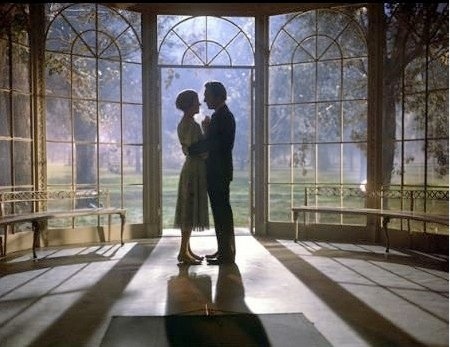
Yet maybe the label derivative is born out of our emotional experience, rather than rational analysis, of art. In this sense, the sounds of older influences within new music are not just a product of the artist’s cultural borrowing, but of our own psychological interpreting. Perhaps, in other words, we are not cognitively prepared to experience things as new. How did I first experience other artists? My first encounters almost always followed the same pattern. I heard the old influences first: other bands that inhabited new music. And I can generalize further. All of my new experiences – music, trips abroad, new foods – come with reminders, comparisons, analogies with the old – the already known.
This is a well-demarcated phenomenon, particularly in studies of exploration. Christopher Columbus had never been to Asia, yet found in America all of the things that he expected to see there: cinnamon, Amazons, anthropophagi, and the Great Khan. As Anthony Grafton pointed out in New Worlds, Ancient Texts: The Power of Tradition and the Shock of Discovery, the New World didn’t look so new to Europeans at first. Columbus went to his grave thinking he had reached Asia. Only over time, as the New World became old so to speak, did it come to be framed as new, as other, as disorienting. The XX began with an old soul. Now it seems fresh. Newness, like cheese, gets stronger with age.
Two Visions of Mars
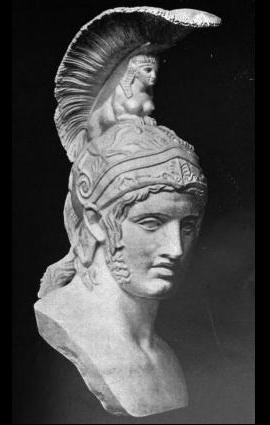
Here’s a teaser from an article I’m writing on Mars. It should be coming out soon. When I sell the rights to Sony Pictures, I’m going to ask that Russell Crowe play Mars. Is there any other logical choice?
Two Visions of Mars
Before he became the Roman god of war, Mars lived a quieter life as the protector of farms, crops, and animals. He was beloved by Romans as the father of Romulus; this made him the celestial father of the Roman people. Mars began to change as the Roman Empire changed. While farmers continued to look to him for protection, so did the imperial legions which left the Italian peninsula on expeditions of conquest.
In the first century BCE, therefore, Mars represented two things at once. He was the giver of life, the guardian of agriculture. He was also the blood-stained warrior, the defender of soldiers marching at the frontiers of the known world. While Romans may have been united in their love of Mars, they looked to him for different reasons.
Despite the change from god to planet, Mars continues to mean different things for different people. On one hand, it is an archive of the past, a planetary laboratory where scientists seek answers about the history of the solar system and the origins of life. On the other, it is the landscape of the future, the next human frontier, the first real step out of our planetary cradle.

In principle, these different visions of Mars – as science laboratory and human frontier – are complementary. On the science side, mission planners have long defended robotic expeditions for their value in paving the way for human exploration. Mariner, Viking, and Pathfinder all found justification as the trailblazers of human missions. Most recently, the Jet Propulsion Laboratory defended its uber-Rover, the Mars Scientific Laboratory, as a mission that will “prove techniques that will contribute to human landing systems”

Mars Scientific Laboratory photo credit: NASA
Advocates of human spaceflight also defend the compatibility of human exploration and science, often on the grounds that humans are more effective in doing science than remotely-operated probes. As Mars Society president Robert Zubrin declares, Martian science “is a job for humans” [Launius & McCurdy, Robots in Space, 21].

In practice, however, the divide over Mars runs deep. Many space scientists express growing frustration with human space flight, which they view as an expensive distraction from scientific exploration. Lower costs, improvements in computer design and miniaturization, and the proven durability of Martian probes have encouraged their faith in robotic science and made arguments for sending astronauts to Mars less compelling.
By contrast, many supporters of human missions to Mars believe that the focus on science and robotic exploration has become too narrow, ignoring the deeper meanings of exploration, its capacity to inspire people today, and shape the societies of tomorrow. For those looking to place boots on Mars, NASA seems to be drifting in a Sargasso Sea of underfunded programs and policy revisions, never able to chart its course for the New World….
The Discovery of HMS Investigator
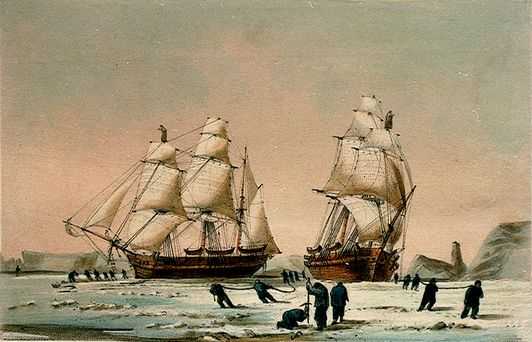
HMS Investigator
In 1845, Sir John Franklin and 128 men sailed into the Arctic aboard HMS Erebus and HMS Terror in search of the Northwest Passage. They were never heard from again. The mystery of the search for Franklin took decades to solve. Theories about the causes of the expedition’s demise continue to the present.
The irony of the Franklin expedition is that it accomplished more in failure than it ever could have in success. The disappearance of the party sparked dozens of relief expeditions from Britain and led to a comprehensive survey of the Canadian Arctic archipelago and its native peoples.
For the United States, which entered the search effort in 1850, the rescue of Franklin became the driving force for U.S. exploration of the Arctic, a 60-year effort that established the polar regions as next frontier after the American west.
Last week an expedition organized by Parks Canada found HMS Investigator which set out to find the Franklin party in 1850. In taking up the search for Investigator, Parks Canada made itself a part of the 150 year old legacy of the Franklin search. It also established a place in a much larger lost-explorer theme that became dominant in the 19th century as explorers set out to find other explorers who had gone missing.
Yet in his editorial about the discovery, Canadian Minister of the Environment Jim Prentice is eager to point the different, distinctly modern, uniquely Canadian elements of the Parks Canada search.

Jim Prentice, Canadian Minister of the Environment
First, it was done on the cheap:
This modern-day expedition was typically Canadian: quietly conceived and carried out on a modest budget from an unassuming cluster of 10 orange Mountain Equipment Co-op tents scattered on the rocky shore of Mercy Bay.
Second, the crew was quintessentially Canadian:
The senior marine archaeologist manning the sonar was Calgary-born Ryan Harris. Alongside him were archaeologists Jonathan Moore, who hails from Kingston, Ont., and Thierry Boyer of Montreal. Also present was soft-spoken John Lucas, a Canadian of Inuit ancestry and the senior Parks Canada officer for Aulavik National Park.
With some substitutions of names and technology, this statement sounds a lot like the patriotic boosterism of the British Admiralty or the American Geographical Society 150 years ago.
Ultimately Prentise’s interest in showing this effort as ‘exceptionally’ Canadian make it sound a lot like other efforts in 19th century frontier conquering. While their are the usual nods to the importance of archeology and the history of indigenous peoples, he ends his editorial on the subject that was of highest importance to the Great Powers in the late 1800s: territorial rights.
Most importantly, however, the quest for the Investigator celebrates our Arctic heritage and speaks to the exercise of our sovereignty in the Arctic Archipelago today.
Things change, things stay the same.
Most importantly, however, the quest for the Investigator celebrates our Arctic heritage and speaks to the exercise of our sovereignty in the Arctic Archipelago today.
Field Notes: Moscow
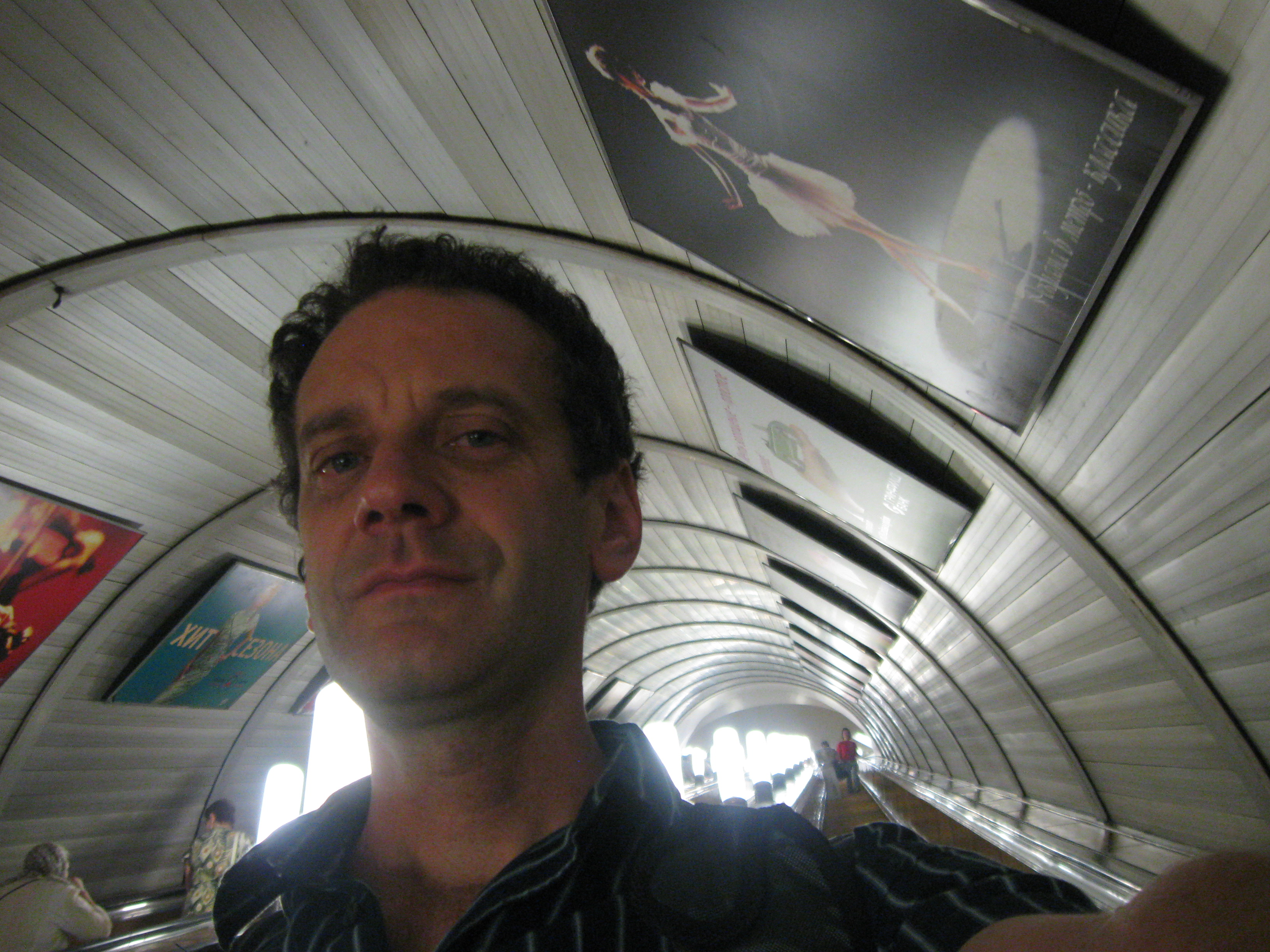
In the Moscow Metro
As someone who studies travel, and loves to travel, it still makes me feel self-conscious at times to BE a traveler. This is because the experience of travel rarely feels purely experiential to me: sensations of places, people, and things are always mediated by ideas of travel, by my awareness of the histories of exploration, contact, and encounter. In short, I rarely seem to find the “raw feed” of the travel experience. When it arrives, there is always a news ticker scrolling somewhere at the bottom of the screen.
I imagine that psychologists go through something like this when talking to their therapists. Does the shrink-on-the-couch recall her experiences as pure sensory feed, a chronicle of acts and feelings that follow in easy succession? I doubt it. She must be analyzing these acts as she recalls them, “shrinking” her own actions as she relates them to her therapist.

Chris McCandless
This is not unique. One does not have to be a historian of exploration or therapist to weave third-person narratives out of one’s first-person encounters. Chris McCandless, idealistic explorer of Jon Krakauer’s book Into the Wild, writes a journal about his travels as if they were happening to someone else, an else that McCandless even gives a name “Alex Supertramp.”
In this conscious creation of an alternate self, McCandless is tipping his hand: travel is not really the subject of his drama; it is merely the stage for self-discovery, a platform upon which he (Chris/Alex) acts the part of heroic protagonist and omniscient narrator. Not all travelers are so dramatically inclined, but it does lead us to a broader question: can we ever experience the journey as raw feed of new experience? Is it ever possible to turn the news ticker off really?
And if travel experiences are unavoidably hybrid and impure, jumbled together with ideas about places and our ideas about ourselves, why do they still manage to affect us so deeply? These were the questions that took hold of me in Moscow as I prepared for my journey to Naryan-Mar, a small Arctic city near the Barents Sea in a region known as the Nenets Autonomous Okrug (NAO). I was heading there for the Arctic Perspectives XXI Conference, an international, interdisciplinary gathering of scholars talking about about circumpolar issues in the far north.
By any literary measure, my 48 hours in Moscow were uneventful. I did not get arrested. I wasn’t poisoned or ransomed. I did not suffer from a temporary bout of amnesia. Nor did Moscow resemble the exotic communist fantasy of the Western imagination. The Moscow of 2010 is not Stalin’s Moscow or Gorbachev’s or even Yeltsin’s. It is a modern European capital ablaze with neon, populated by chic clubs and fast food restaurants.

House of the Embankment (Dom Naberezhnoy) during rush hour
And yet I found it amazingly, frighteningly, marvelously other. It was most dramatically other in language. I do not speak more than 50 words of Russian and can only slowly decipher Cyrillic script. But the experience of foreignness went deeper, attaching itself to little things rather than big ones. Circular outlets. Underground crosswalks. Conventions of dress. Codes of conduct in the metro. On the train. In the airport. In the cafe. These are the quotidian marvels that every traveler experiences, the state of being a stranger in a strange land.

Outlet in my hostel room
Yet however small, they are pervasive and all-encompassing. At one level, the traveler sees Moscow as the Muscovite sees it: a landscape of imperial edifices and perpetual motion. Yet for me, it was a landscape of little differences, some of them comprehensible, others not. Yet more affecting was the sense that these surface differences – in language, brand names, architectural style – were the thinnest film over a great well of difference lurking beyond the visible. Who do Russians watch at 11:30pm while Americans are watching the Late Show? When do they file their taxes? What are the Russian equivalents of the televangelist, the road trip, the visit to Burning Man? And if there are no equivalents, what are the Russian customs which defy cultural translation? What are the rhymes that parents sing to their children at night?
How can any traveler fathom the depths of such difference? How many years in Moscow would be required to apprehend it from the inside? And in this feeling of profound otherness, I suspect there is an answer – a partial answer at least – to the question of why we travel even as we are constantly trying to analyze and box what we experience. We adopt these analytical modes — seeing oneself as a character, comparing experiences with other events, recalling background literature — because the experience of difference would otherwise overwhelm us. They give some order – a shabby, imperfect order – to the flood of unfamiliar sights and sounds.
Even those of us who enjoy the vertigo of travel – this feeling of incomprehensible otherness – still need this crutch I think, a way of organizing what we see so we are capable of functioning. And perhaps it is more than just a crutch too. Because in rendering it in familiar terms, the travel experience becomes integrated into the world back home, a part of us despite its unfathomable nature.
Next post: Field Notes: Naryan-Mar
Prester John
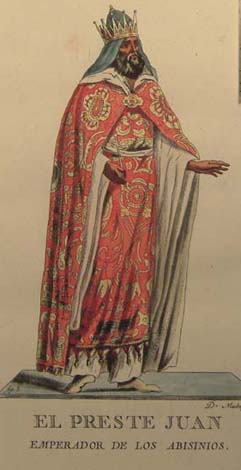
For Europeans in the 1450s, the Western Ocean (or the Atlantic as we now call it) was a frightening place. Unlike the cozy, well-mapped Mediterranean which was surrounded by three continents, the Western Ocean was unbounded, poorly understood, and filled with dangers.
The dangers were not the threat of sea monsters or falling off the edge of the world. Medieval sailors and geographers understood that the earth was spherical. (The idea that they thought it was flat is a fantasy conjured up by Washington Irving in his 1828 biography of Christopher Columbus.)
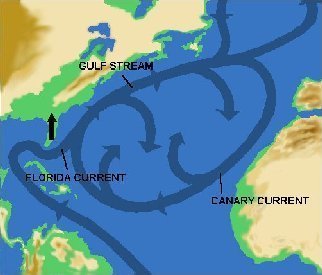
The Canary Current (part of the North Atlantic gyre)
Rather, the real threat was the ocean itself. Expeditions that followed the West African coast had revealed strong winds and currents that made travel south (with the current) easy, but return extremely difficult, especially with vessels that could not tack close to the wind. By the 1430s, Europeans had even identified a spot on the West African coast, Cape Bojador, as the point of no return.
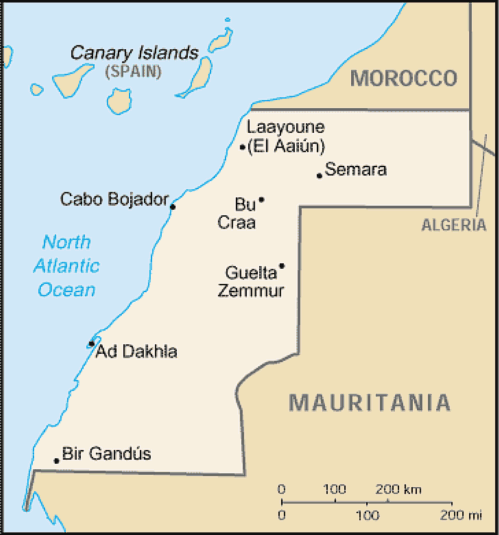
Cape Bojador, West African Coast
And yet Europeans, led by the Portuguese, continued to push further south despite this risk. They developed trade factories off the west coast of Africa which exchanged Europeans goods — horses, wool, iron — for gold, ivory, and slaves. And ultimately they followed the African coast around the Cape of Good Hope and into the Indian Ocean, reaching the Indies — the holy grail of luxury items — in 1498.
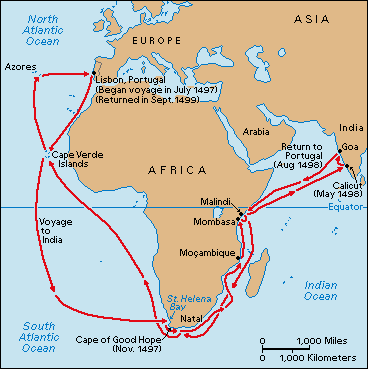
Route of Vasco da Gama, 1498
All of this makes European exploration seem logical and methodical, driven by the promise of riches. Yet Europeans were interested in more than slaves and spices. Africa attracted Europe’s attention because it was considered the most likely location of Prester John, legendary Christian king and potential ally in the fight against the Muslims who occupied the Holy Land.
Historians have long placed Prester John within the category of myth, and in so far as myths describe “traditional stories, usually concerning heroes or events, with or without a determinable basis of fact” I suppose Prester John qualifies.
But “myth” has subtler, darker meanings. The world is filled with traditional stories that have a tenuous relationship to observable facts: the Gospels, the Koran, and the Torah are filled with them. Yet we describe these stories as “beliefs” out of faith or respect. We usually reserve the word “myth,” however, for those stories — unicorns, leprechauns, a living Elvis — that we dismiss as untrue.
The point here is not to say that Prester John was real, but to say that in characterizing him as a mythic figure, historians have tended to discount his serious influence on European exploration and discovery.
This is a central argument of historian Michael Brooks in his excellent thesis, Prester John: A Reexamination and Compendium of the Mythical Figure Who Helped Spark European Expansion. Brooks shows that, while it might be clear in hindsight that Prester John was more fable than reality, it was not clear to Europeans in the 15th and 16th centuries, all of whom could point to multiple accounts of the Christian king from different, trustworthy sources. The Travels of Sir John Mandeville, one of the most popular books in late medieval Europe, even offers a first-hand account of Prester John’s palace:
He dwelleth commonly in the city of Susa. And there is his principal palace, that is so rich and so noble, that no man will trow it by estimation, but he had seen it. And above the chief tower of the palace be two round pommels of gold, and in everych of them be two carbuncles great and large, that shine full bright upon the night. And the principal gates of his palace be of precious stone that men clepe sardonyx, and the border and the bars be of ivory. [Mandeville quoted in Brooks, 87]
On the basis of these multiple, mutually supportive documents, Dom Henrique (Henry the Navigator) charged his explorers to bring back intelligence about the Indies and of the land of Prester John. This was not merely an addendum to their orders for geographical discovery. Argues Brooks:
Without the lure of making political connections with the supposed co-religionist Prester John in the struggle against the Islamic world, the European history of overseas expansions would likely have taken a different course [3].
This serious, sustained interest in Prester John helps explain the longevity of the legend well into the seventeenth century. I could not help seeing many similarities in Brooks’ account of Prester John with other stories of exploration. The one I have written the most about, the theory of the open polar sea, has also been discounted by historians as “myth” even though it was taken very seriously by scientists, explorers, and geographers in the nineteenth century, shaping the missions of numerous explorers.
Brooks’ thesis is available in pdf here.
He also posts a number of articles and reviews on history and exploration on his blog, historymike.


