Time to Eat the Dogs
A Podcast About Science, History, and ExplorationArchive for July, 2008
Digital Archive: The Joseph Dalton Hooker Website

Joseph Dalton Hooker: not your average armchair naturalist
Of Victorian England’s perambulating naturalists, Charles Darwin is the most celebrated. But he was only one of many, a throng of young men and women who left British shores for places unknown including Joseph Banks, Alfred Russell Wallace, Thomas Huxley, Mary Kingsley, and Henry Walter Bates. These were not foppish lads and doe-eyed ingénues on vacation. They followed new, dangerous itineraries: into the Pacific and Polar Regions, the interiors of South America and Africa, and the islands and archipelagos of the Indian Ocean. This was not some logical extension of the European Grand Tour; these men and women sought to bring home information that would shape science, and, no doubt, further their careers.

Sketch of a Himalayan Rhododendron by Joseph Dalton Hooker
One of the most important of these ranks was Joseph Dalton Hooker, doctor, naval surgeon, mountain climber, and botanist. Hooker traveled to the Antarctic with James Ross, dug for fossils in Wales, and tromped up the Himalayas in search of botanical specimens (interested in, among other things, testing Darwin’s theories of biogeography and isolation).
If this whets your appetite, check out Jim Endersby’s Joseph Dalton Hooker Website, a nicely designed site with biographical pages, extensive extracts of Hooker’s writings, and a list of collectors who helped him in the field. If this is not enough for the obsessive-compulsive Hookerologist in you, Endersby has also provided a list of archives and secondary literature on Hooker to keep you occupied until the bicentennial of Hooker’s birth in 2017.
Enjoy!
http://www.jdhooker.org.uk/index.htm
For more on Hooker, see Michael Barton’s post as well as Brian Switek’s.
The Problem with Scientific Exploration
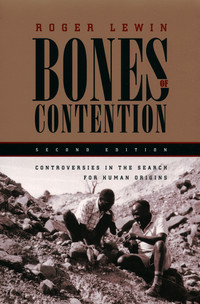
As I make my way through Roger Lewin’s book Bones of Contention: Controversies in the Search for Human Origins, I’ve become convinced of two things.
First, I am embarrassed not to have read it already. Bones of Contention is well written, filled with balanced portrayals of all the major players (with personal interviews of many), crammed with arguments and counter arguments, all the while retaining a sociological slant on the business of science. That is, the creation of new knowledge in paleoanthropology seems to have less to do with new fossils or dating techniques than personalities, group dynamics, and intellectual preconceptions. Fossils matter, but often yield center stage to the human actors whirling around them. Yet through all of this, the characters of this story, many of whom are still alive, are not reduced to caricatures. They remain interesting, passionate, even sympathetic figures. I wonder why it isn’t featured in more history of modern science courses? It’s now on my list.
Second, I keep finding parallels between the history of exploration and the history of paleoanthropology. As I mentioned in a previous post, Louis Leakey seems to fit a more generalizable “cultural type” for the modern explorer. As I read about Louis’s son Richard I have been finding similar parallels. For example, there is a point in the late 19th century when explorers, particularly Arctic explorers begin to distance themselves from science. There are many reasons for this, but part of it stems from a question of self-image. Some explorers are able to generate a certain anti-scientific cachet with patrons and the press. Something like this happened with Richard Leakey as well:
Leakey is frank about his lack of technical training.”I am not a proper scientist, never will be.” Although Leakey sometimes wears this like a badge, his friends and colleagues believe that in the KBS affair, at least, it was a liability. (251)
The other point that I found interesting was in the way that Richard Leakey organized his expeditions. They tended to be very close-knit affairs, with individuals expected to work together as well as protecting one another professionally. His expeditions tended to be very well run at the expense, it turns out, of academic independence:
Anyone who has had experience of field camps will acknowledge that none is run like Leakey’s. In addition to the practical side of life in the Leakey camp, which is excellent, there is demanded a very special form of commitment. Ian Findlater, who was part of the Leakey team for more than five years, describes it this way: “Richard ran an expedition and as joint leader and main operator of the practical side he felt that he had a right to loyalty from the expedition members. Inevitably that meant agreement with him on all important factors associated with the expedition. In fact, I suspect that it was the only way such an expedition can be run. Glynn’s democractically run side of the expedition was always chaotic and badly organized. Richard’s way has its weaknesses — if you did not agree on important issues you could either back down or leave. Most of us backed down for a few times and then eventually left. Despite this, my own preference would be to work for an expedition run by Richard.” (250)
This sounds somewhat similar to Robert Peary’s expeditions to the Arctic, highly organized, tightly run affairs that offered a lot of experience to other members. At the same time, most of the members of the expedition who had aspirations to lead their own expeditions (or to capitalize on the expedition with the press) ended up running afoul of Peary who rigidly controlled what members said and wrote about his treks into the Arctic.
So in the end, it makes me wonder about models of exploration. Which of them are best suited for doing science, at least science as we currently conceive of it? In the cases of Peary and Leakey, their private field expeditions depended heavily on private funding and their personal appeal as celebrities. Richard Leakey had a deeper commitment to scientific knowledge than Robert Peary, but in both cases, their approach to exploring, so well suited for travel, survival, and promotion made them less well suited for the professional give-and-take needed for scientific work.
The Explorer’s Universe
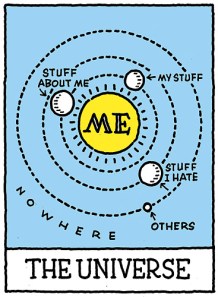 Map by Ron Barrett, New York Times
Explorers find praise as ambassadors of the unknown, knowledge seekers, the eyes and ears of the people they’ve left behind. But ultimately, how many iconic explorers are in this business because of knowledge? When Robert Peary wasn’t mushing his dogs over hummocks of pack ice, he was scribbling down his plans for his post-polar life. Dozens of pages in his Arctic journal are devoted to his plans for gaining publishing contracts, designs for geographic medals of honor, and a plan for the mausoleum that would one day hold his mortal remains (if he turned out to be mortal). One might argue that these explorers are the exceptions to the rule, that most were out risking life and limb for higher purposes. Perhaps, perhaps.
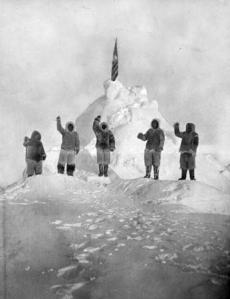 Robert Peary with party at the North Pole (or not)
Certainly large scale, state-sponsored expeditions are immune from this sort of vanity, right? Or do these expeditions merely institutionalize the cult of the explorer? Cold War space missions were, let’s face it, more about impressing the neighbors than understanding the universe.
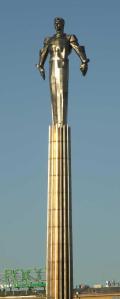 Monument to cosmonaut Yuri Gagarin
I don’t want to paint with too broad a brush here. There are many explorers, past and present, who do not fit this description. But they do not receive much attention, competing as they are with the explorers who are on the media’s A-list.
Planning Our Trip to Mars
I’ve been grousing here and at HNN about NASA’s goal to return to the Moon and Mars, a plan that does not offer, in my opinion, a mission compelling enough to warrant its multi-billion dollar price tag.
Trolling around the blogosphere, I am beginning to realize that grumpiness about NASA’s Mars mission runs deep, extending to the ranks of policy makers, aerospace engineers, and space scientists.
For example, John Marburger, Director of the Office of Science and Technology Policy, gave a speech at the Goddard Memorial Symposium recently in which he considered the big picture of U.S. space policy. Marburger is generally supportive of space exploration, but warned about the ad hoc nature of space exploration to date:
The one big question any vision of space exploration must answer is “Are we going to do it at all?” As I put it in my speech two years ago, “Questions about the vision boil down to whether we want to incorporate the Solar System in our economic sphere, or not.” If we are serious about this, then our objective must be more than a disconnected series of missions, each conducted at huge expense and risk, and none building a lasting infrastructure to reduce the expense and risk of future operations. If we are serious, we will build capability, not just on the ground but in space. And our objective must be to make the use of space for human purposes a routine function. [full speech].
Engineers have also been speaking out about the ad hoc quality of planning the mission. From Gravity Loss:
So how is it that an agency getting 15 billion dollars a year is failing to pin down the mass numbers any better? … What will the payload landed on the moon be? What propellants are used? What is the Altair’s or Orion’s mass?…It has seemed that a certain cycle has formed. First a solution on Ares I is based on some logic linking it to Shuttle hardware, infrastructure or Ares V with common elements, which should save a lot of money and time and keep the workforce etc etc. Somewhat later, rumors about a severe performance shortfall on either launcher start circulating. Then after a while NASA announces a new configuration where the commonality is disrupted. And again forward we go. [full post]
And a similar economic criticism (with a free-market tilt), from Jon Goff at Selenian Boondocks:
Having NASA develop its Constellation architecture means that 20 years from now, it will be just as hard for a commercial entity to get to the moon as it would be if Constellation was cancelled tomorrow. Nothing that is being done “reduces the risk or expense of future operations” or “makes the use of space for human purposes a routine function.” I’m glad that at least someone is trying to tie this all back to actual benefit to the nation. I’m also glad that John pointed out that the whole “NASA only spends less than 1% of the federal budget” line does not give NASA carte blanche to spend that money however it darned well pleases. That money is supposed to be spent in a way that furthers the national interest, preferably in a way that makes space more accessible for everyone. [full post]
If I find happier opinions, I will report them here, scout’s honor. The cheeriest news, as you might expect, can be found at the NASA website.
Centre de Recherche sur la Littérature des Voyages (CRLV)
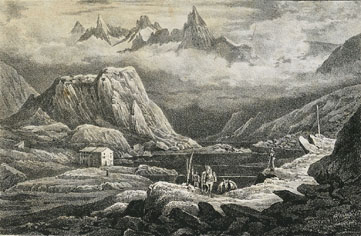 Voyage en Suisse, en Lombardie et en Piémont, 1834 (CRLV)
I have worked on Arctic exploration for over a decade and have been feeling lately that it’s time for a change. I like exploration too much to leave it as a field of study (as is probably obvious from this blog), so I have been digging into the literature on another love of mine, mountains, specifically the role of mountains in the work of nineteenth-century scientists.
 I don’t have any method for starting new research projects. I have a “if time, pursue this” file, but most of these ideas feel stale by the time I get back to them. So I usually set off into the literature much the way less-than-smart dogs take to being off the leash: running around sniffing randomly until they find something good, chasing it till it runs out, then running some more until they something else. I pursue this approach until I find food. Methodological rigor comes later, usually about the time I need to apply for a grant.
In any event, I was in my dog phase a few months ago, when I started to realize something about the secondary literature on mountains. There are some divisions I expected to find according to discipline (lots of material in art history, for example, not that much in the history of science). But there were also some divisions I didn’t expect, namely differences according to nationality. In particular, it seemed to me that French scholarship on the intellectual history of mountains was very well developed whereas Anglo-American literature was still getting off the ground.
How much do we miss by not wading into the literature of other languages, other countries? It depends upon the research question obviously. But in my case, it’s something I need to do. I can read French, with effort, fingers gripped to the side of my desk. This too must change. I have been on the lookout in the last few weeks for serious exploration blogs or sites outside of the U.S and the U.K.
One of the best that I’ve found is the Centre de Recherche sur la Littérature des Voyages (CRLV). This site has been around for a while, offers an impressive, searchable bibliography of primary literature on exploration (by author and location), a list of CRLV publications, schedule of conferences, and series of conference podcasts, some of which have abstracts and transcripts. Impressive.
I’ve been happy to note more traffic here from other countries, particularly Scandinavia. If you think I should be aware of exploration-related sites, please drop me a line.


 Time to Eat the Dogs