Time to Eat the Dogs
A Podcast About Science, History, and ExplorationArchive for June, 2009
News of the Expedition: Absolutely Free
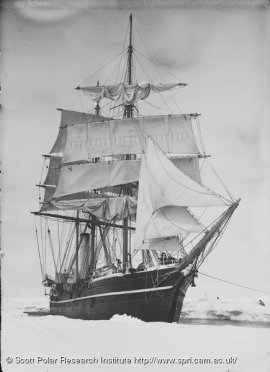
Terra Nova, British Antarctic Expedition, 1910. Courtesy of Freeze Frame.
Sitting at the long desk of an archive, wearing cotton gloves, reading old letters on the verge of turning to powder; this is about as good as it gets for a historian. Yet more and more of my research takes place elsewhere, now on my laptop mostly, looking at materials that have been scanned and displayed online.
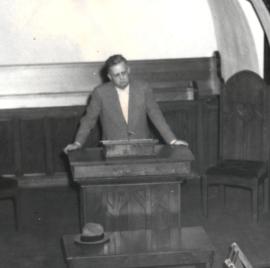
Frank Luther Mott, 1951
Things have changed. When Frank Luther Mott began researching his comprehensive History of American Magazines in the 1920s, he had to track down a paper copy of each periodical in libraries scattered across the country. Many of these publications, printed on acidic paper, were already falling apart.
By 1941, University Microfilms (now ProQuest) began photographing American periodicals, making them available as reels of microfilm. By the time the project was complete, UM had a collection of 1100 American periodicals spanning the years from 1741-1900.
This was the state of things when I began my dissertation research in the late 1990s. When I wanted to find out what was being written about Arctic exploration in the press, I consulted a set of books, the 19th century Poole’s Guide to Periodical Literature, which gave titles and citations of popular literature by subject. Then I would drive to Chicago (from Madison WI) with my list of citations to track down the articles on the spools of microfilm housed at University of Chicago and Loyola University.
Now Poole’s has been turned into a digital database that can be searched online. The American Periodical Series has also been scanned, and, because of character recognition software, can be searched down to the level of single words. Where I spent hours tracking down a handful of articles indexed by Pooles by title and subject, a “full text” search of the American Periodical Series online yields thousands of results, all of which are instantly readable, printable, and download-able from the comfort of my front porch.
Less romantic than heading to the archive, I understand, but infinitely more powerful and convenient.
Still, the conversion to digital has its downside. Poole’s and the American Periodical Series have been digitized by private companies which sell subscriptions to their databases at a hefty price. The result is that that Research I universities like Yale have extraordinary access, whereas smaller universities like the University of Hartford make due with less. Many of my European friends — working at institutions with little money for databases — go without.
The good news is that freely available digital resources are growing in breadth and depth. While the American Periodical Series remains a subscription-service, students of American history can access the 3.8 million pages of 19th century books and periodicals in the Making of America database developed by the University of Michigan. You can also find close to a million pages of material at the Making of America sister site at the Cornell University. Serious free research also extends to the Library of Congress’s 1 million pages of newspaper text at Chronicling America.
These are general databases for American history. Students of more specialized topics, such as the history of exploration, can also find free riches online. In addition to the links at the right, you might also want to check out:
Harvard University Library’s Expedition and Discoveries
A site of highlights and citations from dozens of 19th century expeditions fielded by Harvard and other organizations.
The Scott Polar Research Institute’s collection of polar images from 1845-1982, searchable by date, expedition, photographer, or subject matter.
Mountaineering and Polar Collection
The National Library of Scotland’s site for important historical expeditions, from the ascent of Mt. Blanc to investigations of Antarctica.
Film Review: Up

Carl Fredricksen under attack by explorer Charles Muntz
Since the release of the Incredibles in 2004, Pixar has proven that it can run with grown-ups as well as the kindergarten crowd. Kid movies, after all, will always have multiple audiences. The trick is to produce stories that cohere as well as engage these different movie-goers. The Batman and Bugs Bunny of my youth did this by packing episodes with jokes, allusions, and celebrity guest stars geared to my parents. No matter, the shows had enough fights, cliff-falls, and shotgun-blasts to keep me watching.

Pixar’s strategy, however, has been more ambitious: to produce films that pull in adults by compelling stories rather than sophisticated jokes.
The Incredibles (2004), for example, broke with a tradition of scripting superhero movies as bildungsroman, coming-of-age stories for teens with mutant powers. Instead it told the story of superheroes as they are getting soft, wrestling with the demands of family life, middle age, and lost ambitions. While there are plenty of explosions and chase sequences, the real action of The Incredibles is in the livingroom, when Bob Parr (Mr Incredible) spars with his wife Helen (Elastigirl) about life’s priorities.

The Incredibles (2004)
Up boasts no superheroes or spandex, but it follows The Incredibles‘ lead by creating a protagonist, Carl Fredricksen (Ed Asner), widower and would-be adventurer, who has seen brighter days. When we meet Carl, he is grieving the loss of his wife Ellie (Ellie Docter). After a court pressures him to sell his house and enter a retirement community, he uses his balloon expertise to turn his Victorian house into a helium dirigible, sailing aloft and out of reach of contractors and nursing home attendants.

He decides to steer his craft south, towards the mythic South American land of Paradise Falls, a place he dreamed of visiting with Ellie since they formed an adventure club as kids. Only after lifting off does Carl realize that he has a passenger, Russell (Jordan Nagai), a Wilderness Explorer trying to earn an “Assisting the Elderly” merit badge.

Russell
What inspires me to write about Up here? Because the film is about exploration in the many senses of the word. From its opening shot, Up creates a backstory for Paradise Falls, a lost world which was explored by wealthy adventurer Charles Muntz (Christopher Plumber) in his dirigible, The Spirit of Adventure. Muntz returns claiming discovery of a large flightless bird, meeting with ridicule. With no proof of his discovery, he is stripped of his membership in the National Explorer’s Club, and leaves on The Spirit of Adventure (with a large pack of dogs) vowing to return once he has proven his claim to the world.
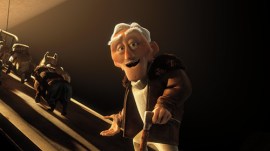
Charles Muntz, explorer of Paradise Falls
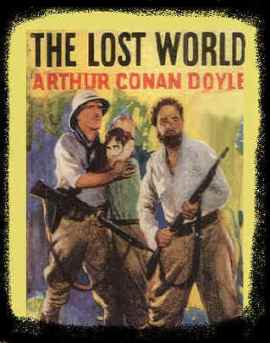
Muntz’s exploration of South America borrows much from Arthur Conan Doyle’s 1912 book, The Lost World, which also tells the story of a South American expedition (led by Dr. Challenger) who is ridiculed for claiming the discovery of living dinosaurs.
Yet as a wealthy explorer with a keen sense of technology, Muntz also resembles Howard Hughes, piloting the H-4 Hercules (Spruce Goose) in 1947, and Walter Wellman, who steered the dirigible America toward the North Pole in 1906. He also reminds me of Frederick Cook, whose claims of discovering the North Pole in 1909 eventually brought about public ridicule and expulsion from the Explorers Club the following year. (As for Muntz’s dogs, trained to perform human tasks and provided the power of speech, I couldn’t help but think of The Island of Dr. Moreau by H. G. Wells).
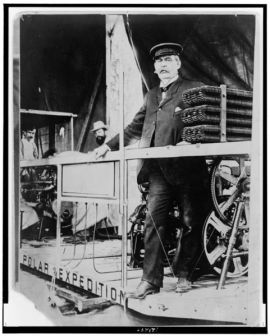
Walter Wellman aboard America
As for the giant flightless bird of Paradise Falls (named “Kevin” by Russell), it could be an allusion to Doyle’s dinosaur, but it also made me of the most famous description of a South American flightless bird, Charles Darwin’s discovery of the Rhea in 1833, a find that had serious implications for his theory of evolution.
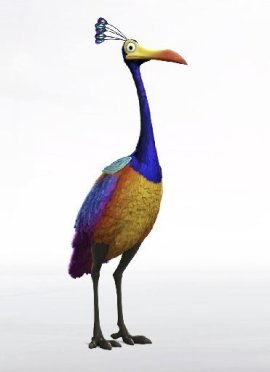
Kevin, flightless bird of Paradise Falls
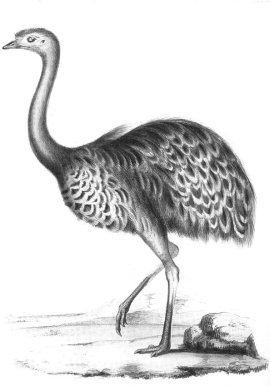
Rhea Darwinii
More compelling than these historical and literary allusions, however, are the deeper questions Up raises about the idea of exploration. As children, Carl and Ellie bonded over the idea of exploring Paradise Falls, a dream that was never realized during Ellie’s lifetime. It fuels Carl’s quest to reach the mythic locale after her death. Yet once he reaches the Falls, Carl opens up Ellie’s childhood “My Adventures” scrapbook to find that the pages after “Paradise Falls” are not empty, but filled with pictures of Carl and Ellie through the happy years of their marriage. Adventure – Ellie knows – is where you find it, and discovery, as William Goetzmann points out in Exploration and Empire, is almost always a question of re-discovery, finding new things in places already traveled.

Ellie and Carl
Most of all, Carl’s insight into the idea of adventure reminded me of Philip Carey, protagonist of Somerset Maughm’s novel Of Human Bondage (1915). Although Carey nurtured a lifelong dream to travel, he eventually decides to shelve this plan when he falls in love, seeing a different path to discovery:
What did he care for Spain and its cities, Cordova, Toledo, Leon; what to him were the pagodas of Burmah and the lagoons of the South Sea Islands?…He had lived always in the future, and the present always, always had slipped through his fingers. His ideals? He thought of his desire to make a design, intricate and beautiful, out of the myriad, meaningless facts of life: had he not seen also that the simplest pattern, that in which a man was born, worked, married, had children, and died, was likewise the most perfect?
Charles Muntz is the most traveled character of Up. He is also the least enlightened by his travels, scarcely touched by his experiences of Paradise Falls except for his obsessive quest with finding the flightless bird. Ellie, by contrast, never leaves the suburbs and the zoo where she works. But she understands that exploration is a state of mind as much as a plan of action, an experience that does not require talking dogs or dirigibles.
Book Review: Science and Empire in the Atlantic World
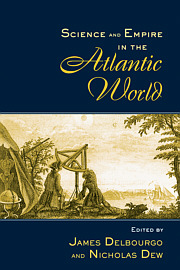
JAMES DELBOURGO and NICHOLAS DEW (eds.), Science and Empire in the Atlantic World. New York: Routledge, 2008. Pp. xiv + 365. ISBN 978-0-415-96127-1. £18.99 (paperback).
Maybe I shouldn’t read too much into titles, but Science and Empire in the Atlantic World caught my attention. At first glance, it seemed a strange choice of words since “science and empire” has become a common, almost clichéd, phrase in the history of science and science technology studies (STS). The phrase took hold in the 1970s when Marxist scholarship revealed the exploitative functions of imperial science and gained inspiration from other critiques such as Edward Said’s Orientalism in 1978.
By the 1980s, books and articles containing “science” and “empire” blossomed in the scholarly press. Yet the phrase has since witnessed a slow decline, as scholars have grown uneasy with portrayals of colonial science as a hegemonic expression of European power. Replacement terms tend to emphasize the reciprocal relationships in the production of science. Most notable among these is “Atlantic World,” a term that now races like a forest fire through history of science titles, probably due to Bernard Bailyn’s influential Seminar in the History of the Atlantic World which he instituted at Harvard in 1995. Why, then, marry “Science and Empire” with “Atlantic World” together in one title?

Bernard Bailyn
The answer comes from the function of “empire” within this edited collection. All twelve essays here challenge empire, or more precisely, an imperial top-down model of science in describing the Atlantic World. The “Empire” of the title, in other words, does not represent a historic process to be revealed, but a historiographic concept to be critiqued, a goal that Dew and Delbourgo accomplish with devastating efficiency. By focusing on famous “heroic narratives of discovery” (5) Delbourgo and Dew argue, studies of imperial science have missed the day-to-day activities which shaped the study of nature in the Atlantic World. In other words, historians of science (including me) have grown too comfortable thinking of Atlantic science through the image of a sextant-wielding Baron von Humboldt.
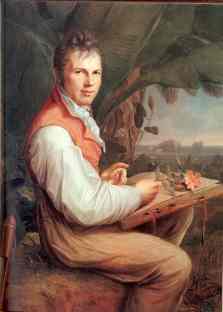
Alexander von Humboldt
As Science and Empire demonstrates, knowledge of the Atlantic World depended upon the labors of far lesser-known figures: sailors, surgeon-barbers, Creole collectors, and diasporic Africans among others. Most essays go beyond describing the actions of these invisible networks, connecting them with better known ones.
Alison Sandman, for example, explains how pilots competed with learned cosmographers to control cartographic knowledge in early modern Spain. Júnia Ferreira Furtado’s essay, focused on Brazil, shows how Dutch surgeon-barbers “broke the monopoly of erudite knowledge enjoyed by doctors,” (Furtado, 132) giving tropical medicine a pronounced, empirical tilt. Even well known figures are not what they appear. Joyce Chaplin revisits Benjamin Franklin, poster-child of elite science, to show how he relied upon the reports of sailors and sea captains in describing the Atlantic “Gulph Stream.”
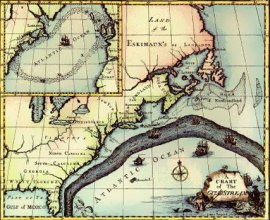
Franklin Map of Gulf Stream, 1769
Taken together, the essays portray Atlantic science differently than the influential center-periphery model of science described by Bruno Latour in Science in Action (1987). Within Latour’s model, knowledge of the world starts and ends in the metropole where men of science provide the questions and instruments needed to understand nature at the edges of empire. While Latour’s system works well in describing many aspects of state-sponsored expeditions, it fails to explain other types of knowledge networks.

Bruno Latour
For one thing, Atlantic networks were unstable. As Neil Safier explains in tracing the work of French naturalist Joseph de Jussieu, acquiring and transmitting information was a precarious business. “The successful circulation of information from one point in the Atlantic to another was often dependent on circumstances that could just as easily go wrong as right” (Safier, 219). The networks developed by Spanish botanical expeditions, as described by Daniela Bleichmar, were of sturdier stuff. Yet Bleichmar points out other weaknesses in the Latourian model, specifically how “periphery” is a term ill-suited to describe botanical science in the Americas: “Circulation [of information] did not resemble the flight of a boomerang, always returning to the center, but rather a more reciprocal paddle game. Every letter or shipment from one side provoked a reply from the other.” (Bleichmar, 239). While European “centers” were important – no one disputes the asymmetries in power between mother country and colonies – they were dependent upon colonial peoples’ cooperation. This was not merely a question of finding Indians and Africans to collect things. As Susan Scott Parrish and Ralph Bauer point out in essays on diasporic Africans and Native American magic, respectively, Europeans adapted indigenous knowledge systems to make sense of an occult, magical nature. If London, Paris, and Madrid operated as hubs of scientific calculation, they were centers shaped by the world wheeling around them.
With such a strong theme linking all the essays, Science and Empire does not really need section headings. I found the four offered — “Networks of Circulation,” “Writing an American Book of Nature,” “Itineraries of Collection,” and “Contested Powers” – too vague to be useful. There are fruitful subordinate themes that track across essays, such as the tension between theory and empiricism (Sandman, Bauer, Furtado, Barrera-Osorio) and environmental history and technology (Golinski, Dew, Delbourgo, and Regourd). Still this is a minor quip. Dew and Delbourgo have managed to square the circle of edited collections: bringing together a diverse set of essays to target an important historiographical issue.
This review will be published in the upcoming issue of the British Journal for the History of Science. My thanks to BJHS for permission to reprint it here.


 Time to Eat the Dogs