Time to Eat the Dogs
A Podcast About Science, History, and ExplorationArchive for May, 2009
Wild Thing
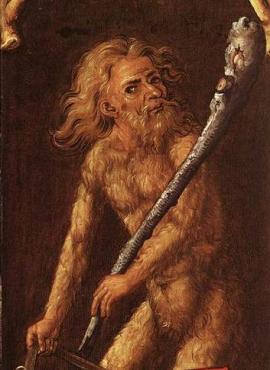
Woodwose (detail), Albrecht Durer, 1499
Whether going up mountains, down rivers, over canyons, or across the pack-ice, adventurists often express a malaise with “civilized life” back home. In the wild, the drudgeries of the mall-shopping, lawn-mowing, 401K-filing world fall away, and with them, the barriers to authentic experience. Says Mt Everest climber Stephen Venables:
Although you don’t deliberately seek an epic, you know that one day something like that might happen. When it did happen on Everest, it was harder and more prolonged and draining than anything I had ever done, but also more exhilarating than anything I had ever done. It was like a watershed. It was something I was probably never going to repeat again. [quoted in Maria Coffey, Where the Mountain Cast Its Shadow, 137]
Why does civilization make some people feel so queasy that they’d travel to the most dangerous places on earth to find relief? A common answer is that human beings are not well-adapted to the world they inhabit, that some deeply buried instinct drives us to leave our suburban ghettos and take up high-altitude mountain climbing. A related argument holds that humans are innately curious, so curious that they are impelled, like cats near washing machines, to explore at any cost.
I don’t like these explanations. No one doubts that human beings have inherited behaviors, all animals do, but humans have proven remarkably plastic as a species. Speech patterns, fashion, diet, and language all show how impressionable we are to environment, experience, and culture.
Perhaps this reveals my bias too: as a cultural historian, I tend to think of explanations that are cultural rather than biological. In this case, I am inclined to believe that explorers and adventurers find catharsis in the wild because, well, they have learned to think of such places as cathartic.
Historians such as T. J. Jackson Lears and Gail Bederman have built a strong case for this argument. Looking at a wide array of evidence from the 19th and early 20th centuries, they link the urge to return to nature with cultural events. In particular, “going native,” Primitivism, and the Arts and Crafts movement all gain popularity just as Western societies transition from agricultural to industrial economies. For Lears and Bederman, the “call of the wild” has less to do with the feral impulses of the human psyche, and more to do with the disorienting world of the industrial city.
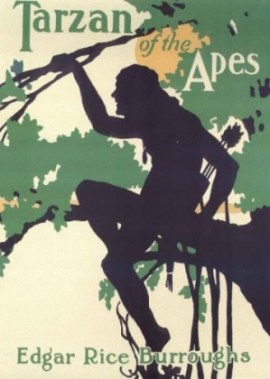
Tarzan of the Apes (Cover), Edgar Rice Burroughs, 1912
Yet, I will admit, the “call-of-the-wild” impulse cannot be entirely explained by culture either. If we travel back in time before industrialization, we can still find a certain malaise with civilization.
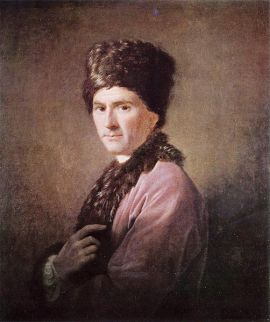
Jean-Jacques Rousseau, Allan Ramsay, 1766
Living in 18th century Paris, Jean-Jacques Rousseau railed against the vanities and corruptions of civilized life. He found role models in the islands of the South Pacific where native peoples lived – so he thought – more virtuous lives closer to nature.
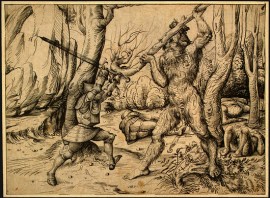
The Fight in the Forest, Hans Burgkmair, 1500 CE
We can go back even further. For Medieval Europeans the “Wildman” was a common, if legendary, figure in art and literature. Often, wildmen represented civilized men who, in the throes of madness, grief, or unrequited love, cast off everything and entered a state of nature. They reverted to savagery, acted violently, and lost their powers of speech and reason. Yet when these wildmen, by chance, were returned to the civilized world, they often emerged better for the experience: stronger of spirit and purer of heart. Such was the case with Merlin of the King Arthur legends.
Even the ancient Sumerian Epic of Gilgamesh, which dates to at least 2000 BCE, features the feral wild-child Enkidu, a boy raised by beasts and ignorant of all of civilization’s pleasures until seduced by the temple prostitute Shamhat. No industrial cities here.
What to make of all this? Perhaps there is something of the “call-of-the-wild” that strikes deep, beneath the reaches of culture (is there such a place?). From what we know, it appears that human beings spent most of their 125,000 year history in motion, as nomadic, itinerant tribes. Only in the last 10,000 years or so have we put down roots, developing agriculture and the foundations of complex, specialized societies. Is this restlessness a a biological shadow of our long journey as hunter-gathers? A vestigial organ of the civilized psyche? I never used to think so but I wonder.
What Kind of Explorer are You?
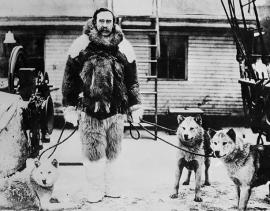
Robert Peary
Explorers’ narratives only get you so close to the truth. They are — like all memoirs — public documents, manuscripts that are written to be read by others. Yet they sometimes reveal things unawares. For example, Robert Peary’s 1910 book, The North Pole, is not a source you would consult to figure out if Peary really made it to the North Pole in 1909. But the book reveals much about Peary’s view of the North Pole quest and his ideals of leadership (or, to be more accurate, Peary’s views as channeled through his ghostwriter). Describing the final push across the polar pack ice in April 1909, Peary states:
This was the time for which I had reserved all my energies, the time for which I had worked for twenty-two years, for which I had lived the simple life and trained myself as for a race. In spite of my years, I felt fit for the demands of the coming days and was eager to be on the trail. As for my party, my equipment, and my supplies, they were perfect beyond my most sanguine dreams of earlier years. My party might be regarded as an ideal which had now come to realization-as loyal and responsive to my will as the fingers of my right hand. [Peary, North Pole, 270-271]
Peary’s view of his expedition “as for a race” is telling. Seeing the North Pole as the finish line in a contest rather than a region to be investigated, Peary tended to look at other explorers as rival contestants rather than colleagues or collaborators.
Peary’s view of his team as “fingers” is also revealing. It shows that Peary thought of leadership as a something dictated from the top. Teams should not exhibit independence or creative judgment, any more than fingers should challenge the mind that directs them.
While Peary’s attitudes were common among explorers, they were not universal. Alexander von Humboldt used his expedition narrative to give voice to peoples often omitted in travel literature, in particular, the Spanish and indigenous Americans who made his researches possible.
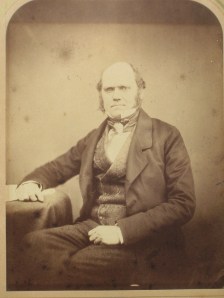
Charles Darwin
Explorer-scientists Charles Darwin and Alfred Russell Wallace had good reason to feel competitive: both arrived at the theory of natural selection independently. Yet while Darwin learned of Wallace’s discovery with a certain amount of gloom, he co-reported Wallace’s work with his own. Wallace, for his part, upheld the priority of Darwin’s claim. Both men remained on good terms.
Is it your field of work that determines your approach to your peers and employees? Or other factors — class, family, work culture, personality? As I worked on my dissertation, I remember looking warily at works that approached my topic too closely. While some of these works ultimately proved helpful, they seemed dangerous at first: objects just below the waterline which might force me to change course, or worse, send my thesis to the bottom.
Yet graduate school was also a time of generous acts. We grad students kept an eye out for one another: writing down citations for each other, photocopying sources, drinking beer, listening to bad practice speeches.
Now I’m fortunate to belong to a community of generous peers: people I seek out for advice, to read early drafts, recommend books, or suggest lines of thought. These are not the only ways to approach life in the Academy – I know of a few Pearys in the field – but fortunately I see them only at some distance, marking out territory and planting flags.


 Time to Eat the Dogs