Time to Eat the Dogs
A Podcast About Science, History, and ExplorationArchive for December, 2008
Contingent World, Part 3 of 3
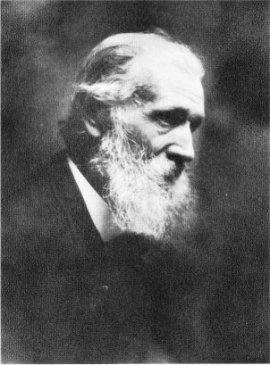
John Muir
I didn’t plan on writing another post on contingency, but I was reading Donald Worster’s new biography of John Muir, A Passion For Nature: The Life of John Muir, and found this:
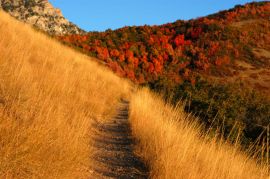
A human life, like any mountain trail, winds and twists through a very complicated, ever-changing landscape, taking unexpected turns and ending up in unexpected places. The lay of the land, the physical or natural environment, has some influence over the path one chooses to take — going around rather than over boulders, say, or along the banks of a stream rather than through a tangled wood. Likewise in the course of an individual life, nature helps give shape to the direction a man or woman takes and determines how his or her life unfolds. So also does one’s inner self, the drives and emotions that one inherits from ancestors far back in evolutionary time, determine the route. But the trail of any one’s life is also shaped by the ideas floating around in the cultural air one breathes. All those influences make it impossible explain easily why a person’s life follows this path rather than another. [Worster, Passion for Nature, 11]
Ok, the metaphor of the “life path” is a bit overused as a literary metaphor. Indeed, it was already overused in the nineteenth century before Robert Frost lofted it into cliché orbit with “The Road Not Taken” in 1916.
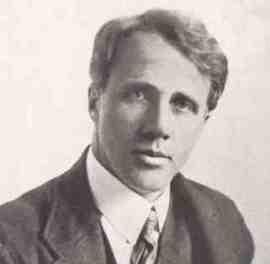
Robert Frost
Nevertheless, I think Worster pulls it off in talking about Muir. After all, how else should an environmental historian speak about someone who is the ultimate lover of all things path and mountain? But more to the point, I think the passage nicely encapsulates the many contingent forces that shape the life of an individual.
Fallen Giants Wins the Banff Book Award
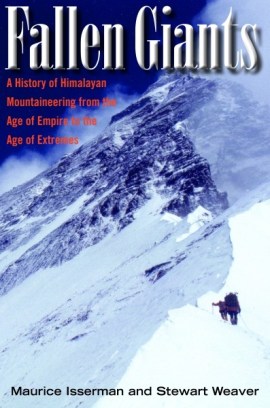
Congratulations to Maurice Isserman and Stewart Weaver, winners of the 2008 Banff Mountain Book Award for Mountaineering History. Their excellent book, Fallen Giants: A History of Himalayan Mountaineering from the Age of Empire to the Age of Extremes , does not merely chronicle the harrowing ascents and colorful personalities of high-altitude climbing. It also offers a look at mountaineering as a cultural project that blossomed in the 19th and 20th centuries. (In the interest of full disclosure, I am friends with Stewart and an acquaintance of Maurice).

Maurice Isserman (left) receives Banff Award from Mike Mortimer (right)
David Chaundy-Smart, editor of Gripped Magazine, states:
Tilman speculated that a chronicle of the “fall of the giants” of the Himalayas would not be as interesting as chronicles of the failed attempts. He never anticipated that Maurice Isserman and Stewart Weaver would eventually paraphrase him in the title of an exhaustive and entertaining history of Himalayan mountaineering. This is a standard-setting work that credibly accounts for the struggle to summit the 8000 metre peaks with a seamless discussion of politics, economics and the development of climbing technique backed by a mind-boggling list of sources.
If this isn’t enough to satisfy your Himalayan appetite, visit the Pitt Rivers Museum’s Tibet Album. Here you’ll find a collection of British photographs in Central Tibet from 1920-1950. The collection totals 6000 photographs by Charles Bell, Arthur Hopkinson, Evan Nepean, Hugh Richardson, Frederick Spencer Chapman, and Harry Staunton among others. Taken together with Everest expedition photos of the Bently Beetham Collection (listed in my links and profiled here), one gets a vivid picture of British-Nepali-Tibetan encounters in the early 20th century.
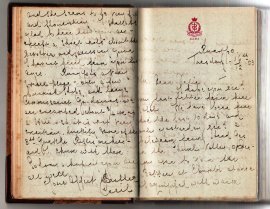
Cecil Mainprise Diary, photo from blog: Field Force to Lhasa 1903-04
You can also find the journal of Cecil Mainprise, medical officer of General Sir Francis Younghusband’s expedition to Tibet in 1903, dutifully published in blog form by his great nephew Jonathan Buckley.
Reading all of this material may give you a bit of altitude sickness. Best to descend for a while and acclimatize. I’ll be here with more after the New Year.
The Night Before Christmas
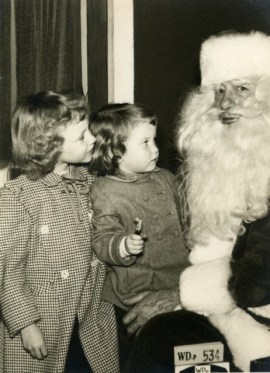
In the spirit of the season, here’s a version of The Night Before Christmas using some of the search terms that people have used to find Time to Eat the Dogs. (My blog software informs me of these search terms in an ever-growing list). Thanks for all of the great comments and suggestions over the past year. Drive safely, eat well, and I’ll see you next year.
The Night Before Christmas
‘Twas the night before Christmas, when all through the house
Not a creature was stirring, not even a cyclops;
The stockings were hung by the chimney with care,
In hopes that Ernest Shackleton soon would be there;
The ancient naked men were nestled all snug in their beds,
While visions of misshapen world maps danced in their heads;
And mamma in her ‘kerchief, and Thor Heyerdahl in his cap,
Had just settled down for a long winter’s nap,
When out on K2 there arose such a clatter,
I sprang from my high altitude human balloon to see what was the matter.
Away to the laminar flow hood I flew like a flash,
Tore open the shutters and threw up the sash.
The moon on the breast of the new-fallen snow
Gave the lustre of mid-day to objects below,
When, what to my wondering eyes should appear,
But a mad magazine evolutionary chart, and eight tiny reindeer,
With a Peruvian tribe, so lively and quick,
I knew in a moment it must be St. Nick.
More rapid than dinosaurs his coursers they came,
And he whistled, and shouted, and called them by name;
“Now, Mallory! now, Darwin! now, Armstrong and Peary!
On, Wallace! on Aldrin! on Martens and Kingsley!
To the top of the world! to the top of the wall!
Now dash away! dash away! dash away all!”
As dry leaves that before the K-T extinction event fly,
When they meet with an obstacle, mount to the sky,
So up to the space rover the coursers they flew,
With the sleigh full of toys, and Shackleton too.
And then, in a twinkling, I heard on the roof
The prancing and pawing of turkey fricassee.
As I drew in my hand, and was turning around,
Down the chimney Shackleton came with a bound.
He was dressed all in fur, from his head to his foot,
And his clothes were all tarnished with ashes and soot;
A bundle of strange maps he had flung on his back,
And he looked like John McCain just opening his pack.
His eyes — how they twinkled! his dimples how merry!
His cheeks were like roses, his nose like a cherry!
His ancient order of foresters was drawn up like a bow,
And the beard of his chin was as white as the storm over Everest;
The stump of a hominid he held tight in his teeth,
And the smoke it encircled his head like a wreath;
He had a broad face and a little crash test dummy,
That shook, when he laughed like a sled-ful of jelly.
He was chubby and plump, a right jolly old elf,
And I laughed when I saw him, in spite of myself;
A wink of his eye and a twist of his leviathan,
Soon gave me to know I had nothing to dread;
He spoke not a word, but went straight to his work,
And filled the SSV Corwith Cramer; then turned with a jerk,
And laying his finger aside of his nose,
And giving a nod, up to orbit he rose;
He sprang to his Mars Phoenix Lander, to his team gave a whistle,
And away they all flew like the down of a thistle.
But I heard him exclaim, ere he drove out of sight,
“Road trip” and “I need to escape modern life”
Contingent World, Part 2 of 3
Last week I wrote about unpredictability, mainly as it applies to the sciences. But one doesn’t have to understand evolutionary biology or chaos theory to appreciate the real-world significance of contingency.
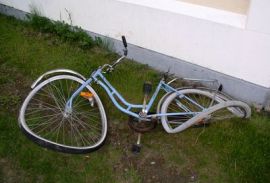
Crashing your bike, for example, is a highly contingent event, balancing on the fulcrum of the tiny circumstance: the patch of black ice or the open car door. Careening into the pavement, one feels keenly the power of the unforeseeable cause. Yet other events, such as weddings, usually unfold according to predetermined paths and produce predictable outcomes. Indeed, wedding planners make their living on this assumption, convincing couples that certainty is achievable, that contingency can be banished from church and reception hall.
All of this is to say something that is probably already pretty obvious: some events are more predictable than others. Historians have no quibble with this. The more interesting question is this: what kind of events matter? Which of them are the movers of history? (Or, as a historian might phrase it, which forces have the most historical agency?).
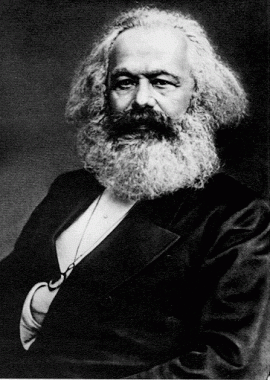
Karl Marx
For some, the power of contingency remains a relatively minor factor in history, dwarfed by the unfolding of large-scale, long-term events. Karl Marx’s theory of historical materialism, for example, sets up a series of stages (Feudalism, Capitalism, Socialism, Communism) that societies pass through as people try to fulfill their basic needs. In Marx’s vision, societies evolve according to a pattern which cannot be easily upset by contingent forces. History is a supertanker which moves through the water with a momentum scarcely touched by the people on deck, no matter how unpredictably they might be acting.
On the other hand, there are the proponents of “great man” history who tend to place the course of events in the hands of individuals who make decisions that change the world: Caesar, Napoleon, Hitler, Justin Timberlake. This vision of history tends to be far more open to the power of contingency since unforeseeable events clearly effect the lives of individuals, even “great men.” While these histories remain enormously popular and fly off the shelves at Barnes and Nobles, they are seen as rather old-fashioned in the Academy. Here among the turtle-neck and tweed-jacket classes, the “great man” has been replaced by a focus on other agents: institutions, states, empires, or culture.
Yet even with the interest in big-scale forces such as institutions and empires, the idea of contingency has gained caché within the Academy. For many it is clear that institutional or imperial events also do not have predictable outcomes, unfolding in surprising ways with unforeseeable consequences.
The irony in all of this is that historians are largely to blame for making history seem inevitable. It is not for want of trying. Historians, even more than political analysts, do Monday-morning quarterbacking, bringing coherence to events that benefit from the wisdom of hindsight. This is what we do. Yet the irony is that, in bringing coherence to seemingly chaotic events, we loose something of the reality of the event as it unfolded.
The hardest part of history, as I see it, is not in chasing down and explaining these events. It’s in conveying the sense of open-endedness that people felt in living through them.
Contingent World, Part 1 of 3
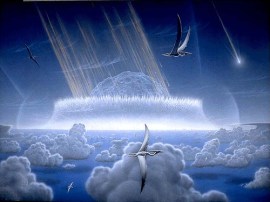
Artist Rendition of the K-T Extinction Event
A month ago, I wrote here about about Nate Turner and statistical prediction. The post discussed forces big, slow, and predictable. It got me thinking about the opposite side of the spectrum: of forces short, swift, and unpredictable. So for the next couple of posts, I’m going to dig into this a bit, starting with politics.
In the next two weeks, election officials will finally decide Minnesota’s senate race between Norm Coleman (R) and Al Franken (D). Out of 2.8 million votes cast, Coleman and Franken are now separated by about fifty votes. I would like to remain optimistic about this but let’s face it: with such a narrow margin, it’s almost guaranteed that the loser will bring charges of fraud, lost ballots, etc.

Norm Coleman and Al Franken
After the fireworks are over, we will see a slow coming-to-terms by the losing campaign, a Kübler Ross-ian transition from bargaining to depression to acceptance. As this occurs, we will also see “what if” stories blossom like desert flowers. Pundits and reporters will talk about how small changes in events, message, or media would have produced a different outcome.
The last bloom of political “what if” stories followed the 2000 U.S. presidential election. With great wailing and gnashing of teeth, Democrats tried to make sense of an election in which Al Gore won the popular vote yet still lost the election to George Bush. Razor thin victories for Bush in a number of battleground states, most famously Florida where he won by 537 votes of 6 million cast, fueled speculation about the many ways the election could have turned out differently.

Nader the Raider by Bill Day
For many, the spoiler was Ralph Nader, leader of the Green Party, who drew votes away from Gore. For others, it was the dysfunctional Florida voting system. Still others blamed Katherine Harris, Florida State Attorney General, who confirmed the official vote count. Or the Supreme Court. Or Gore himself, who seemed so overstarched as a candidate that he even lost his own state of Tennessee.
In a sense, they are all correct. Any number of factors could have tilted the election in Gore’s favor. In the language of the Academy, we would say that the 2000 presidential election was highly contingent: the outcome wasn’t set in stone. It could have turned out differently.
As an idea, contingency has considerable heft across the disciplines of the Academy. On the science side, evolutionary biologists, have written extensively about the degree to which evolution depended upon contingencies of the environment, that the concept of fitness does not only apply to the fleetest fox or the brawniest buck, but sometimes to the dumb luck of being well adapted to an unforeseeable event. Steven Jay Gould writes about this in regards to the middle-Cambrian organisms discovered in the Burgess Shale Formation.

Castorocauda lutrasimilis, the "Jurassic Beaver," survivor of the K-T extinction event.
Better known to the rest of us are early mammals who managed to win the Darwinian lottery by being around when a comet the size of Manhattan plowed into the Earth 65 million years ago. Although the evolutionary implications of this event are still hotly debated, few doubt that something big happened to disrupt ecosystems all over the world, ultimately leading to the extinction of the dinosaurs.
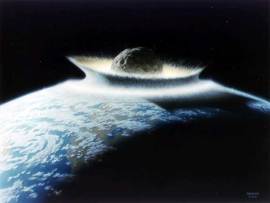
The K-T extinction event, as its called, makes clear an important point: even if history of life on earth is based upon slow, incremental changes to species over time, its evolutionary course was unpredictable. Life, like the Cretaceous comet of death, could have taken a different path. Had it done so, perhaps we would all be frightened weasel-like creatures, stealing our food in the shadows of brontosaurs and pteranodons. (For more on weasels and evolution, visit John Lynch’s Stranger Fruit)
Contingencies do not have to be comet-sized, however, to have big effects. Such was the discovery of meteorologist Edward Lorenz who found that weather simulations produced wildly different outcomes based upon minute changes in initial conditions. From this, Lorenz coined the term “Butterfly Effect,” the idea that the flapping of a butterfly’s wings might change the atmosphere enough to create (or prevent) a tornado from occurring at some future time.

Lorenz’s ideas are now a part of a larger corpus of work on chaos theory which shows the stunning effects of contingency (or as mathematicians call it, a ‘sensitive dependence on initial conditions’) in phenomena as disparate as air turbulence, irregular heart beats, and the eye movements of schizophrenics.
All of this happens at some distance from where I sit in the humanities, surrounded by books on art, maps, and social history. Yet contingency plays a critical role here too, something I’ll take up in my next post.


 Time to Eat the Dogs